The Broad
When Eli and Edythe Broad decided to build a museum, they made one decision that shaped everything else: admission would be free. In a city where parking alone can cost twenty dollars, in a cultural district where neighboring institutions charge substantial entry fees, this choice was philosophical as much as practical. The Broad, which opened on September 20, 2015, on Grand Avenue in downtown Los Angeles, was designed from the beginning to reach people who might otherwise assume contemporary art was not for them.
The Veil and the Vault
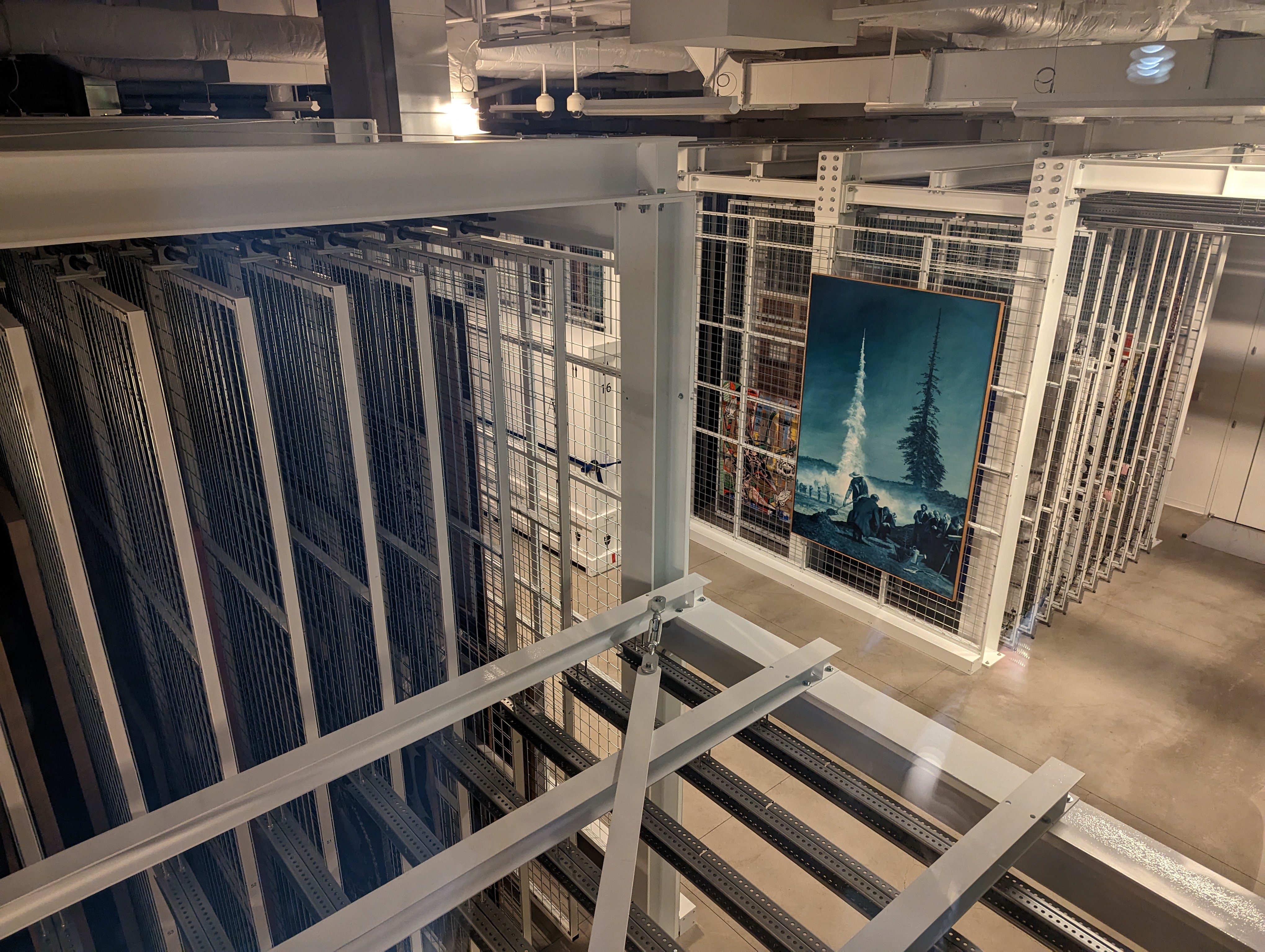
The building designed by Diller Scofidio + Renfro is organized around two concepts that its architects named as the governing principles of the design: the veil and the vault. The vault is the ground-floor storage space that houses the bulk of the nearly two-thousand-piece Broad collection — the working archive that backs up everything visible in the galleries above. The veil is the exterior honeycomb shell of 2,500 rhomboidal fiberglass panels that wraps the building, filtering light and giving the structure its distinctive appearance.
Between vault and veil, 318 skylight monitors bring diffused natural light into the upper gallery floor. The quality of that light — even, soft, without the glare that direct sunlight would produce — was central to the architects' thinking about how art should be experienced. The $140 million building cost reflects the complexity of achieving what looks, from the outside, almost simple: a white structure with an unusual skin, housing art in good light.
A Collection Built Over Decades
Eli Broad began collecting art seriously in the 1970s, and the collection he and Edythe assembled over the following decades became one of the most significant in private hands. It spans postwar American art through the present, with particular strength in works by Jeff Koons, Cindy Sherman, Jean-Michel Basquiat, Roy Lichtenstein, and Kara Walker. The Broad holds one of the largest collections of work by Jeff Koons anywhere, and among the strongest holdings of Cindy Sherman's photographic self-portraits.
The collection is not simply displayed in the museum; it circulates. The Broad has a lending program that sends works to institutions around the world, treating the collection as a resource for scholarship and public access rather than a static possession. This philosophy — that great art should be seen, not stored — connects directly to the free admission policy and the decision to build public-facing galleries rather than a private archive.
Free Admission and What It Means
The practical effect of free general admission became visible almost immediately after opening. In its first full year, The Broad attracted enormous crowds; by 2019 it had welcomed over 900,000 visitors, making it one of the most visited contemporary art museums in the country. Timed reservations helped manage the flow, but the intent was clear: the threshold between the street and the gallery would have no financial barrier.
The museum's location on Grand Avenue places it within a few hundred feet of Walt Disney Concert Hall, the Museum of Contemporary Art Los Angeles, and the Los Angeles Philharmonic — a concentration of cultural institutions sometimes called the Grand Avenue Arts District. Free admission at The Broad changes the character of that district, making it possible to walk in off the street without planning or budgeting, to spend an hour with a single Jeff Koons sculpture and leave, to return on another day for the Sherman photographs.
Expansion and Ambition
In 2024, the museum announced a $100 million expansion — roughly equal to the original construction cost — signaling that the first decade of operation had validated the founding vision rather than exhausted it. The expansion will add gallery space, improve visitor facilities, and deepen the museum's capacity to show more of the collection simultaneously.
The announcement also reflected Los Angeles's evolving position in the contemporary art world. The city has always produced and attracted major artists, but its institutions historically lagged behind New York and European capitals in infrastructure and visibility. The Broad's success, and its expansion, represent a maturation of the LA art ecosystem — one in which a world-class contemporary collection sits open to anyone who walks through the door.
From the Air
The Broad sits on Grand Avenue in downtown Los Angeles, at approximately 34.0544 N, 118.251 W. The building's white honeycomb exterior is visible from the air when approaching downtown from the west. It stands adjacent to Walt Disney Concert Hall, Frank Gehry's titanium-clad structure, making the intersection of Grand Avenue and 2nd Street one of the most architecturally distinctive spots in the downtown skyline. Los Angeles International Airport (KLAX) lies about 14 miles to the southwest.