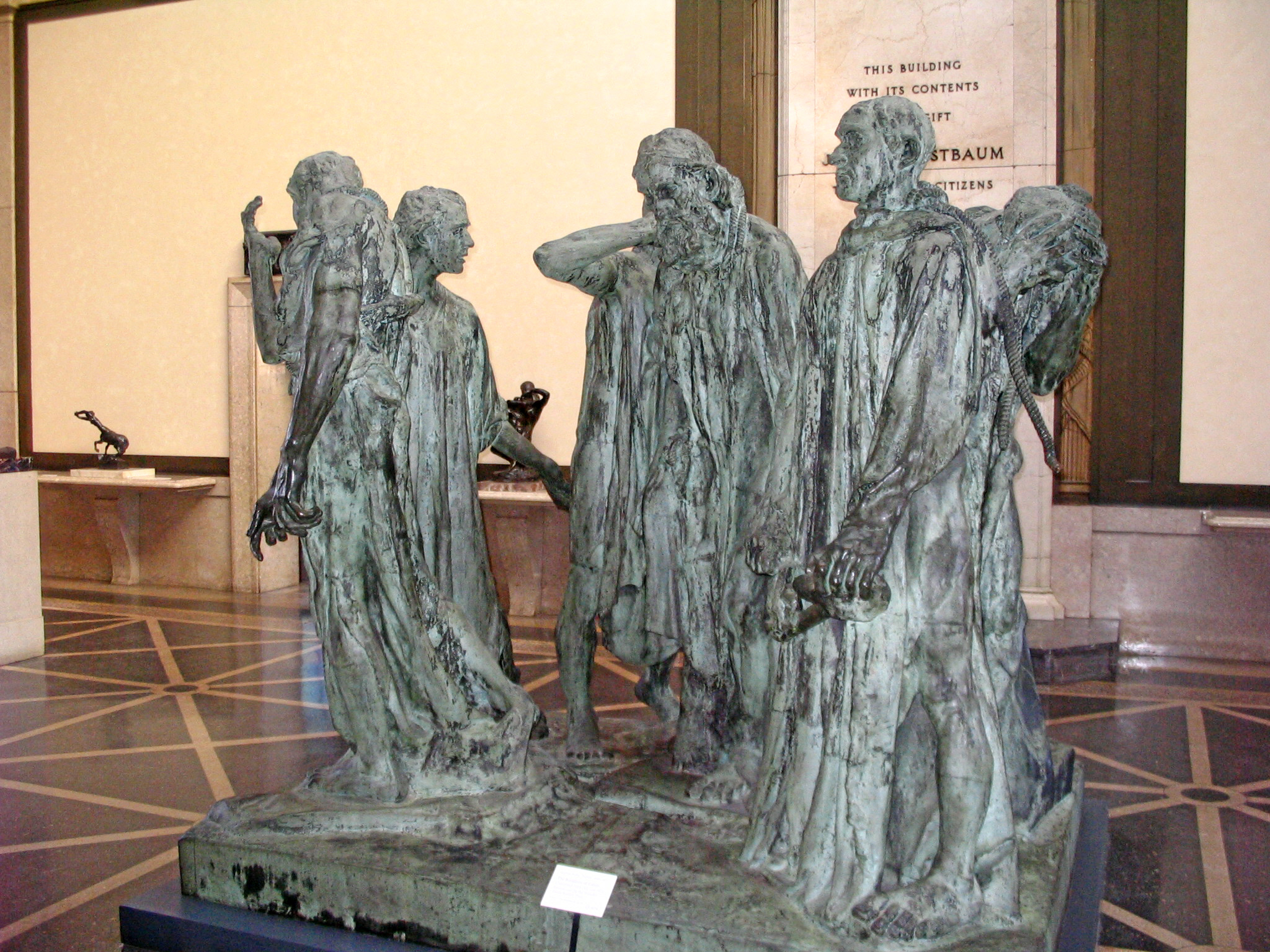
The Burghers of Calais
Rodin wanted them on the ground. No pedestal. He wanted the people of Calais to walk past these six bronze men in the street and almost bump into them - to see, at eye level, the faces of citizens walking to what they believed would be their execution. Calais ignored him. In 1895 the city set the sculpture on a tall plinth in front of Parc Richelieu, the way public monuments were supposed to be set. It took half a century before someone finally moved The Burghers to the ground in front of the Hotel de Ville and let Rodin's idea breathe. By then the bronze men had been recast and shipped to London, Paris, Tokyo, Pasadena, Philadelphia, Copenhagen, Basel, Washington, New York and Seoul. They were no longer just a memorial to a moment in 1347. They were a sculpture about what it costs to be brave.
Six volunteers
The moment Rodin sculpted lasted maybe a minute. On 3 August 1347, after an eleven-month siege, King Edward III of England agreed to spare the people of starving Calais if six of the town's leaders came out to him bareheaded and barefoot, in their shirts, with nooses around their necks and the keys of the town and castle in their hands. They expected to be hanged. According to the chronicler Jean Froissart, the wealthiest man in Calais, Eustache de Saint Pierre, stepped forward first. Jean d'Aire followed, then Jacques de Wissant, then his brother Pierre, then Jean de Fiennes, then Andrieu d'Andres. They walked out together. Edward's queen, Philippa of Hainault, then pregnant, was said to have begged her husband to spare them. He did. The story might be embellished - Froissart often was - but the six names survive, and the basic shape of what happened survives. Six men volunteered to die so their neighbours might live.
The commission
In 1884, more than five centuries later, the city of Calais commissioned Auguste Rodin to memorialise that moment. The contract assumed he would make a single figure - Eustache de Saint Pierre, heroic, allegorical, antique. Rodin made all six. He completed the work in 1889. He gave them ordinary clothes and ordinary fear. Jean d'Aire grips the key to the city with both hands and stares straight ahead; he looks like a man who has decided. Andrieu d'Andres holds his head in his hands; he looks like a man who has not yet finished deciding. Jean de Fiennes' arms are open, as if asking a question of the air. Pierre de Wissant turns his head back toward what he is leaving. None of them look noble in the antique sense. They look like men. The civic committee that commissioned the piece was unhappy: it lacked, they said, the overtly heroic references that public sculpture was supposed to carry. They were not entirely wrong. They had asked for a monument and received a meditation.
Twelve casts
Under French law, only twelve original casts of any Rodin sculpture may exist. All twelve of The Burghers were eventually made. The first remains in Calais. Others stand at the Glyptoteket in Copenhagen, the Musee royal de Mariemont in Belgium, the Victoria Tower Gardens beside the Houses of Parliament in London, the Rodin Museum in Philadelphia, the gardens of the Musee Rodin in Paris, the Kunstmuseum in Basel, the Hirshhorn Sculpture Garden in Washington, the National Museum of Western Art in Tokyo, the Norton Simon in Pasadena, the Metropolitan Museum in New York, and the Leeum Museum of Art in Seoul - the last cast, made in 1995. To walk past them in different cities is to encounter the same six men again, slightly different in patina, in scale of plinth, in light. The London cast was unveiled on 19 July 1915, in the second year of a war that had already redefined what it meant to ask men to walk to their deaths.
A bust from the ruins
There is one more cast that does not appear in the official count, because what is left of it is a fragment. Cantor Fitzgerald, the bond-trading firm whose corporate offices occupied floors 101 to 105 of the original One World Trade Center, kept an extensive collection of Rodin sculpture. Among the works lost on 11 September 2001 were pieces of The Burghers of Calais. A bust of Jean d'Aire was recovered a quarter-mile from Ground Zero. It is dented, scarred, recognisable. The face that Rodin shaped to hold the key of a doomed city in 1889 survived the fall of the towers and the people who had been working alongside it. It is a strange kind of provenance. It is also, perhaps, the most Rodin-faithful version of the sculpture that now exists - off its pedestal, at street level, marked by the world it was passing through.
What the sculpture is about
Rodin did not sculpt the moment when Philippa of Hainault saved them. He sculpted the moment before. He sculpted the walking. The six are not yet condemned and not yet spared; they are between those states, which is the state where courage actually lives. Each man is alone with his own response. None of them looks at the others. None of them looks at us. They are not a chorus and they are not a parade. They are six citizens, named in a chronicle, who agreed to die for a town whose names we no longer remember. The sculpture is one of the few public monuments of the late nineteenth century that refuses to lie about what bravery costs. To stand at the foot of any of the twelve casts - in Calais, in London, in New York, in Tokyo - is to be invited, as Rodin wanted, to almost bump into them. They are not above us. They are walking.
From the Air
The original cast of Rodin's Burghers of Calais stands today in front of the Hotel de Ville at the centre of Calais, near 50.95 N, 1.86 E. Calais-Dunkerque airfield (LFAC) lies on the western edge of town. From altitude the most distinctive landmark is the Hotel de Ville belfry, a UNESCO World Heritage site, rising 75 metres above the medieval grid of the old enceinte where the historic surrender took place in 1347.