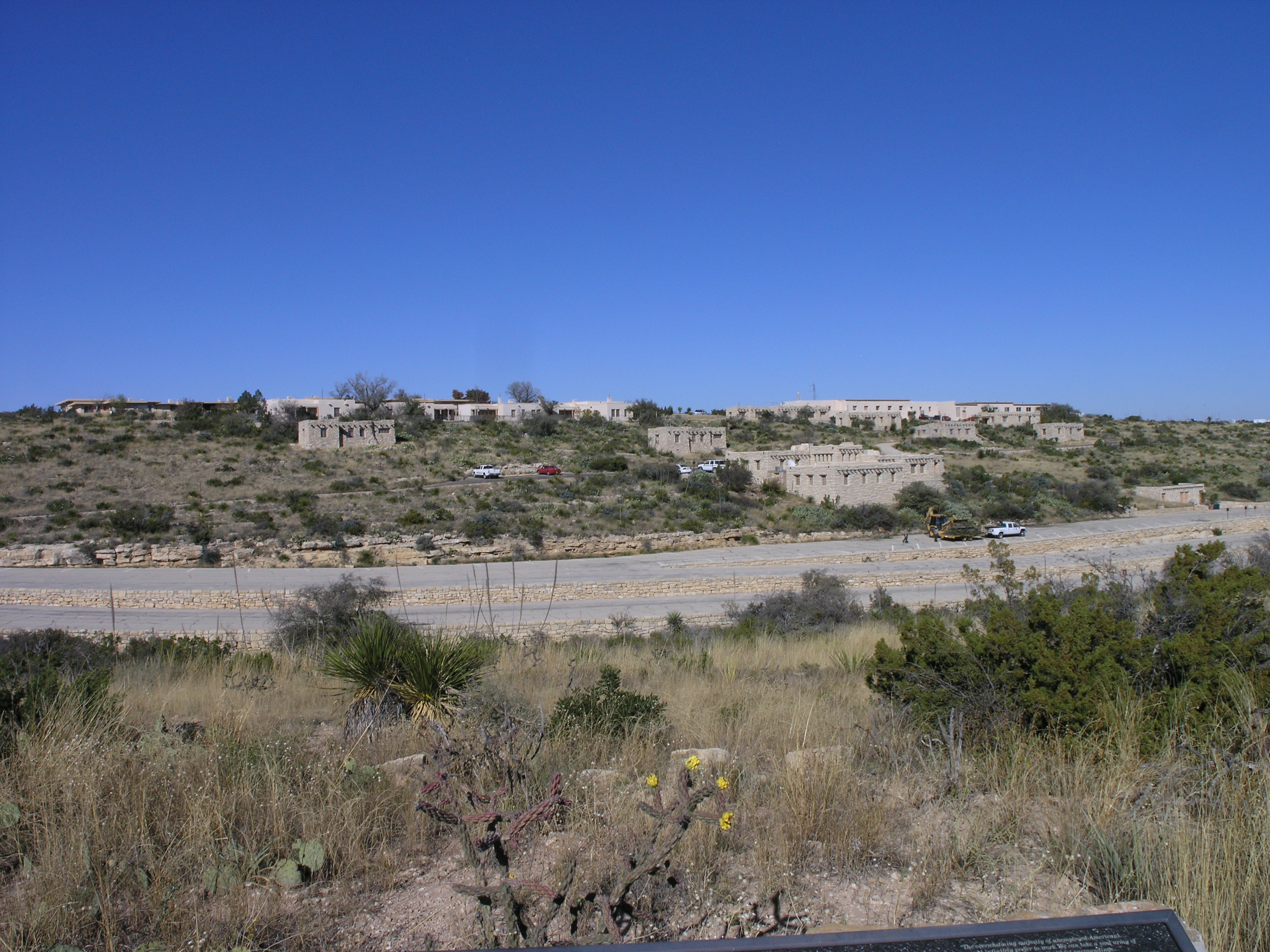
The Caverns Historic District
Before visitors descend into the Big Room, they pass through a different kind of history. The Caverns Historic District encompasses the administrative buildings, residences, and visitor facilities built between the early 1920s and 1942 around the natural entrance to Carlsbad Cavern. These structures document the National Park Service's evolving approach to architecture in wild places - the belief that buildings should emerge from their landscape rather than impose upon it. The earlier structures use local limestone and Pueblo Revival forms; later buildings shift to adobe and New Mexico Territorial style. All were designed to harmonize with the desert environment while providing the infrastructure necessary to welcome hundreds of thousands of visitors each year to one of the world's great caves.
Design by Necessity
Planning for Carlsbad Cavern's surface facilities began with Daniel Ray Hull, chief landscape architect for the National Park Service's Western Division in Los Angeles. Hull established the Pueblo Revival style as the design language for the park - low buildings with thick walls, flat roofs, and earth-toned surfaces that echoed the prehistoric architecture of the region's Indigenous peoples. Thomas Chalmers Vint, who succeeded Hull and moved the division to San Francisco, continued this vision while conducting survey work in the cavern itself. During one such survey, Vint slipped and broke his leg deep underground. A cowboy named Jim White - the same Jim White who had first explored the cave decades earlier - was sent for help. It took hours for rescue to arrive, and Vint had to endure a long train ride to El Paso to have his leg set. The incident crystallized the need for safe, well-planned facilities: stairs instead of ladders, proper lighting, medical services, and visitor amenities.
Stone and Adobe
The earliest structures in the historic district were built of local limestone, cut from the same Capitan Reef formation that created the cave below. These buildings expressed the Pueblo Revival ideal: heavy masonry walls, exposed wooden beams, deep-set windows, and forms that seemed to grow from the rocky hillside. The parking terraces, designed by A.W. Burney of Yellowstone National Park's engineering division, were integrated into the terrain with rustic stone retaining walls and native plant landscaping. A cactus garden incorporated a prehistoric mescal pit - an agave roasting site left by the Mescalero Apache centuries earlier - connecting the developed area to the land's deeper human history. When the Civilian Conservation Corps established a camp at nearby Rattlesnake Springs in 1938, the architectural style shifted to New Mexico Territorial Revival, with adobe walls and simpler ornament. The CCC workers built until 1942, when the camp was disbanded for World War II.
Entrances and Exits
Until 1932, every visitor to Carlsbad Cavern had to walk: down a long switchback trail through the natural entrance, 750 feet into the earth, and then back up again. For some, the return climb was too much. The 1932 visitor center solved this problem with elevators - two of them, capable of lifting visitors from the cave floor to the surface in under a minute. The new building included a cafeteria, waiting area, museum, and first aid station. The switchback trail remained for those who wanted the traditional experience of walking into the underworld through the cave's gaping mouth, but the elevators democratized access to the Big Room. Over subsequent decades, some early structures were demolished as intrusions: the ticket office, chief ranger's house, and original powerhouse were removed between 1959 and 1974 to restore the natural appearance of the entrance area. By 1984, however, the removal of toilet facilities was regretted, and a new rustic stone comfort station was built near the bat flight amphitheater.
The Amphitheater
Every summer evening, hundreds of thousands of bats spiral out of the Natural Entrance on their way to hunt insects across the desert. The Park Service recognized early that this spectacle needed a viewing area - somewhere visitors could watch the exodus without disturbing the colony. The bat flight amphitheater, built between 1963 and 1966, continues the design tradition established decades earlier. Constructed of local limestone, it drops about twenty feet from rim to stage in 22 rows of tiered seating arranged in semicircular arches. The amphitheater is sited northwest of the Natural Entrance, oriented so that seated visitors look toward the cave's mouth without blocking the bats' flight path. Rangers provide evening programs during bat season, and park rules prohibit artificial lighting or flash photography. The amphitheater was the last major addition to the Caverns Historic District, which was listed on the National Register of Historic Places on August 18, 1988.
Layers of History
The Caverns Historic District contains thirteen contributing structures, but its significance extends beyond individual buildings. The district documents the National Park Service's philosophy of contextual design during a formative period - the idea that park architecture should reflect and enhance the character of the landscape rather than compete with natural attractions. It also preserves evidence of the Civilian Conservation Corps' role in building America's national parks during the Depression, when young men from across the country came to remote places like Carlsbad to construct the infrastructure that would serve visitors for generations. The Carlsbad Caverns Trail, which follows the historic switchback path from the visitor center to the natural entrance and then descends into the cave, has been a National Recreation Trail since 1983. Walking this path, visitors move through multiple layers of history: Apache mescal pits, CCC stonework, 1930s railings, and finally the ancient limestone formations below - a cross-section of time both human and geologic.
From the Air
Located at 32.18°N, 104.44°W within Carlsbad Caverns National Park. From altitude, the historic district appears as a cluster of low buildings and a large parking area on a hillside in the northern Guadalupe Mountains. The visitor center, amphitheater, and parking terraces are visible, as is the road approaching from US 62/180 to the northeast. The Natural Entrance to the cave itself is not visible from the air - it opens horizontally into the hillside. Evening flights during summer (April-October) may coincide with the bat emergence, when hundreds of thousands of bats spiral up from the entrance at dusk. Nearest airport: Carlsbad-Cavern City Air Terminal (KCNM) approximately 30 miles northeast. Elevation: approximately 4,400 feet MSL.