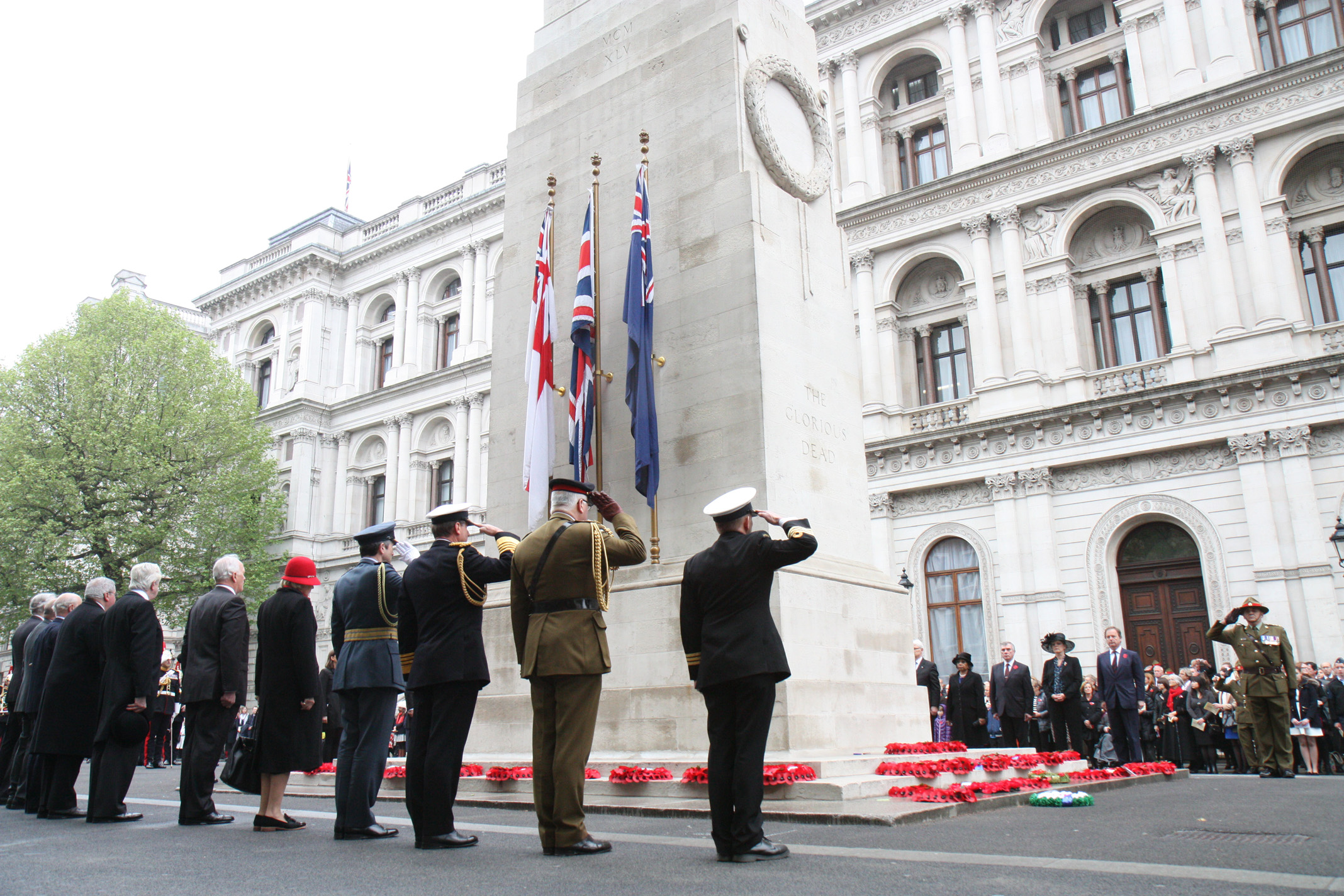
The Cenotaph
It says so much because it says nothing at all. No bronze soldier stands at attention. No angel lifts her wings. No cross marks the faith of the fallen. The Cenotaph is simply a Portland stone pylon rising 35 feet above the traffic of Whitehall, crowned by an empty tomb and draped with fabric flags. The word itself comes from the Greek for empty tomb, and that emptiness is precisely the point. More than 1.1 million men from the British Empire were killed in the First World War, and the vast majority were buried near where they fell, in the mud of Flanders or the chalk of the Somme. Their families had no grave to visit. The Cenotaph became what they needed: a place to stand, to remember, to grieve.
Wood, Plaster, and a Nation's Grief
The Cenotaph began as an afterthought. In 1919, the British government planned a victory parade through London, and Prime Minister David Lloyd George, inspired by a similar French event, asked Edwin Lutyens to design a temporary saluting point for the troops. Lutyens sketched the design over dinner, producing a structure that was built in wood and plaster by the Office of Works. During the parade on 19 July 1919, more than 15,000 servicemen, including French Marshal Ferdinand Foch and American General John J. Pershing, saluted the monument as they marched past. What happened next caught everyone off guard. Within a week, an estimated 1.2 million people came to pay their respects. Flowers and wreaths buried the base ten feet deep. Deputations arrived from as far as Dundee. The temporary structure, designed to last days, had become the focus of a nation's unprocessed grief.
Geometry as Elegy
Calls to rebuild the Cenotaph in stone were immediate and overwhelming. Lutyens made minimal changes to his original design, but added entasis, a subtle curvature borrowed from ancient Greek architecture. None of the lines on the permanent monument are truly straight or parallel. If the apparently vertical sides were extended, they would meet at a point approximately 1,000 feet above the ground. If the apparently horizontal surfaces were extended, they would form a sphere whose centre lies 900 feet below. The effect is almost imperceptible to the naked eye, but it draws the gaze upward in a slow spiral: from the inscription to the flags, to the wreaths, and finally to the empty tomb at the summit. Lutyens was a pantheist who opposed placing any overt religious symbol on the memorial, and the government agreed, reasoning that the Cenotaph honoured people from all parts of the empire, irrespective of their religious creeds.
The Eleventh Hour
The permanent Cenotaph was unveiled by King George V at eleven o'clock on 11 November 1920, the second anniversary of the Armistice. The ceremony was combined with the repatriation of the Unknown Warrior, an unidentified soldier brought from France for burial in Westminster Abbey. The king unveiled the monument, two minutes of silence followed, then the Last Post sounded. The public response exceeded even that of 1919. Whitehall was closed to traffic for days. Queues to pass the Cenotaph stretched for hours, continuing through the night. Within a week, an estimated 1.25 million people had visited. Lloyd George wrote to Lutyens that the Cenotaph is the token of our mourning as a nation, while the Grave of the Unknown Warrior is the token of our mourning as individuals.
Still Standing, Still Silent
The National Service of Remembrance has been held at the Cenotaph every year since, the ceremony changing little since the 1930s. On Remembrance Sunday, the nearest Sunday to 11 November, Whitehall falls silent at eleven o'clock. The monarch and prime minister lay wreaths, followed by other members of the royal family, politicians, and Commonwealth high commissioners. Veterans and serving personnel march past. The BBC has broadcast the ceremony since 1928, making it one of the longest-running annual broadcasts in the world. In 1946, the Cenotaph was rededicated to include the dead of the Second World War, and the dates in Roman numerals were added. The monument was designated Grade I listed in 1970, the highest level of protection. Its influence has been immense: at least 55 replica cenotaphs were built across Britain, and others appeared throughout the Commonwealth, from Bermuda to New Zealand. The Imperial War Museum identified 44 freestanding Lutyens war memorials across England, all now listed buildings. But the Whitehall Cenotaph remains the original, the one the historian Jay Winter called a work of genius because of its simplicity. It is a form on which anyone can inscribe their own thoughts, reveries, sadness.
From the Air
Located at 51.5025N, 0.1266W in the centre of Whitehall, London, between Downing Street and the Palace of Westminster. The memorial stands in the middle of the road. Nearest airports: London Heathrow (EGLL) 14 nm west, London City (EGLC) 7 nm east. Best viewed at 1,500-2,500 ft AGL. Whitehall runs north-south between Trafalgar Square and Parliament Square.