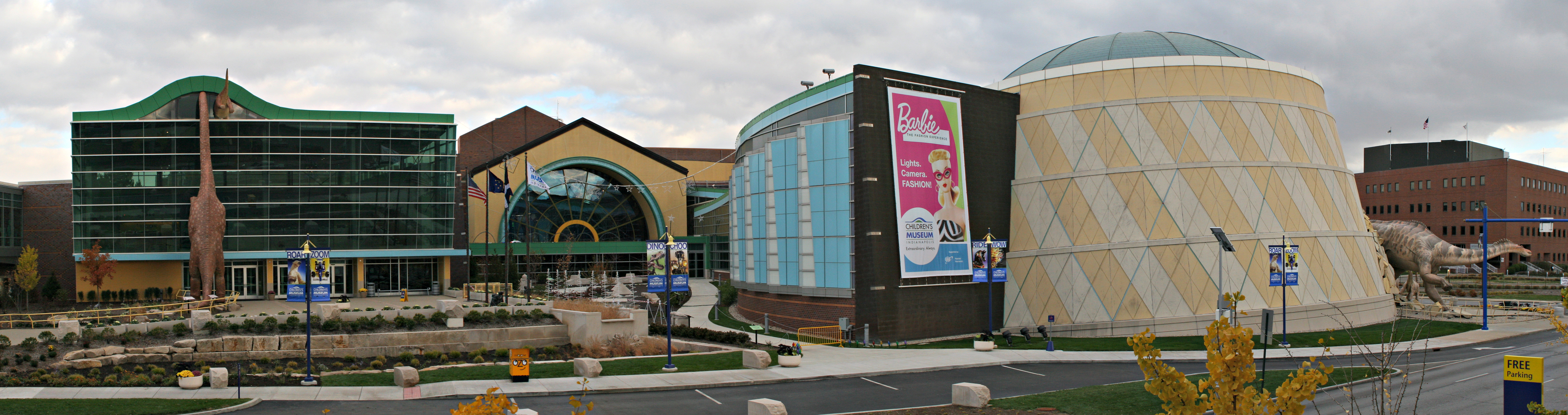
The Children's Museum of Indianapolis: Where Dinosaurs Crash Through the Walls
The first thing you see is the Brachiosaurus. A family of them, adult and juvenile, their sculpted forms climbing into the front of the building as if the museum walls cannot contain what lives inside. They are physiologically accurate to current paleontological knowledge, created by sculptor Gary Staab and painted by Brian Cooley, and they announce immediately that this is not a place where children are told to keep their hands to themselves. The Children's Museum of Indianapolis is the largest children's museum on Earth, five floors and over 130,000 artifacts designed around a single philosophy: touch everything. Founded in 1925 by a woman who visited Brooklyn and came home determined to build something bigger, it has been ranked the best children's museum in the United States by both Child and Parents magazines. The New York Times called it "the gold standard of museums for children."
From a Carriage House to a Mansion
Mary Stewart Carey owned the Stewart-Carey Glass Company and a conviction that Indianapolis children deserved a museum of their own. After visiting the Brooklyn Children's Museum in 1924, she enlisted the Progressive Teacher's Association and local civic leaders, and in 1925 the museum opened in the carriage house of The Propylaeum, a civic club. The early exhibits were created and donated by school children themselves. Within a year, Carey moved the museum into her own mansion on Meridian Street and hired the first curator, Arthur Carr. When Grace Golden took over as director in 1942, she transformed the institution through grants from the Lilly Endowment and partnerships with other museums. A gallery of dinosaur skeletons arrived in 1949. The mummy Wenuhotep came on permanent loan from the University of Chicago in 1959. By 1992, the museum hosted 4,000 programs annually with 835,000 visitors and $12.4 million in revenue. It was the fourth-oldest children's museum in the world, and it was still growing.
A Carousel That Survived a Century
On the fourth floor, a Dentzel carousel spins to the music of a rare Wurlitzer style 146-B Military Band Organ. The carousel's hand-carved animal figures were originally installed in 1917 at White City Amusement Park in what is now Broad Ripple Park. The museum restored and reinstalled it in 1973. It is the largest artifact in the collection and a National Historic Landmark, a designation earned not by a building or a battlefield but by a circle of painted wooden animals that have carried children for over a century. Nearby, North America's largest water clock, designed by French physicist and artist Bernard Gitton, marks time in cascading liquid on the main floor. These are the kinds of objects that define this museum: things that move, things that flow, things that invite participation rather than passive observation.
Sixty-Five Million Years Ago, Indoors
Dinosphere plunges visitors into the late Cretaceous period through sound and light that simulate a day 65 million years ago. The exhibit houses one of the largest displays of juvenile and family dinosaur fossils in the country, including Tyrannosaurus rex, Triceratops, Gorgosaurus, and the whimsically named Dracorex hogwartsia. Children can excavate fossils in the Dig Site, touch a real T. rex femur in the Paleo Prep Lab, and talk to working paleontologists. In 2021, a $27.5 million renovation expanded Dinosphere with Mission Jurassic, adding exhibits on sauropod dinosaurs and marine reptiles from the Jurassic period. Outside, the life-sized Brachiosaurus sculptures appear to crash through the building, as if the Mesozoic era refuses to stay contained within museum walls.
Children Who Changed the World
The Power of Children gallery on the third floor tells the stories of Anne Frank, Ruby Bridges, Ryan White, and Malala Yousafzai through historically accurate, immersive environments. Frank's Amsterdam hiding place is recreated; Bridges' New Orleans schoolroom is reconstructed. First-person interpreters, live theater, dramatic lighting, and artifacts draw visitors into lives that proved how much difference a young person could make. The exhibit creates space for examining prejudice and discrimination and imagining solutions. It is characteristic of this museum's ambition: beneath the dinosaurs and the carousel, beneath the fun, there is always a serious purpose. Over 1,500 volunteers contribute more than 65,000 hours annually to keep the museum running. In 2008, more than 83,000 students arrived on field trips from 775 schools. The endowment, first established in the 1960s, supplies over half the museum's operating income, ensuring that what Mary Stewart Carey started in a carriage house endures.
From the Air
Located at 39.811°N, 86.158°W on North Meridian Street, approximately 3 miles north of downtown Indianapolis. The museum complex covers a substantial footprint visible from the air, with the distinctive Brachiosaurus sculptures on the exterior. Indianapolis International Airport (KIND) is 14 miles southwest. The flat central Indiana terrain provides clear sightlines to the museum's neighborhood along the Meridian Street corridor.