The Cloisters: Medieval Europe on a Manhattan Hilltop
George Grey Barnard was broke again. The American sculptor had spent years bicycling through rural France, buying medieval stonework from farmers who used abbey columns as fence posts and tomb effigies as footbridges. He claimed to have found the 13th-century sarcophagus of crusader knight Jean d'Alluye lying face-down over a stream. By 1914, Barnard had shipped enough carved capitals, cloistered arcades, and Romanesque doorways to New York to open his own gallery in Fort Washington. It was the seed of something extraordinary: a museum not merely filled with medieval art, but built from actual medieval buildings, reassembled stone by stone on a rocky bluff overlooking the Hudson River.
A Sculptor's Obsession, A Tycoon's Checkbook
Barnard was brilliant and chaotic, a man who lost track of where his purchases came from and lurched from one financial crisis to the next. John D. Rockefeller Jr. was his opposite in every way: reserved, meticulous, enormously wealthy. The two were introduced by architect William Bosworth and did not get along. But in 1925, during one of Barnard's recurring monetary crises, Rockefeller acquired his entire collection for around $700,000. The deal included the bones of four French cloisters: pieces of the Benedictine abbey of Sant Miquel de Cuixa from the Pyrenees, founded in 878; arcades from Saint-Guilhem-le-Desert; double capitals from the Cistercian monastery at Bonnefont-en-Comminges; and carved marble from the Carmelite convent at Trie-sur-Baise. These structures, survivors of centuries of war, revolution, and neglect, would become the architectural foundation of the museum.
Stone by Stone Across the Atlantic
Between 1934 and 1939, architect Charles Collens designed a building that was itself a work of art. Elements from the five monasteries were disassembled, cataloged, crated, and shipped across the Atlantic, then reconstructed and woven into a cohesive whole on a steep hill in Fort Tryon Park. The Fuentidueña Apse alone, a semicircular Romanesque structure from a church near Segovia, was broken into nearly 3,300 individually numbered sandstone and limestone blocks and shipped in 839 crates. Rockefeller controlled every detail, sometimes frustrating his architects. He also purchased several hundred acres of the New Jersey Palisades clifftops directly across the river, ensuring the view from the museum would never be spoiled by development. The Cloisters opened on May 10, 1938, described as a collection shown in a setting that 'stimulates imagination and creates a receptive mood for enjoyment.'
Unicorns, Crusaders, and Illuminated Gold
The museum holds about 5,000 works spanning the 12th through 15th centuries. Its most celebrated treasures include the Unicorn Tapestries, a series of vivid Flemish hangings completed around 1505, whose original patron remains unknown despite centuries of scholarship, purchased by Rockefeller in 1922 for about one million dollars. The French army once used them to cover potatoes and keep them from freezing. The Hours of Jeanne d'Evreux, a tiny Gothic book of hours with 25 full-page miniatures and nearly 700 border images, has been called 'the high point of Parisian court painting.' The 12th-century Cloisters Cross, carved from walrus ivory, contains more than 92 intricately carved figures and 98 inscriptions. In the Gothic chapel, the sarcophagus of Jean d'Alluye shows the crusader knight as a young man, eyes open, dressed in chain armor with longsword and shield, the same effigy Barnard reportedly found face-down over that French stream.
Gardens of the Middle Ages
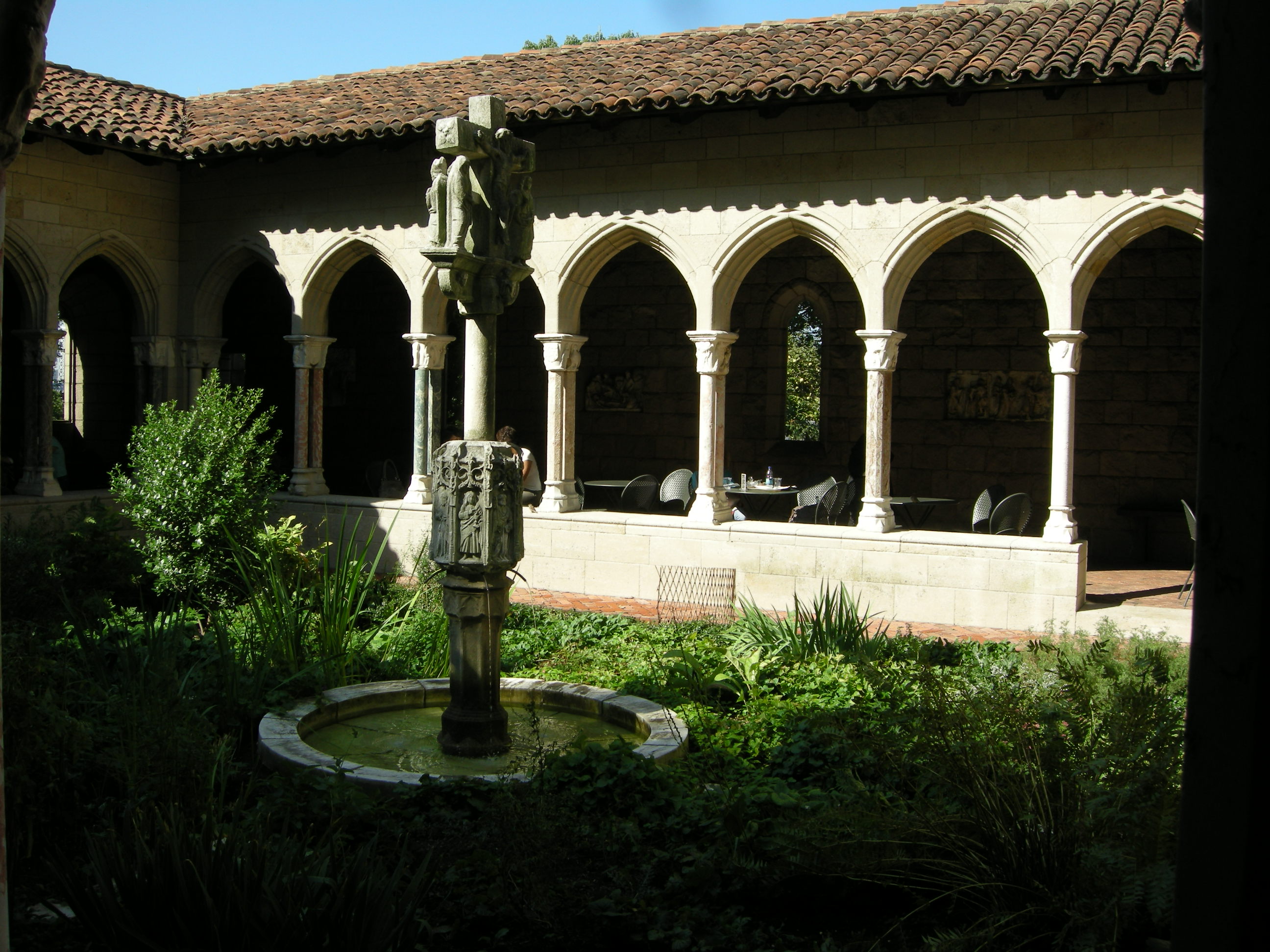
Three gardens grow within the cloistered arcades, planted with over 250 genera of species documented in medieval texts. The Cuxa garden, the museum's centerpiece, is surrounded by capitals carved with representations of Daniel in the Lions' Den and the Mouth of Hell, demons herding naked sinners in chains. The Bonnefont garden features a medlar tree of the type depicted in the Unicorn Tapestries, centered around a wellhead that stood at Bonnefont-en-Comminges in the 12th century. From this garden, visitors look across the Hudson to the Palisades cliffs that Rockefeller preserved. The Trie garden hosts around 80 species and a tall limestone cascade fountain, enclosed by 18 white marble capitals carved between 1484 and 1490 with scenes from Genesis to the life of Christ. These are living medieval gardens, tended by horticulturalists who are also historians of 13th- and 14th-century gardening techniques.
The View Rockefeller Built
The Cloisters sits at one of the highest points in Manhattan, and Rockefeller engineered the experience in every direction. Fort Tryon Park, designed by the firm of Frederick Law Olmsted Jr., wraps the museum in green. The Palisades across the river remain undeveloped because Rockefeller bought them. Even the building itself was designed to appear as though it grew naturally from the rocky hilltop, its stonework blending European medieval architecture with the Manhattan schist beneath it. Inside, the rooms are arranged not as conventional galleries but as atmospheric spaces where light through stained glass, the sound of fountains, and the texture of ancient stone create something closer to time travel than museum-going. The architect Collens described his vision to Rockefeller: the building should present 'a well-studied outline done in the very simplest form of stonework growing naturally out of the rocky hill-top.' Nearly ninety years later, it still does.
From the Air
Located at 40.86N, 73.93W in the Fort Tryon Park area of northern Manhattan. From altitude, the museum appears as a medieval-style stone building complex set among parkland on one of Manhattan's highest points, near the northern tip of the island. The Hudson River runs along the western edge, with the dramatic Palisades cliffs visible across the river in New Jersey. Fort Tryon Park's green canopy surrounds the museum. The George Washington Bridge (ICAO: no airport, but Teterboro KTEB is 5nm west) is visible about one mile to the south. Recommended viewing altitude: 2,000-3,000 feet AGL for best perspective on the museum's hilltop setting and its relationship to the Hudson River and Palisades.