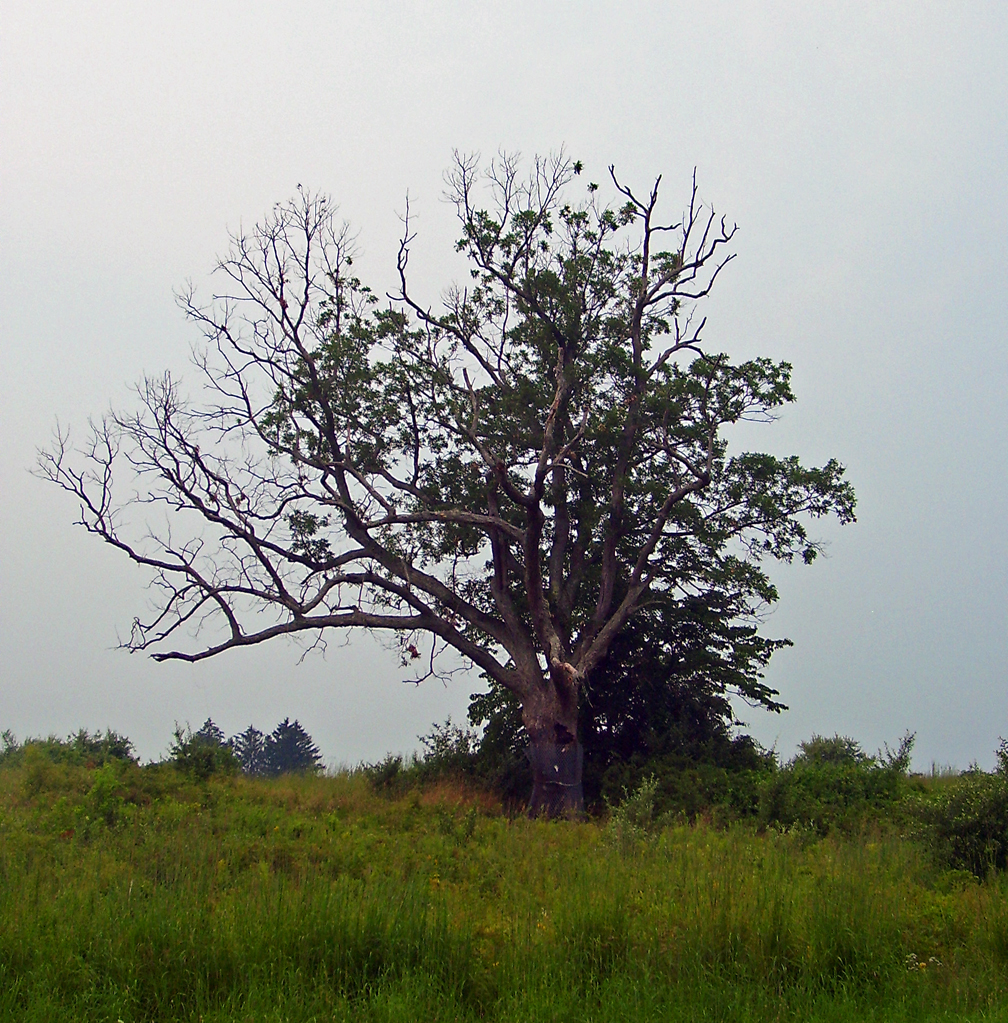
The Devil's Tree
It stands alone in an open field off Mountain Road in the Martinsville section of Bernards Township, Somerset County -- a solitary oak with dead limbs reaching upward like grasping fingers, surrounded by nothing but grass and the edge of a housing development. There is no plaque, no historical marker, just a chain-link fence around the trunk installed after years of vandalism. But ask anyone in central New Jersey about the Devil's Tree, and the stories come pouring out. It is the most famous cursed tree in a state that collects oddities the way other places collect landmarks.
The Legends
The catalog of curses attributed to the tree reads like a folklore anthology. Disrespect it -- kick it, insult it, relieve yourself on its roots -- and misfortune follows: car accidents, mechanical breakdowns, unexplained bad luck. Get too close, some say, and a phantom black Ford pickup truck will chase you down the road before vanishing at a certain point. Touch the bark and your hands will turn black if you try to eat afterward. In winter, the ground beneath the tree reportedly stays bare of snow regardless of how much has fallen. A nearby boulder called Heat Rock is said to be warm to the touch in any weather, and locals sometimes describe both the rock and the tree as portals to somewhere below.
Darker Roots
Beneath the supernatural folklore lies a grimmer set of claims. According to local oral tradition, Bernards Township was once a center of Ku Klux Klan activity in New Jersey, and the tree was allegedly used to lynch Black people and enslaved individuals dating back to colonial times. Another persistent story tells of a farmer who hanged himself from its branches after killing his family. These claims are difficult to verify -- the Klan's history in New Jersey is documented, but direct links to this specific tree remain in the realm of local memory rather than archival record. What is not in doubt is that the legends draw their power from a real history of racial violence. The tree stands as a reminder that some stories persist not because they are supernatural, but because they are rooted in something people have not fully reckoned with.
Heat Rock and the Uncanny Field
The snowless ground and the warm boulder invite rational explanation. An underground geological feature -- a spring, a gas vent, a thermal anomaly in the bedrock -- could account for localized heat. The Watchung Mountains, whose basalt ridges frame this part of Somerset County, are the product of Jurassic-era volcanic activity, and thermal remnants are not impossible in such terrain. But rational explanations have never been the point. The power of the Devil's Tree lies in the way it gathers stories to itself like a gravity well, pulling in the anxieties and guilty knowledge of its community and giving them a physical address. Every town needs a place where the unspeakable is spoken about in whispers, and this field on Mountain Road serves that purpose.
Protected, Fenced, and Still Standing
When Bernards Township considered developing the land where the tree stands, the plans might have required its removal. Instead, the township chose to protect it. In 2007, a sign was posted indicating visiting hours. The chain-link fence around the trunk followed repeated acts of vandalism -- people attempting to cut it down, carve into it, or set it on fire, perhaps testing the curse or trying to end it. The irony is thick: the tree endures in part because people keep trying to destroy it and failing, which only reinforces the legend. It remains an undeveloped field in a landscape of suburban houses, a pocket of wildness that the community has chosen to preserve -- not as a historical monument but as something stranger and harder to categorize.
From the Air
Located at 40.630N, 74.583W in the Martinsville section of Bernards Township, Somerset County, NJ. The tree stands in an open field off Mountain Road, visible as a solitary oak at low altitude (1,000-3,000 ft AGL). Nearest airports: Somerset Airport (SMQ) about 4 nm northwest, Morristown Municipal (KMMU) about 12 nm north.