The Dot
Picture a scaffold eight stories tall wrapped around a 22-meter steel sphere on the edge of Emmen. Inside that cage of pipes and planks, seventeen artists from seven countries are working in shifts. Their faces are hidden — the Toyists never show their faces in public; that is part of the rules of their collective — and they are painting an industrial gas container in colors no chemical plant ever wore. The job will take 6,000 hours and cover 1,250 square meters in multiple layers. When the canvas finally drops on June 4, 2010, the blue globe that has loomed over this corner of Drenthe for decades will have become The Dot, a giant living-with-energy mural perched on what used to be a piece of utility infrastructure.
An Idea That Waited Thirteen Years
The Toyist who calls himself Dejo, founder of the movement, had the idea in 1997. He looked at the gas globe in Emmen — one of only two of its kind still standing in Europe — and saw a canvas. Convincing other people took longer. Eight years passed before the first serious meetings, in 2005, with the energy company Essent that owned the container. Three more years passed before everything aligned: the foundation Living Industry, set up to find new lives for old industrial sites, agreed to back the project. The municipality of Emmen signed on. By the time the scaffolding went up around the sphere in 2008 and the first paint touched steel in July 2009, Dejo had been carrying the picture in his head for twelve years.
Who the Toyists Are
Toyism is a small international art movement founded in the Netherlands, and one of its founding principles is anonymity. Members work under invented pseudonyms — Dejo, Sirius, Yacky, Voxx, and dozens of others — and appear in public only in costume. The point is not theater for its own sake. The Toyists argue that ego gets in the way of art, and that work made collectively, by people whose individual identities recede, lands differently with a viewer. Watching them paint The Dot was a strange thing: a swarm of figures in matching outfits and masks scaling the scaffolding, day after day, through a Dutch summer and a winter pause and another summer, until the sphere went from utility blue to riotous color.
Reading the Painting
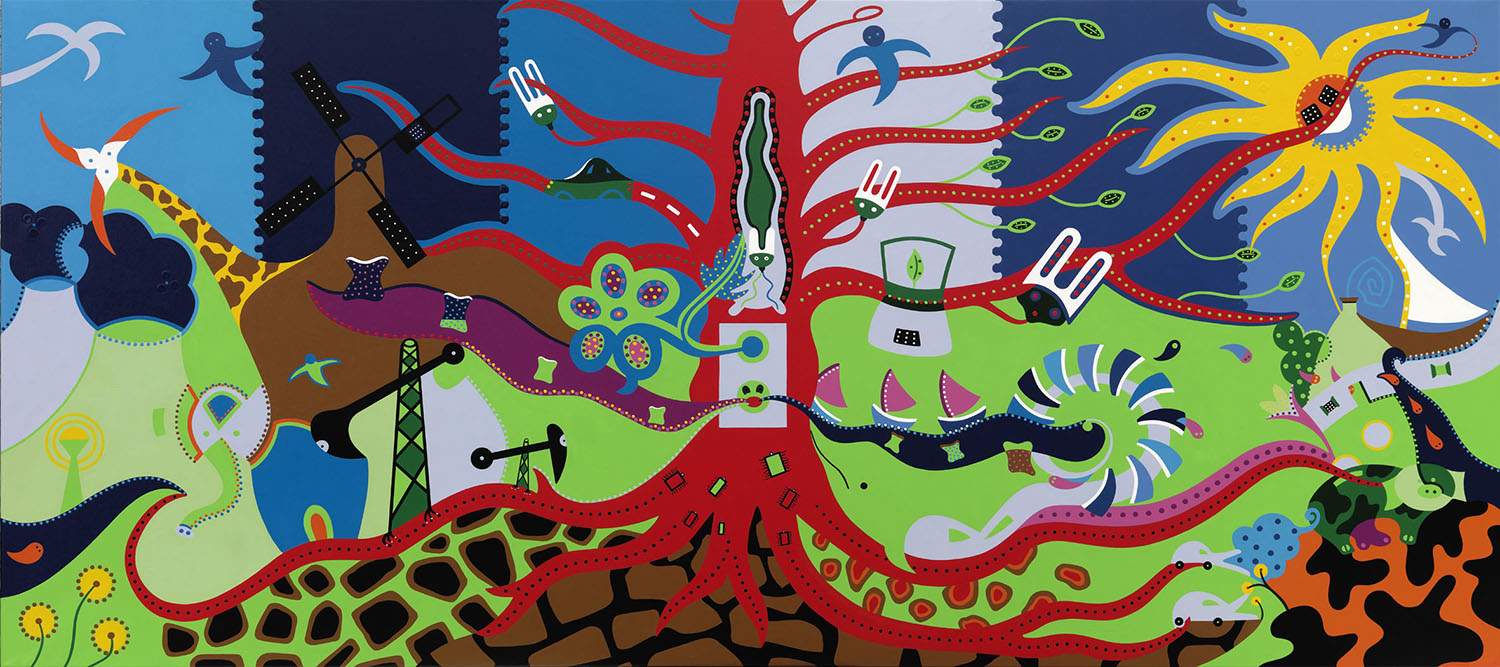
The theme the Toyists chose for the gas globe was live with energy, and they organized the surface around the four classical elements. Earth represents raw energy. Water carries hydroelectric power. Fire is the sun. Air is the wind. Each panel sets old and new ways of generating power against each other, woven through with figurative imagery telling the story of how humans have pulled energy out of the world. At the centre of the whole composition stands a tree, the Toyists' standing metaphor for life, growth, and change. Drenthe's own peat history — the centuries of cutting and burning that powered the Dutch Golden Age — gets its own visual nod. And scattered across the entire sphere are the small recurring characters the Toyists love: ecobunny lights and battery-insects, energy made cute and creeping across a former gas tank.
A Restoration by Crowdfunding
Paint on a 22-meter steel sphere has a hard life. Five years after the unveiling, in the summer of 2015, the colors had begun to peel and The Dot needed help. The Toyists launched a crowdfunding campaign, raised the money from people who had grown attached to the painted globe, and went back up the scaffold to put things right. The repainting is part of why the piece feels alive. Most public art is a monument; The Dot is more like a relationship, periodically renewed. The Toyists later painted a similar work, called Uppspretta, on a tower in Keflavík, Iceland in 2013. But the original is here in Emmen, on the edge of the peat country, where a piece of fossil-fuel infrastructure became, against the odds, a celebration of energy in all its forms.
From the Air
Located at 52.777 north, 6.912 east on the eastern edge of Emmen in Drenthe. The painted sphere is 22 meters tall and dramatically colored — it is one of the easiest landmarks to spot in this part of the Netherlands once you know where to look. Nearby airfields: Emmen Airfield (EHEH-area general aviation) and Groningen Airport Eelde (EHGG) roughly 35 nautical miles north. Recommended viewing altitude 1,500 to 3,000 feet AGL for a clear look at the painted surface.