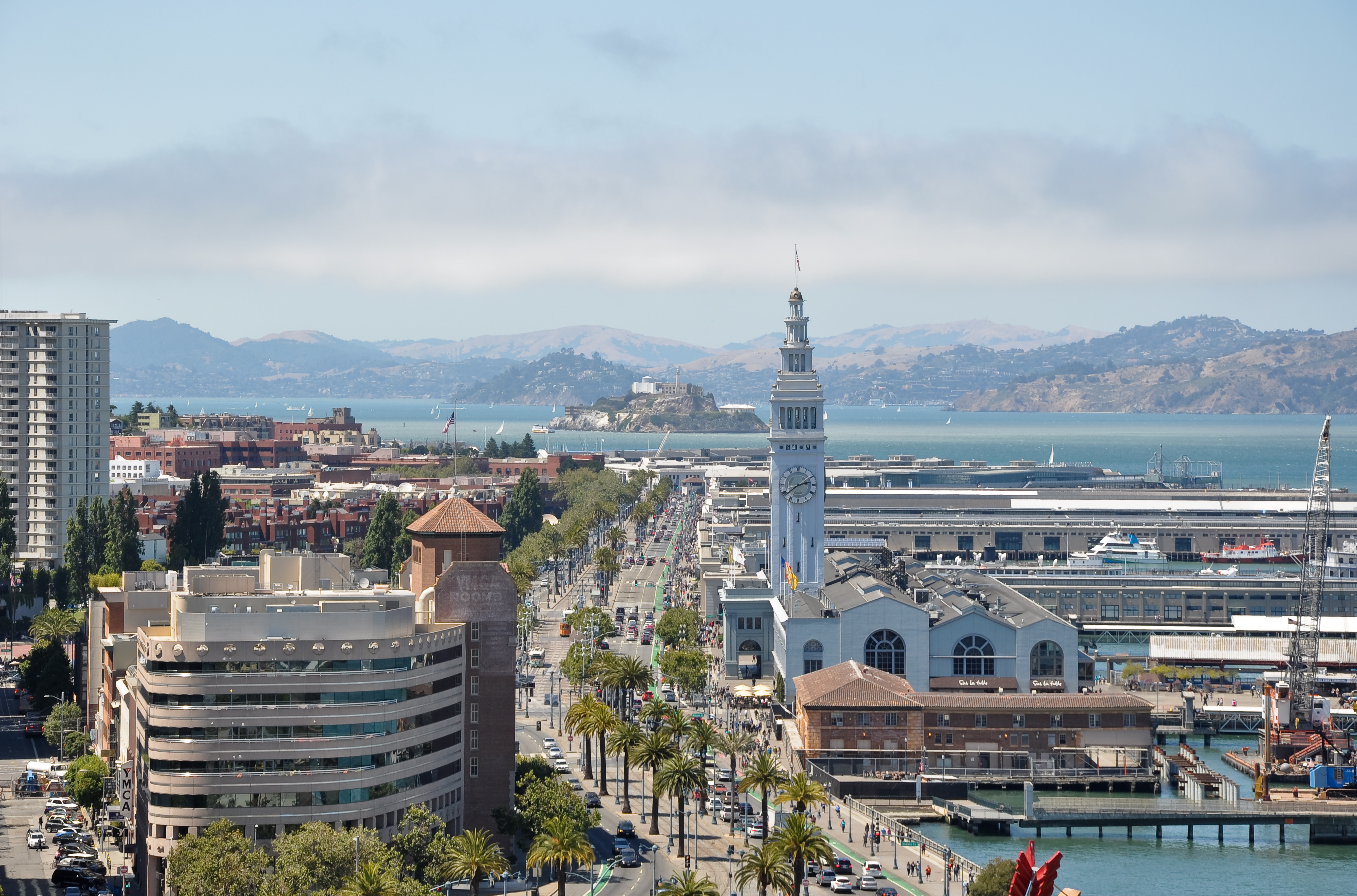
The Embarcadero (San Francisco)
For thirty years, a concrete freeway stood between San Francisco and its own waterfront. The Embarcadero Freeway, built in the 1950s, cut off the Ferry Building and the piers from downtown like a wall separating a city from its reason for existing. Then, on October 17, 1989, the Loma Prieta earthquake did what decades of civic argument could not: it damaged the freeway so badly that demolition became inevitable. When the freeway came down in 1991, the Embarcadero -- the three-mile waterfront boulevard whose name comes from the Spanish for 'the place to embark' -- was reborn.
Land That Was Once Water
San Francisco's original shoreline ran inland from Clark's Point below Telegraph Hill to present-day Montgomery Street, enclosing Yerba Buena Cove. As the Gold Rush city expanded, the cove was filled -- decades of landfill that created the Financial District. Along the new shore, a massive seawall was constructed between the 1860s and the 1920s, and the Embarcadero roadway followed its line. Piers extended into the bay like fingers, and the San Francisco Belt Railroad ran along the boulevard carrying freight. During the early twentieth century, steamships like the Delta Queen docked at Pier 1-1/2, ferrying passengers between San Francisco and Sacramento. During World War II, nearly every pier and wharf served the military, with troop ships and naval vessels lining the waterfront.
Freeway and Decline
The Bay Bridge's completion shifted traffic patterns, and container shipping moved most cargo operations to Oakland. The Embarcadero entered a long decline. The freeway, built to improve automobile access to the Bay Bridge, was the final insult -- an elevated concrete highway that blocked the Ferry Building from view and severed the waterfront from the city it was meant to serve. For three decades, the Embarcadero was a forgotten zone, its historic piers moldering behind the freeway's shadow. The 1989 earthquake changed everything. Structural damage to the freeway gave city leaders the political opening to tear it down, and the demolition unleashed one of the most dramatic urban transformations in American history.
Palm Trees and Streetcars
After the freeway was cleared, massive redevelopment created a grand palm-lined boulevard with restored plazas, new public spaces, and extended Muni streetcar lines. The F Market line runs vintage streetcars along the waterfront to Fisherman's Wharf. The sidewalk between China Basin and Fisherman's Wharf was named 'Herb Caen Way...' after the beloved San Francisco Chronicle columnist, with the three dots of an ellipsis deliberately included to honor his Pulitzer Prize-winning writing style. Cupid's Span, a large public sculpture by Claes Oldenburg and Coosje van Bruggen, was installed at Rincon Park in 2002. In 2016, the National Trust for Historic Preservation named the Embarcadero one of America's 11 Most Endangered Historic Places, citing the dual threats of sea-level rise and seismic vulnerability to the century-old seawall -- a reminder that the land itself is borrowed from the bay.
From the Air
Located at 37.799N, 122.395W along San Francisco's eastern waterfront. The palm-lined boulevard curves from China Basin to Fisherman's Wharf, clearly visible from the air. Nearest airports: KSFO (11nm south), KOAK (10nm east). Best viewed at 2,000-4,000 ft AGL.