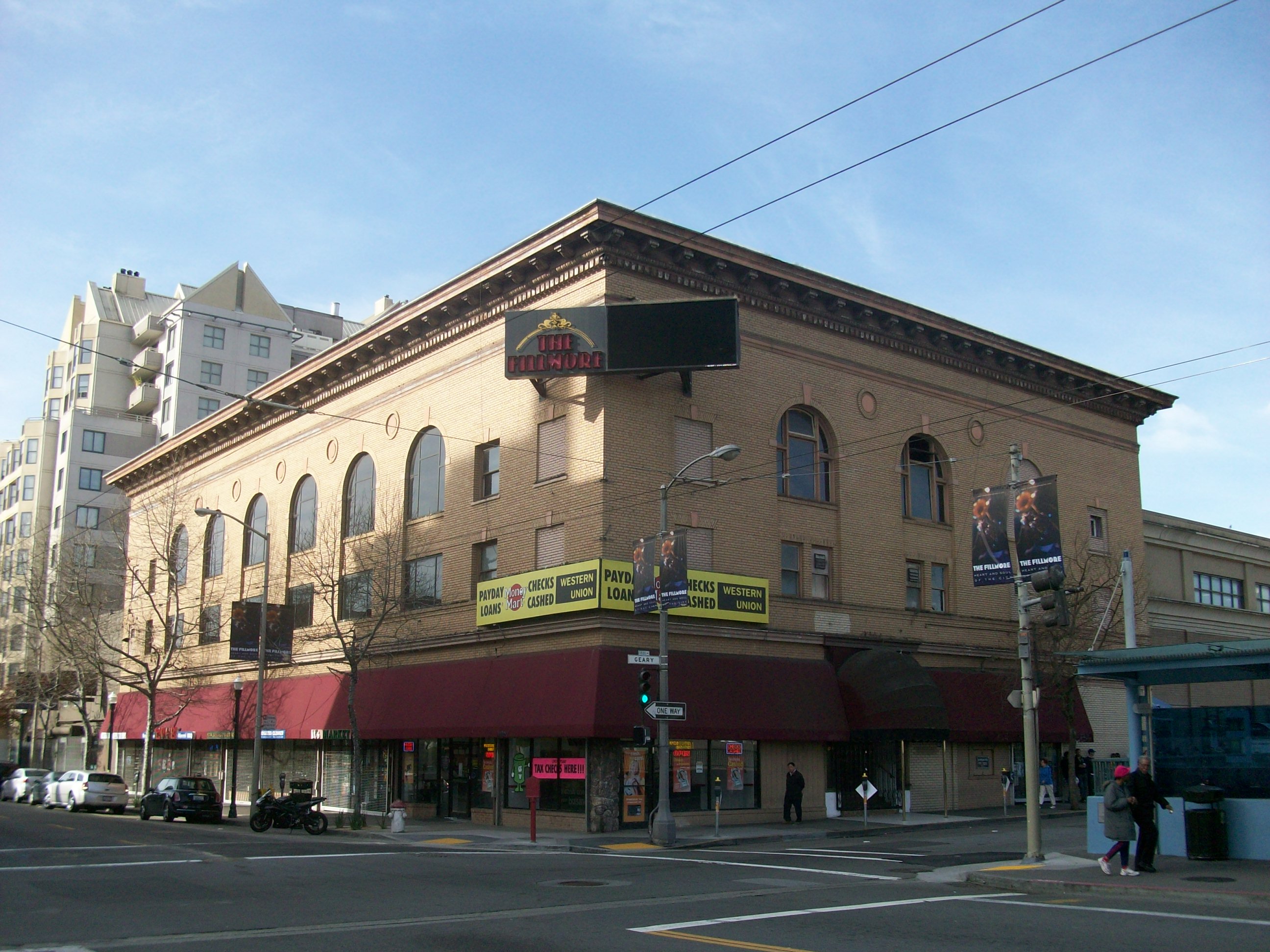
The Fillmore
There is a barrel of free apples near the door. A greeter says "Welcome to the Fillmore!" as you walk in. These small rituals have survived earthquakes, helicopter crashes, punk rock, and the corporatization of live music because they are connected to a room where something happened -- many things, in fact, across seven decades -- that changed the sound of American popular culture. The Fillmore, at the corner of Geary and Fillmore in the Western Addition, holds 1,315 people. It has held, at various points, the Grateful Dead, Jimi Hendrix, Aretha Franklin, the Sex Pistols, Miles Davis, and the Smashing Pumpkins. It has been a dance hall, a roller skating rink, a punk club called The Elite Club, and a victim of the 1989 Loma Prieta earthquake. What it has never been is irrelevant.
Charles Sullivan's Dance Hall
Before Bill Graham, there was Charles Sullivan. In 1954, Sullivan, one of the most successful African American businessmen in San Francisco, took over the lease on a dilapidated dance hall that had cycled through identities since 1912 -- Majestic Hall, Ambassador Dance Hall, Ambassador Roller Skating Rink. He renamed it the Fillmore Auditorium and did something no one else in San Francisco was doing: he hosted integrated dances and booked the biggest names in Black music. James Brown, Ike and Tina Turner, Louis Armstrong, Billie Holiday, and Jimi Hendrix all played Sullivan's room. In December 1965, Sullivan lent his dance hall permit to a young promoter named Bill Graham for a San Francisco Mime Troupe benefit concert. Graham kept coming back on Sullivan's off nights. The cultural revolution that followed would make Graham famous, but the foundation Sullivan built -- an integrated room with world-class Black musicians -- made it possible.
The Psychedelic Earthquake
By the mid-1960s, the Fillmore had become the epicenter of psychedelic rock. The Grateful Dead played 51 concerts there between 1965 and 1969. Jefferson Airplane, Quicksilver Messenger Service, Moby Grape, Big Brother and the Holding Company, Santana, the Doors, and the Who all performed on the same stage. In May 1966, the Velvet Underground and Nico played three nights as part of Andy Warhol's Exploding Plastic Inevitable, a multimedia show featuring stroboscopes, film projections, and wild onstage dancing. Their proto-punk sound clashed with the San Francisco counterculture, but the light show systems built by engineer Danny Williams became part of the Fillmore's identity and the template for rock concert lighting everywhere. B.B. King's performances at the Fillmore introduced white audiences to the authentic blues that had inspired the entire genre. Graham booked Lenny Bruce, poetry readings, and Miles Davis alongside the rock acts, treating the room as a cultural institution rather than a simple music venue.
Death, Earthquake, and Resurrection
In 1968, neighborhood decline and the venue's modest size led Graham to move operations to the Carousel Ballroom, which became Fillmore West. He closed both Fillmore West and Fillmore East in 1971. The original building became The Elite Club, hosting punk shows throughout the early 1980s -- Black Flag, Dead Kennedys, Social Distortion, Bad Brains. Graham reopened the Fillmore in the mid-1980s, but the Loma Prieta earthquake damaged and shuttered it again in October 1989. When Graham died in a helicopter crash in 1991, his associates resolved to fulfill his final wish: retrofit and reopen the original Fillmore. The venue reopened on April 27, 1994, with the Smashing Pumpkins playing an unannounced surprise show and Primus headlining the following night. Live Nation has operated the venue since 2007 and franchised the name to clubs in Denver, Detroit, Philadelphia, and New Orleans.
The Poster Gallery and the Apples
The Fillmore's traditions are deliberate acts of continuity. The psychedelic concert posters created by Wes Wilson and Rick Griffin in the 1960s established a visual vocabulary that defined an era. Copies of the night's poster are still given to fans as they leave sold-out shows. A curated collection lines the mezzanine walls, turning the staircase into an art gallery that traces the history of American rock music one vibrant, swirling image at a time. The barrel of apples, the greeter at the door, the poster at the exit -- these are not marketing gimmicks. They are the institutional memory of a room that remembers Charles Sullivan's integrated dances, Bill Graham's visionary programming, and every earthquake, fire, and cultural upheaval that could have closed the doors permanently but did not.
From the Air
The Fillmore sits at 37.78N, -122.43W in San Francisco's Western Addition, at the corner of Geary Boulevard and Fillmore Street. The venue is in a commercial building not easily distinguished from the air, but the surrounding neighborhood -- between Japantown and the Fillmore District -- is recognizable by the street grid pattern. Nearest airports: KSFO 11nm south, KOAK 9nm east.