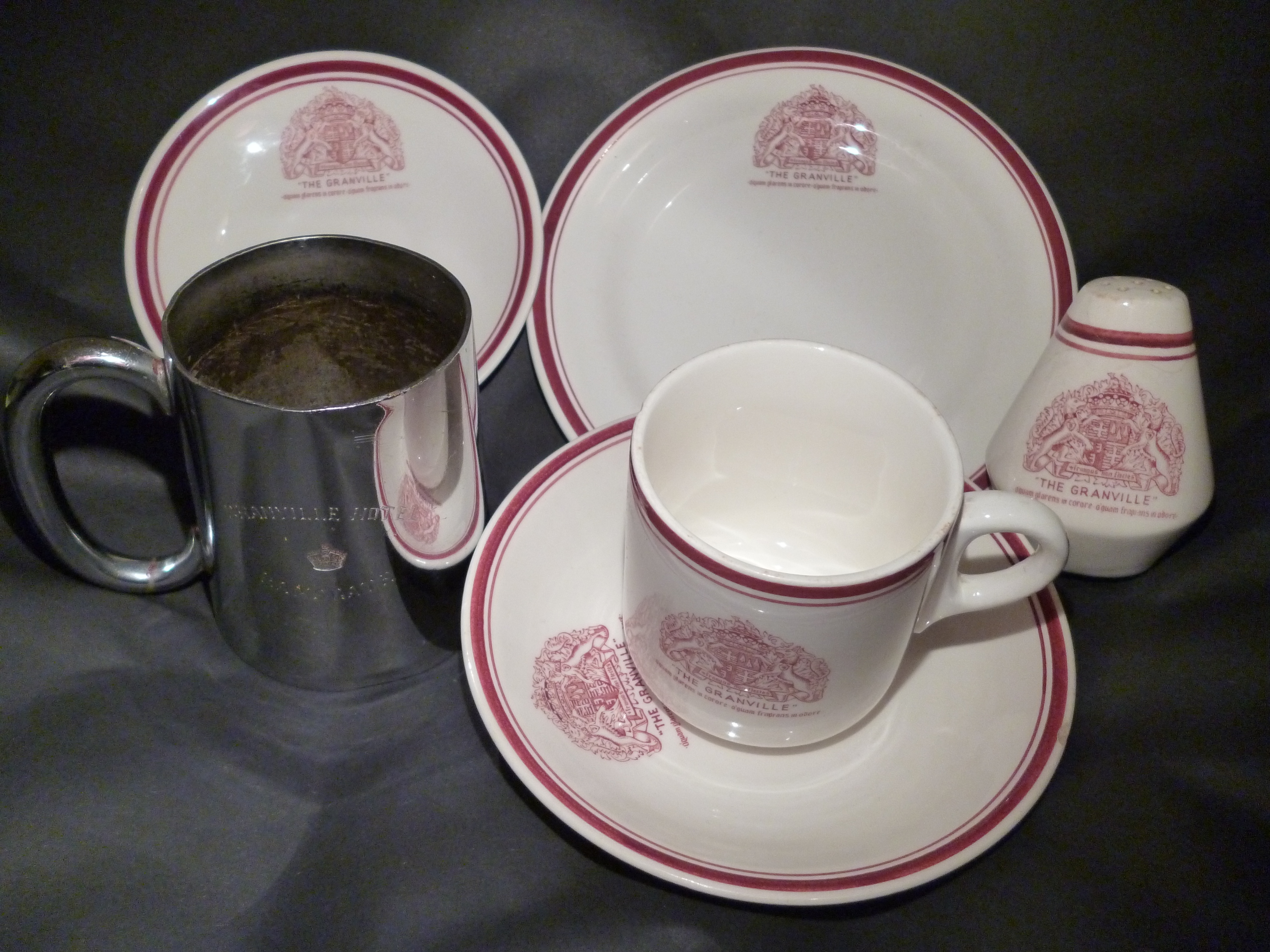
The Granville Hotel, Ramsgate
Pile on the logs to make the fire great. The motto is carved into a massive Caen-stone mantelpiece in the old banqueting hall of the Granville Hotel, above a fireplace held up on red marble columns. It is a hotelier's slogan disguised as a country-house aphorism, and it is exactly what Edward Welby Pugin wanted: opulence pushed to the edge of bankruptcy. He was the eldest son of Augustus Pugin, the genius behind the interior of the Palace of Westminster, and he had inherited his father's Gothic obsession and lost none of his father's capacity for financial ruin. The hotel he built on the cliffs above Ramsgate in 1867 helped bankrupt him six years later. It has been a spa hotel, a Canadian military hospital for shell-shocked soldiers, a jazz club, and now a block of apartments - all of it, somehow, in the same gabled Gothic building above the English Channel.
Eight Houses That Became One Hotel
The Pugin family was already woven into Ramsgate. Augustus Pugin had built his own Gothic Revival house and church on the West Cliff in the 1840s, and is buried there. When the Mount Albion estate on the East Cliff came up for sale in 1866 - the previous owner, Augusta Emma d'Este, had been the natural daughter of a royal duke - Edward Welby Pugin and two business partners bought a plot for 9,250 pounds. In 1867 they erected an eight-house terrace, five floors of stock brick and Gothic detail, with carefully cut stone balconies and tall pointed windows on the top storey. The architectural critic Catriona Blaker calls the terrace 'urban, modern Gothic, not even picturesquely asymmetrical' - meaning it was severe, vertical, and uncompromising. The houses were marketed as exclusive villas to be let by the week to wealthy visitors. Two years later, in 1869, the partners gave up on the villa idea and converted the whole terrace into a single hotel, inaugurated with a grand ball on 7 December and named for the second Earl Granville, the foreign secretary.
Twenty-Five Kinds of Bath
The Granville's selling proposition was water. Opened on 24 December 1870, the spa wing offered over twenty-five different kinds of bath - cold plunges, hot needle showers, salt rubs, and Victorian Turkish baths complete with a hot-room and tepidarium in proper Roman style. There was an 'everflowing sea-water plunge' supplied by pumps from the Channel below the cliff. Edmund Davis, who bought the hotel in 1877, doubled down on the ambition: he built the Granville Marina down at sea level, completed a tunnel through the cliff so guests could pass from the gardens directly to the beach, laid a marble skating rink in the gardens, and inaugurated the Granville Express - a private daily train from Charing Cross to Ramsgate Sands. None of this saved the hotel financially. It limped through frequent bankruptcies through the 1880s and 1890s until Spiers and Pond, the great Victorian catering and hotel chain, bought it in 1898 and rebuilt the front, lowering the Granville Tower.
The Canadians and the Cave
In January 1915, the Government requisitioned the Granville for the war. It became The Granville Canadian Special Hospital, and for two years it took in soldiers shipped back from the Western Front - men with shell shock, with severed nerves, with shattered bones and joints. By April 1917 the hospital was holding 809 wounded Canadians. The corridors that had echoed with the chatter of summer holidaymakers now echoed with whatever shell shock sounded like to the doctors of 1917 - very little of it understood, much of it disbelieved. The hospital closed and moved to Buxton later that year. The hotel reopened in 1920 after a sixty-thousand-pound refit. On 12 November 1940, German bombers destroyed a corner of the building; it was empty at the time. After the war the Granville stopped being a hotel and became Granville House, apartments, but life kept layering on. In the 1950s and 1960s ballroom dancing took over the hall - a sprung floor had been installed by the owner William Hamilton - and in February 1956 the basement became a jazz club called The Cave.
Pile on the Logs
Edward Pugin himself did not live to see most of this. Hotels are expensive things to build, and his ambitions outran the partners' patience. By 1873 he was bankrupt. He died in 1875, exhausted, at forty-one. The Granville is one of his masterworks and one of the things that ruined him. The hall he built in October 1869, with the fireplace and the motto, still stands, listed on the Ramsgate Society's Buildings at Risk Register. The teak staircase was almost destroyed by an arson fire in 1985 but was saved by new fire doors and a 1.5-million-pound restoration. The Granville Cinema across the road is named after the hotel. In 2012 a property investor bought the freehold of Granville House for 156,000 pounds at public auction. The motto on the fireplace - pile on the logs - has acquired, in retrospect, a slightly different meaning than Pugin intended. He meant: be generous, be lavish, let nothing be small. Looking back across a hundred and fifty years of bankruptcy, war, fire, and ballroom dancing, it reads more like: this building will consume whatever you throw at it.
From the Air
51.3356 N, 1.4269 E, on the East Cliff at Ramsgate, Kent. The building is the long Gothic terrace on Victoria Parade, immediately above the Granville Marina. The tunnel through the cliff to the beach is not visible from the air but the marina below the cliffs is obvious. Recommended viewing altitude: 1,000 to 2,500 feet for a good view of the cliff-top terrace silhouette. Nearest airport: Manston (EGMH), the former RAF station, is 4 km west; Lydd (EGMD) is 35 km southwest.