The Hague Center
Walk a kilometer in any direction from the Hofvijver pond and you cross more centuries than most cities offer in a lifetime. The Centrum district of The Hague is the oldest of the city's eight stadsdelen and the second largest by population, packed into nine neighborhoods so distinct that residents will correct you sharply if you confuse one for another. The Schilderswijk speaks Turkish and Berber on its market days. The Archipelbuurt's broad avenues sit silent behind embassy hedges. Between them, in the Oude Centrum, the parliament of the Netherlands has been meeting in roughly the same set of rooms since the thirteenth century.
The Pond That Started a Country
The Hofvijver is just a rectangular pond, maybe two hundred meters long, that reflects the sandstone facade of the Binnenhof, the Dutch parliament. Floris IV, Count of Holland, bought a piece of marsh land here in 1229 and ordered a hunting lodge built next to a freshwater pool. The hunting lodge grew into a castle, the castle grew into a court, and the court eventually became a country. The Mauritshuis sits across the water, a seventeenth-century mansion that now holds Vermeer's Girl with a Pearl Earring and Rembrandt's Anatomy Lesson of Dr Nicolaes Tulp. Visitors stand in the same square where envoys once tied up their horses. The architecture around the Oude Centrum is a stratigraphy of taste from seventeenth-century Renaissance to twentieth-century expressionism, never quite settling on one period because The Hague has never had a single dominant era.
Karl Marx in the Korte Lombardstraat
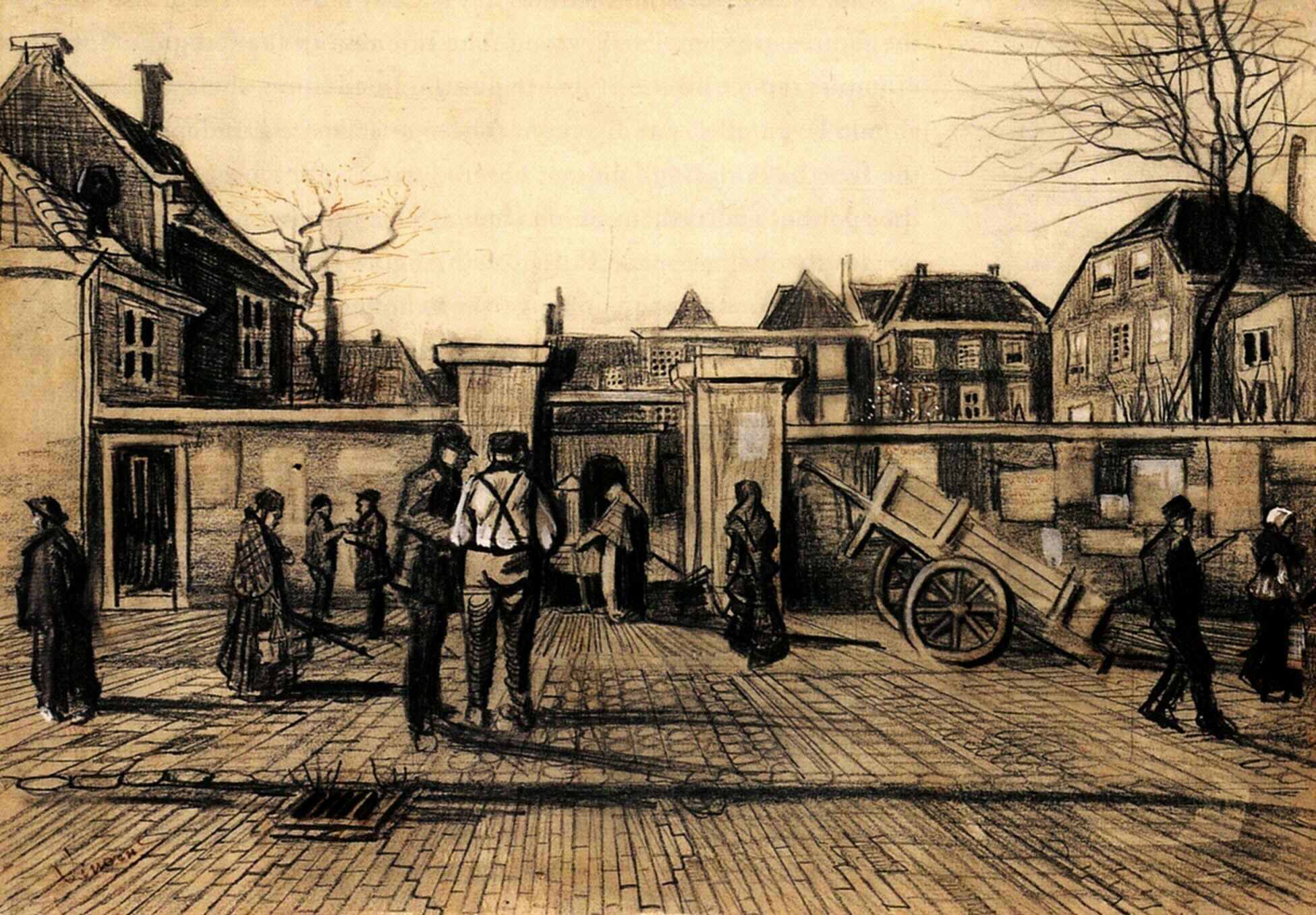
In September 1872 the working-class neighborhood of Kortenbos hosted the fifth congress of the International Workingmen's Association in a cafe-conference room called Excelsior. The two giants of nineteenth-century radicalism, Karl Marx and Mikhail Bakunin, met there for what would prove to be their definitive break. Marx wanted political action through state power; Bakunin wanted to abolish the state entirely. The congress voted Bakunin out of the movement, splitting the international left for generations. The drama did not end with the vote. A balcony, overloaded with onlookers, collapsed during the proceedings and seriously injured several attendees. The cafe is long gone, but the Korte Lombardstraat remains, narrow and easy to miss, a few minutes' walk from where Vincent van Gogh would sketch the back entrance of the city pawnshop a decade later in 1882.
John Adams Bought a House Here
In April 1782 the future second president of the United States moved into a house at Fluwelen Burgwal 18 in the Uilebomen neighborhood. Adams had spent years lobbying the Dutch Republic to recognize American independence and lend money to the new country, and the Netherlands had finally agreed. He purchased the property — at a cost of 15,207 guilders — and the Fluwelen Burgwal house became the first United States embassy anywhere in the world, the first American diplomatic mission established on the European continent. Adams stayed only briefly before negotiating the Treaty of Paris, but the address mattered. The original house is gone, replaced by a high-rise apartment building, but the spot is commemorated each year on Dutch American Friendship Day. Whatever the United States became, this is where its diplomatic life began: in a purchased Dutch townhouse, near a canal, around the corner from the parliament of a republic that had decided to bet on the experiment.
Three Neighborhoods, Three Worlds
The Schilderswijk, immediately south of Hollands Spoor station, is one of the poorest neighborhoods in the Netherlands. More than ninety percent of its residents trace their family origins to Turkey, Morocco, or Suriname, and the unemployment rates have proven stubbornly resistant to decades of urban renewal projects. A few blocks north, the Archipelbuurt is the opposite: wide nineteenth-century avenues lined with houses so large most have been converted into embassies, law firms, or the headquarters of the Nationale Investeringsbank. Tucked along the Archipelbuurt's southwest edge is a Jewish cemetery that has been receiving burials since 1694, predating most of the buildings around it by more than a century. Between these extremes sits the Stationsbuurt, the area around the train station that was demolished and rebuilt in the 1970s, then rebuilt again starting in 2000, this time more gently, retaining the monumental houses around Huygens Park and the Bierkade canal.
Living in Layers
What unites Centrum is not architecture or income but density of incident. The Binnenhof's Ridderzaal still hosts the king's annual Speech from the Throne on the third Tuesday of September, when the Golden Coach rolls through streets that have seen this exact procession for over a century. The Mauritshuis lends Vermeers around the world. The Zeeheldenkwartier west of the old center fills its nineteenth-century townhouses with bars and restaurants where civil servants and law students argue over beer. And the small streets of Kortenbos, with their hofjes, low courtyard houses, remember when this was a workers' district where revolutions were debated in cafes that no longer exist.
From the Air
The Centrum district is centered at approximately 52.0767 N, 4.3100 E, anchored by the Binnenhof and Hofvijver in the Oude Centrum. Visible from cruising altitude as the dense red-tile-roofed core of The Hague, immediately south of the Royal Forest (Haagse Bos). Nearest airports: Rotterdam The Hague (EHRD, 14 km south) and Amsterdam Schiphol (EHAM, 40 km northeast).