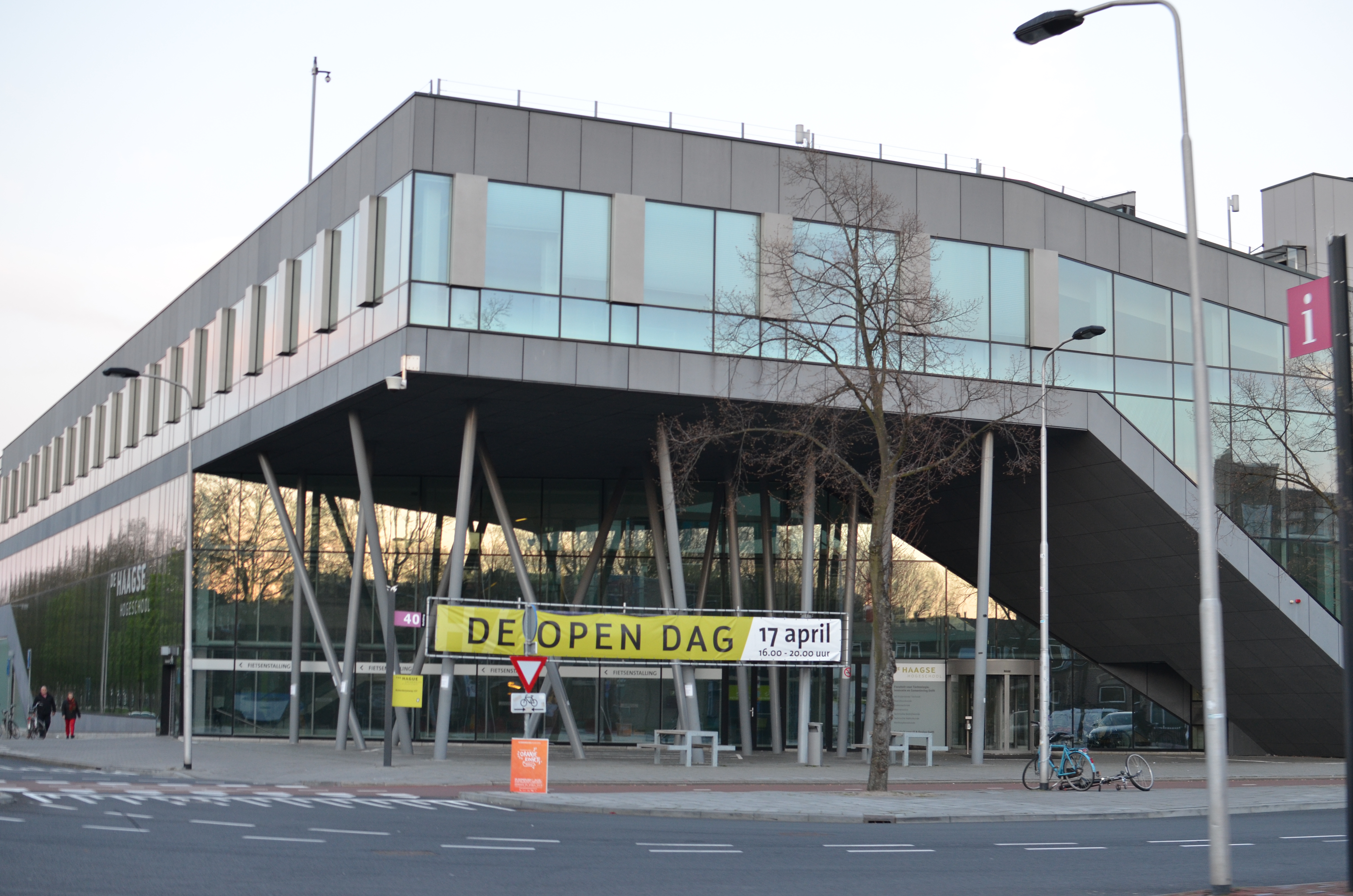
The Hague University of Applied Sciences
On 12 January 1987 the City of The Hague signed off on something unusual even by Dutch administrative standards: a merger of fifteen separate schools, six municipal and nine private, into a single university of applied sciences. Most of the constituent schools were less than a century old. One of them, the Hogere Technische School voor Bouw en Waterbouwkunde, descended from the Haagsche Teeken-Academie, a drawing school founded in 1682, which made the new institution's pedigree older than the United States. The merged school officially welcomed its first students that September. By 2020 it had 26,331 of them.
The Atrium and the Canal
The main campus sits behind Hollands Spoor railway station, the older of The Hague's two main termini, with the Laakhaven canal running past its front door. The 1996 main building turns on a central glass atrium that floods the interior with North Sea light on the rare days the clouds break. From the atrium, the building radiates into laboratories, lecture halls, a central library with 400 study seats, a fitness center, and several departmental cafes. The architecture is deliberately permeable. Students cross the atrium dozens of times a day on the way from one department to another, and the design forces them to keep bumping into each other. This is not a campus where you can hide in your specialization.
The Stadium That Became a School
Until 2007, ADO Den Haag, the city's football club, played in a stadium in the Zuiderpark on the south side of the city. When ADO moved to a new stadium that year, the old grounds came down. What replaced them is the Zuiderpark Sports Campus, opened in 2016 as a joint venture between the university, the municipality, and the Vestia housing association. The campus is now where The Hague trains its physical education teachers, sport managers, and exercise scientists, on roughly the same turf where Eredivisie players used to take corner kicks. The complex includes a sports hall, multiple gymnasia, a ballroom and beach volleyball facilities. Twelve lecture halls share the building with the courts. There is something distinctly Dutch about converting a football stadium into a teacher's college without losing the athletic spirit of the place.
Four Cities, One School
The university operates across four locations. The main Laakhaven campus carries most of the student body. A second campus on the grounds of Delft University of Technology, opened in 2009, hosts seven engineering degrees taught in Dutch, from mechatronics to engineering physics. The Zuiderpark Sports Campus handles physical education and sports management. And in 2003 the university opened the Faculty of IT and Design in Zoetermeer, twenty kilometers east, plugging into that town's substantial software industry. The Zoetermeer faculty moved into the Dutch Innovation Factory at the Dutch Tech Campus in 2013. Four buildings, four neighborhoods, one institution, all stitched together by the same Randstad rail and tram networks that make South Holland feel like a single sprawling city.
A Hundred Twenty-Four Passports
The 2020 enrollment of 26,331 included citizens of 124 different countries. Nine students were stateless, recognized by no nation under its laws. Most foreign students came from Germany, then Romania and Bulgaria; that year also brought the university's first ever student from Panama. The most popular program by enrollment is the International Business bachelor's degree taught in English, followed by Law and European Studies, also in English. The Faculty of Business, Finance and Marketing alone enrolls more than 4,500 students. About half of all students at THUAS have a foreign background of some kind, with or without a Dutch passport. The university has been a UNESCO Associated School since 2009, and the demography of its classrooms reads as a working model of what that means.
Practice, Not Theory
Dutch higher education distinguishes between universities (wetenschappelijk onderwijs, focused on research) and universities of applied sciences (hoger beroepsonderwijs, focused on practice). THUAS is firmly the second. Its seven Centres of Expertise are organized around problems rather than disciplines: cyber security, digital operations and finance, global and inclusive learning, global governance, governance of urban transitions, health innovation, and Mission Zero. The university's research groups work with municipal partners, NGOs, and companies on questions that need answering this year, not someday. Its more than 85,000 alumni have moved into roles that match: International Business graduates running supply chains, European Studies graduates working at NATO down the road, Law graduates filing briefs at the Permanent Court of Arbitration ten minutes north. The Hague is a city of international institutions, and THUAS feeds them.
From the Air
The main campus sits at approximately 52.0675 N, 4.3241 E, immediately southeast of Hollands Spoor station in The Hague. Visible from cruising altitude as a distinctive glass-atrium building along the Laakhaven canal. Satellite campuses lie at Delft University of Technology (15 km southeast), Zuiderpark (3 km south of center), and Zoetermeer (12 km east). Nearest airports: Rotterdam The Hague (EHRD, 12 km south) and Amsterdam Schiphol (EHAM, 40 km northeast).