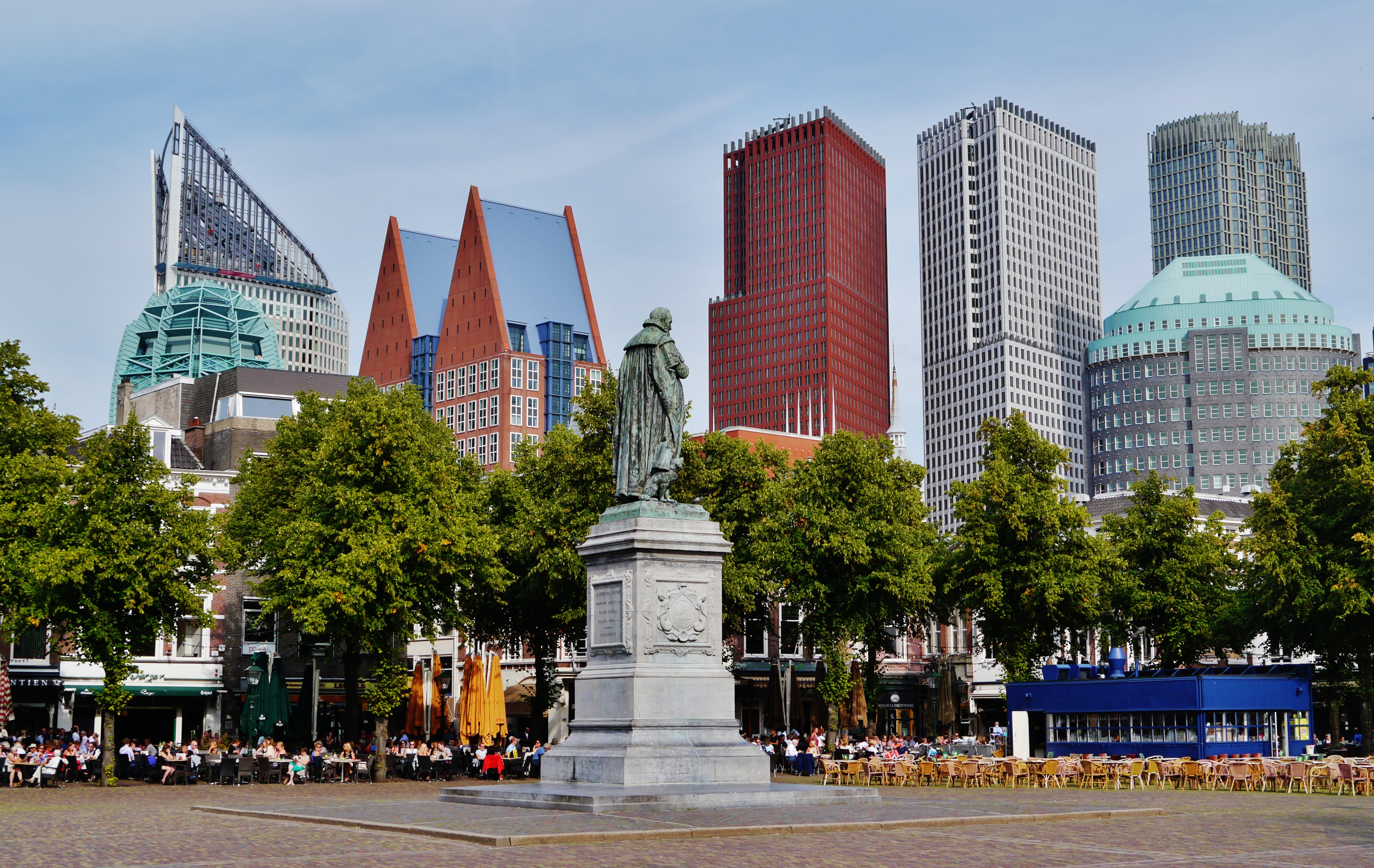
The Hague
The Dutch decided centuries ago that capital cities and seats of government do not have to be the same place. Amsterdam is the constitutional capital of the Kingdom of the Netherlands, but the king lives in The Hague, the parliament meets in The Hague, the prime minister works in The Hague, and the foreign embassies clustered around the Plein and the Lange Voorhout all face The Hague, because that is where the decisions get made. It is the third largest city in the country with 549,163 inhabitants as of 2021, and it sits where the rest of Europe sometimes pretends does not exist: directly on the North Sea, with two beach resorts and a herring industry attached.
Why Amsterdam Got the Title
The Hague began as a hunting lodge that Floris IV, Count of Holland, ordered built next to a marsh pond in 1229. The pond is the Hofvijver, still in the center of the city, and the lodge eventually grew into the Binnenhof, where the States General of the Netherlands has met more or less continuously since the late Middle Ages. When the Dutch Republic gave way to the Kingdom of the Netherlands in 1815, the constitution chose Amsterdam as the formal capital, the only city in the country with a population worthy of the title. But the kingdom kept its government in The Hague, where the buildings, ministries, and institutions had been for centuries. The arrangement looks anachronistic on paper and works fine in practice. The king takes the oath in Amsterdam and lives in The Hague.
The International Quarter
Czar Nicholas II of Russia proposed the first global Peace Conference, which convened at The Hague in 1899 on the theory that if states could be persuaded to settle disputes by law rather than war, an institution to do the settling would have to exist somewhere. The conference produced the Permanent Court of Arbitration, the world's first standing international court. Andrew Carnegie funded the Peace Palace that opened in 1913 to house it. From those foundations the city accumulated almost every international judicial body that needed a home: the International Court of Justice, the International Criminal Court, the International Criminal Tribunal for the former Yugoslavia, the Iran-United States Claims Tribunal, the Special Tribunal for Lebanon, the Organisation for the Prohibition of Chemical Weapons, Europol, Eurojust. The Hague is the fourth UN city after New York, Geneva, and Vienna, and it is the only one whose vocation is law rather than diplomacy or commerce.
The Widow of the Indies
When the Netherlands lost its colonies in the East Indies in December 1949, the Dutch civil servants, soldiers, planters, and their mixed-heritage Indo families who came back from Java and Sumatra largely settled in The Hague. They had spent generations taking long leaves here between postings, and the city already had streets named after Indonesian places. For decades the Tong Tong Fair, formerly called Pasar Malam Besar, was the largest Indo cultural festival in the world, founded in 1959 and consistently drawing more than 100,000 visitors a year to Malieveld park before the organizing company went bankrupt and the fair was cancelled in 2024. The community gave The Hague the nickname it still uses for itself, the Widow of the Indies, a name that holds grief and continuity in roughly equal measure. The food on Hague tables, the rijsttafel and the satay and the spekkoek, came from this story.
Scheveningen and the Sea
The Hague is the only major Dutch city on the North Sea coast, and it deals with the fact in two distinct ways. Scheveningen, in the northwest, is the country's biggest beach resort, drawing roughly ten million visitors a year to its boulevard, its pier, its Kurhaus, and the rebuilt Pathe cinema. The Sea Life center and the Madurodam miniature park sit a few minutes inland. Each year in Scheveningen, Vlaggetjesdag celebrates the arrival of the first herring of the season, Hollandse Nieuwe, with hundreds of thousands of visitors and a charity auction of the first barrel. Kijkduin, in the southwest, is the quieter sibling, smaller and largely for local residents who want a beach without the carnival. Both resorts run on the same long stretch of dunes that has kept the city from sliding into the sea for a thousand years.
Vermeer Across the Pond
The cultural geography of The Hague is unusually walkable. The Mauritshuis sits on the Hofvijver and holds Vermeer's Girl with a Pearl Earring and View of Delft, plus Rembrandt's Anatomy Lesson, in a seventeenth-century mansion small enough to see in a long afternoon. Across the city the Kunstmuseum, designed by H.P. Berlage and opened in 1935, holds the world's largest collection of Piet Mondrian paintings. The Escher Museum occupies the Lange Voorhout Palace in the old center, dedicated entirely to the Hague-born graphic artist whose impossible staircases sold a million dorm posters. Madurodam reduces the Netherlands to 1:25 scale in Scheveningen. The Panorama Mesdag, a 360-degree painting of the 1880s seacoast, has held its viewers since Hendrik Mesdag finished it in 1881.
Prinsjesdag and the Golden Coach
On the third Tuesday of each September the kingdom performs Prinsjesdag, Prince's Day. The king is driven from Noordeinde Palace through streets lined with the royal armed forces to the Ridderzaal inside the Binnenhof. The coach used to be the Golden Coach, a gift from Amsterdam in 1898, but its colonial-era panels have made its use controversial and it has been retired in recent years pending decisions about restoration. The king then reads the Speech from the Throne, the troonrede, written by the cabinet, which sets out government policy for the year. The current king is Willem-Alexander, who lives at Huis ten Bosch in the Haagse Bos and works at Noordeinde. His prime minister as of 2024 is Dick Schoof, who lives in Zoetermeer and commutes.
From the Air
The Hague is centered at 52.07 N, 4.30 E on the Dutch North Sea coast. Visible from cruising altitude as a dense urban area between the dune-line coast and the green agricultural belt to the east, with Scheveningen's distinctive pier extending into the sea. The Peace Palace and Binnenhof are landmarks in the city center; the broad Haagse Bos forest stripes the east side. Nearest airports: Rotterdam The Hague (EHRD, 13 km south) and Amsterdam Schiphol (EHAM, 40 km northeast).