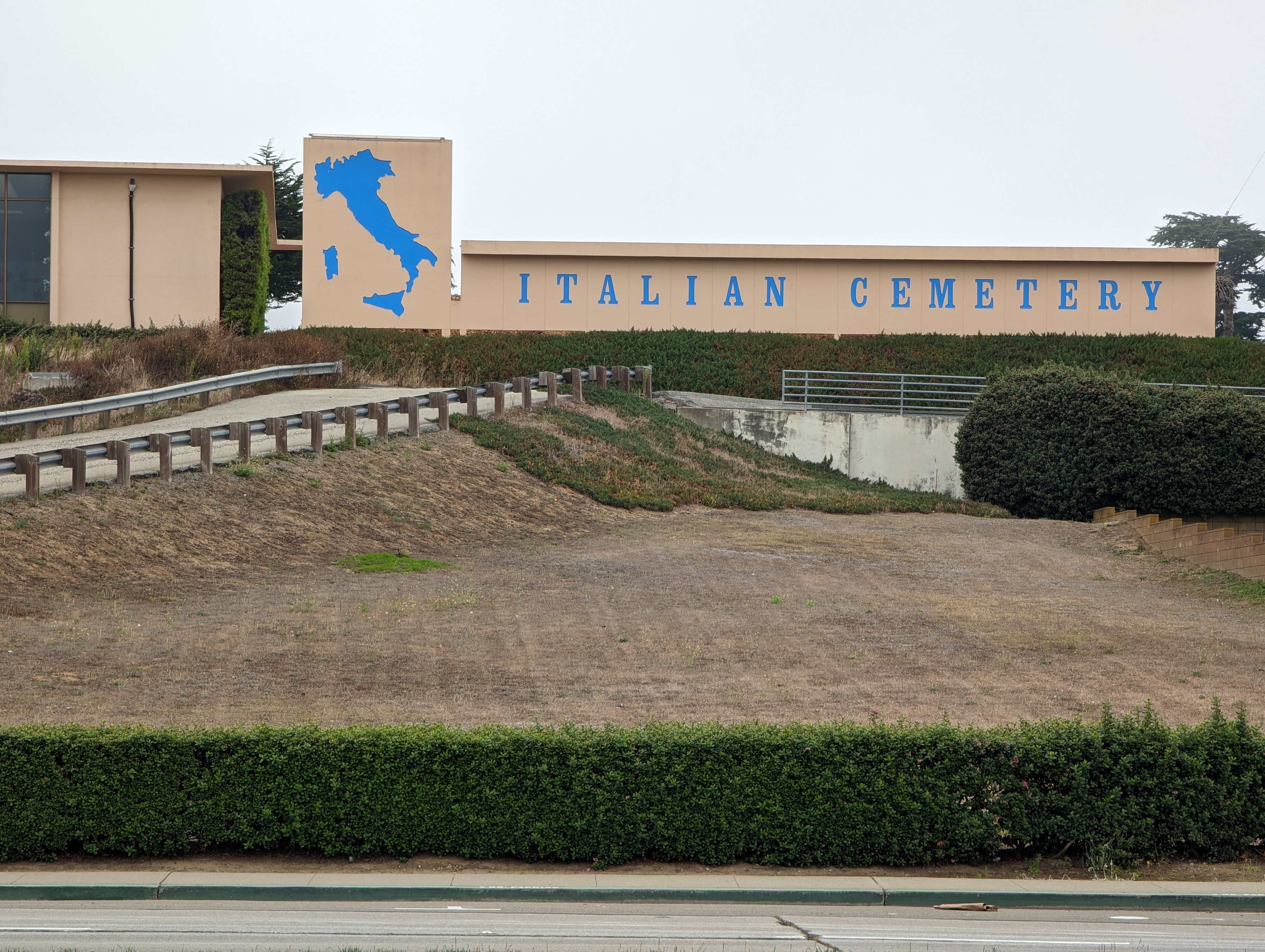
The Italian Cemetery
Colma, California, has more dead residents than living ones. The tiny town south of San Francisco became the final destination for the city's cemeteries when San Francisco banned burials within its borders in 1902 and later relocated existing graves. The Italian Cemetery, founded in 1899 at 540 F Street, was established just before the ban took effect, serving the large Italian immigrant community that had settled in North Beach and throughout the Bay Area. Its monuments, many carved from imported marble in styles drawn from the cemeteries of Genoa and Milan, make it one of the most architecturally distinctive burial grounds on the West Coast.
A Community's Final Address
San Francisco's Italian community in the late 19th century was one of the largest outside Italy. Fishermen from Sicily and Liguria dominated the fishing industry at Fisherman's Wharf. Merchants, vintners, and bankers -- including Amadeo Giannini, founder of the Bank of Italy (later Bank of America) -- built a thriving economic ecosystem in North Beach and beyond. The Italian Cemetery in Colma provided this community with a burial ground where Italian traditions of elaborate memorialization could be maintained. Family tombs, angel sculptures, and ornate mausoleums reflect a culture that treats the dead as continuing members of the family, visited regularly and maintained with care.
The City of the Dead
Colma exists because San Francisco rejected its dead. The 1902 burial ban, followed by decades of cemetery relocations, created an entire town built around funeral services. Seventeen cemeteries, representing different ethnic, religious, and fraternal communities, fill Colma's 2.2 square miles. The Italian Cemetery is one of the older institutions, predating many of its neighbors. Its Mediterranean landscaping, with cypress trees and flowering shrubs, creates an atmosphere distinct from the austere Protestant cemeteries nearby. Walking through the Italian Cemetery feels like visiting a miniature Italian piazza, complete with benches, fountains, and the kind of quiet sociability that Italians maintain even in the presence of the departed.
Continuity Across Generations
The cemetery continues to serve the Italian American community of the Bay Area, though its clientele has broadened over the decades to include families of all backgrounds. Many of the original Italian families whose members rest here have descendants who still live in the Bay Area, maintaining family plots that have been tended for over a century. The cemetery grounds, well-maintained and open to visitors, offer a living connection to the immigrant generation that built San Francisco's Italian neighborhoods -- neighborhoods that have themselves transformed from immigrant enclaves into tourist destinations, with the cemetery preserving what the living city has largely moved past.
From the Air
The Italian Cemetery is at 37.68N, -122.46W in Colma, visible from the air as one of many green cemetery parcels in this small town. Colma is identifiable by its unusually high concentration of cemeteries just south of Daly City. KSFO is 5nm to the southeast.