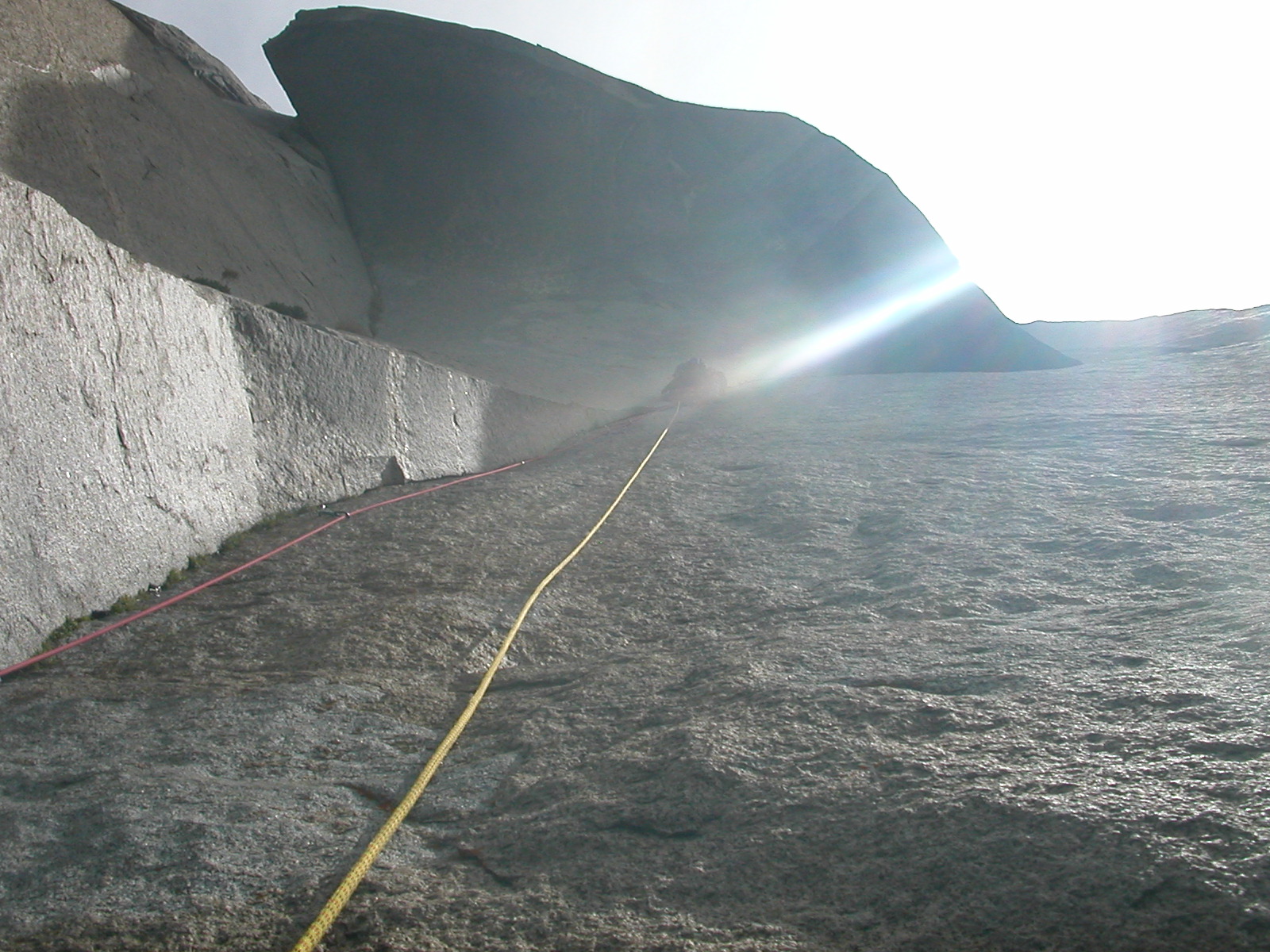
The Nose of El Capitan
Warren Harding's congratulations were hearty and sincere. Royal Robbins had just completed the first ascent of the Northwest Face of Half Dome in 1957, and Harding had wanted that climb badly. "But inside," he later admitted, "the ambitious dreamer in me was troubled." So Harding turned to something larger. Not just larger - the largest unclimbed face anyone could find. The 2,900-foot granite prow of El Capitan rose at the opposite end of Yosemite Valley like a dare. Nobody believed it could be climbed. The rock was too sheer, the scale too immense, the technology too primitive. Harding looked at it and saw a route running straight up the prow, the most exposed line on the most exposed wall in North America. He called it The Nose, and the eighteen months he spent getting to the top would change climbing forever.
Stove Legs and Stubbornness
Harding started in July 1957 with Mark Powell and Bill "Dolt" Feuerer, fixing ropes between camps in the Himalayan siege style because nobody knew another way to spend days on a vertical granite face. The cracks defeated their equipment almost immediately. Standard pitons could not fit the two- to three-inch fissures, so Feuerer cut the legs off wood-burning stoves and hammered them into shape. These improvised pitons gave their name to the Stovelegs, the crack system at the route's midpoint that remains one of its signature features. Powell shattered his leg on a separate climb and dropped out. Feuerer grew disillusioned, though he stayed on as technical advisor, building a bicycle-wheeled cart to haul gear to the halfway ledge now called Dolt Tower. The National Park Service forced a halt due to the crowds gathering in El Capitan Meadow. Partners cycled through. Harding kept going, recruiting, as he put it, "whatever qualified climbers I could con into this rather unpromising venture." Wayne Merry, George Whitmore, and Rich Calderwood became his core team.
Twelve Days on the Final Push
By fall 1958, four separate pushes had carried the team to the 2,000-foot level. Their fixed manila ropes would not survive a winter, so the November push had to be the last. For seven days they inched upward in cooling autumn air, the work blurring into what Harding called a "monotonous grind" - if living and working 2,500 feet above the ground on a granite face could be called monotonous. On November 12, 1958, after roughly 45 total days of climbing spread across 18 months, the team topped out. Harding had drilled 125 bolt holes by hand and placed roughly 675 pitons. The climbing world was stunned. Robbins and three companions returned in 1960 to make the second ascent in seven continuous days without siege tactics - a pointed philosophical rebuke of Harding's methods that kicked off a rivalry between the two climbers and their competing visions of what counted as a legitimate ascent.
The Woman Who Freed the Nose
For decades, two pitches near the top blocked every attempt to free climb The Nose: the Great Roof, a sweeping overhang graded 5.13c, and Changing Corners, a desperate sequence rated 5.14a/b where the crack shifts between two planes of granite and fingertip precision is everything. In 1993, Lynn Hill spent four days on the first free ascent of The Nose, partnered by Brooke Sandahl. She sailed through the Great Roof and climbed all the way to Camp VI without falling, only to be stopped on Changing Corners by a piton jammed in a critical finger hold. She returned, pried the piton free, and completed the first free ascent of The Nose. No man had managed it. The following year, she came back and free climbed the entire route in under 24 hours. Her achievement was so far ahead of its time that the second free ascent did not happen until 1998, when Scott Burke summited after 261 days of effort. Tommy Caldwell and Beth Rodden became the third and fourth people to free climb The Nose in 2005, twelve years after Hill showed it could be done.
Racing the Clock
Speed climbing The Nose became its own obsession. In 1986, John Bachar and Peter Croft completed the route in just over ten hours, a time that seemed absurd for a climb that had taken Harding a year and a half. By 1992, Hans Florine and Croft had pushed the record below four and a half hours. The times kept falling. Florine became the route's great speed specialist, trading the record back and forth with Dean Potter and the Huber brothers across two decades. In 2012, Florine and Alex Honnold set a time of 2 hours, 23 minutes, and 46 seconds. Then in June 2018, Tommy Caldwell and Honnold shattered the barrier that everyone thought was unbreakable. Over three attempts in eight days, they drove the time down to 1 hour, 58 minutes, and 7 seconds - under two hours on a route that had once taken eighteen months. Speed climbing mixes aid and free techniques, and the pace at which Caldwell and Honnold moved up 2,900 feet of vertical granite defied what most climbers thought possible.
A Prow Between Two Worlds
The Nose divides El Capitan's southwest and southeast faces, running up the granite prow like the bow of a ship pointed at the sky. Along its 31 pitches, the route passes through features that have become landmarks in climbing culture. The King Swing on pitch 17 requires a huge pendulum traverse, the climber running sideways across blank granite to reach the next crack system. The Great Roof on pitch 22 arches overhead like a stone wave. Changing Corners on pitch 27 remains the technical crux, demanding moves at the absolute limit of human ability. Today, with a success rate around 60 percent, The Nose typically takes fit climbers two to three days. It draws everyone from first-time big wall aspirants to elite free climbers, each generation finding something new on the same 2,900 feet of granite that Warren Harding looked at in 1957 and decided to climb because someone told him he could not.
From the Air
Located at 37.7286°N, 119.6370°W on the southwest face of El Capitan in Yosemite Valley. The prow of The Nose is the most prominent feature of the wall, visible as a sharp vertical edge dividing the sunlit and shaded faces. Best viewed from 3,000-5,000 ft AGL approaching from the west along the Merced River corridor. El Capitan Meadow lies directly below the wall. Nearest airports: Fresno Yosemite International (KFAT), 65 miles south; Mariposa-Yosemite Airport (MPI), approximately 30 miles west. Half Dome is visible 5 miles to the east.