The Ocean Cleanup
Boyan Slat was eighteen years old when he stood on a TEDx stage in Delft in 2012 and described, with the unshakable confidence of an aerospace engineering student who had been thinking about this for two years, how to clean up the Great Pacific Garbage Patch. The plan was elegant on a slide. A floating barrier, anchored to the seabed, would funnel plastic toward a central platform shaped like a manta ray. The ocean would do most of the work. The talk went viral. The money came. Then the ocean started suggesting, with the patient destructiveness only an ocean can manage, that the slide was a sketch and reality was going to need rewrites.
From Bedroom Sketch to Rotterdam Headquarters
Slat founded The Ocean Cleanup as a nonprofit in 2013 and headquartered it in the Netherlands, a country where everything about engineering against water is a national specialty. A 2014 crowdfunding campaign raised over two million dollars from people who wanted to believe a young person could fix this. In 2015 the project won the London Design Museum's Design of the Year award in the digital category. Marc Benioff put money in. So did Peter Thiel and the Coca-Cola Company. The funding model would later include a partnership with Kia, a twenty-five-million-dollar donation from Airbnb co-founder Joe Gebbia, and roughly half of the thirty million raised by the #TeamSeas campaign that Mark Rober and MrBeast ran on YouTube in 2021. The cause photographed well. The engineering did not always cooperate.
Wilson and the Hawaii Drydock
On 9 September 2018 the first full-scale system launched. It was nicknamed Wilson after the volleyball that drifts away in the film Cast Away, which in retrospect was an oddly prescient choice. The system was a six-hundred-meter floating barrier with a three-meter skirt, made of HDPE pipe joined in fifty-by-twelve-meter sections, towed out to the Pacific and set loose to drift through the patch. It collected debris and then lost it, unable to maintain a consistent speed through the water. In December, mechanical stress tore an eighteen-meter section away. The rig was towed to Hawaii for inspection and repair. After two months it had captured two metric tons of plastic, which sounds substantial until you remember that researchers estimate the patch contains 1.8 trillion pieces and seventy-nine thousand metric tons of floating plastic. The press coverage was unkind. The team went back to the drawing board.
The Quiet Pivot to Rivers
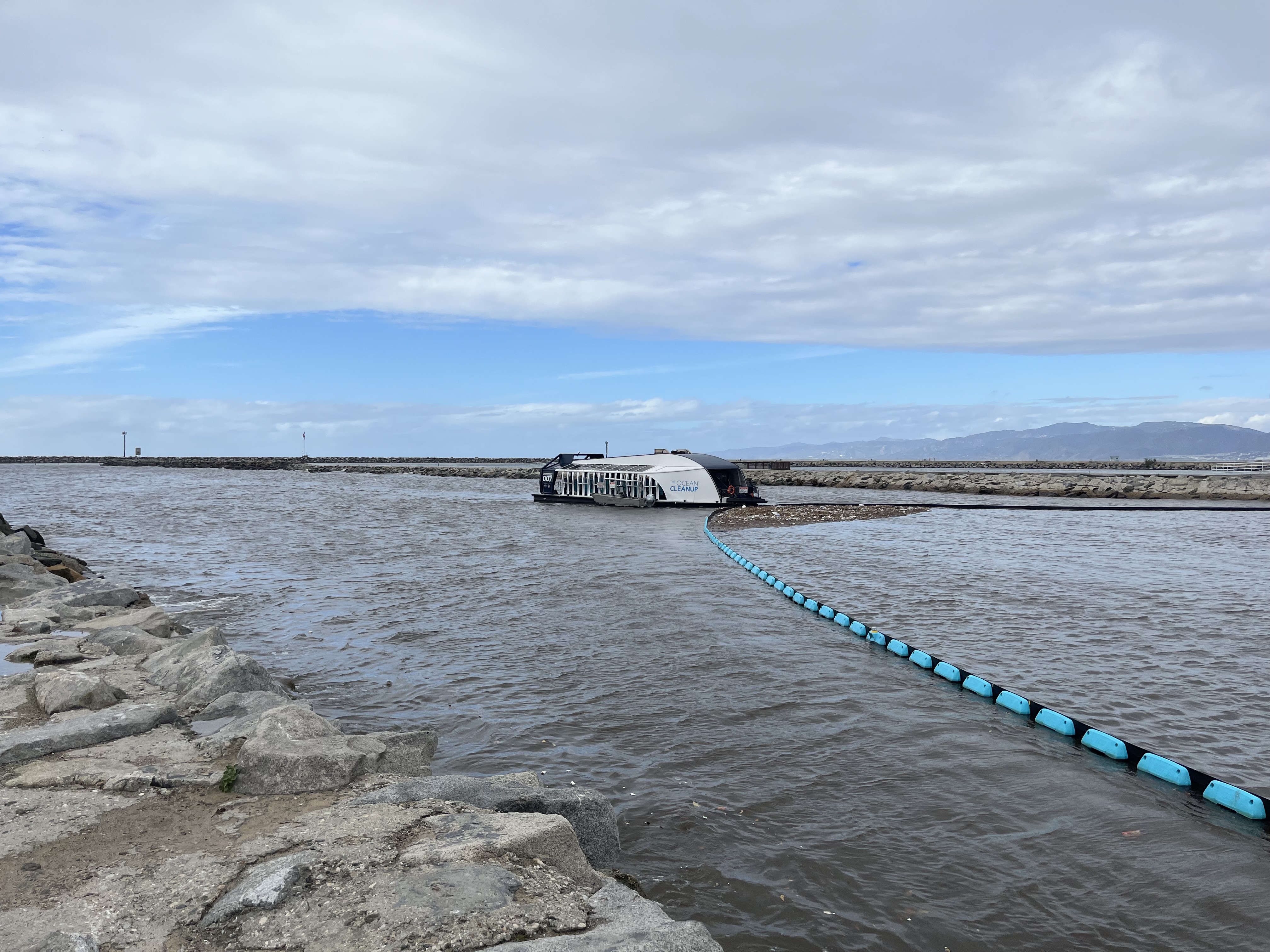
While the ocean systems struggled, the project did something humbler and arguably more important. In October 2019 it unveiled the Interceptor, a solar-powered barge designed to sit in a river mouth and skim plastic before it reached the sea. Two went into Jakarta and Klang in Malaysia. One in Santo Domingo. Then Los Angeles, where an Interceptor in Ballona Creek caught seventy-seven tons during the 2023 storm season. In Guatemala, after an early Trashfence on the Rio Las Vacas tore loose at its anchors, a redesigned pair installed at a slower stretch of river removed ten million kilograms of trash in their first year, a number large enough to make the entire ocean program look like the warm-up act. The project's own research had pointed this way. A 2017 paper in Nature Communications estimated that 1.15 to 2.41 million metric tons of plastic enter the oceans from rivers every year, with eighty-six percent coming from rivers in Asia. About one percent of the world's rivers, roughly a thousand of them, carry eighty percent of the load.
System 03 and the Math Problem
By May 2023 the Pacific operation had its third generation of ocean barrier. System 03, at 2,250 meters, was actively towed by two ships rather than drifting, and was about five times the capacity of its predecessor. The mesh in the retention zone was widened from 10 to 15 millimeters so that blue buttons and violet snails, the small pelagic creatures that share the surface with the plastic, could pass through. The project dropped a zero from the naming scheme to make a point: ten systems, not a hundred, might be enough to clean all five ocean garbage patches. As of January 2026, the organization reports having removed over fifty million kilograms of trash from rivers and the patch combined. Critics like Miriam Goldstein of the Center for American Progress have argued, with the cold accuracy of a marine ecologist, that devices closer to shore recover more plastic per dollar. They are probably right. They are also describing the work the Interceptors are now doing.
What Boyan Built
It is tempting to read this as a story about a teenager who oversold a hard problem and slowly learned humility. That is partly true. It is also a story about a movement that, by founding itself on a charismatic impossibility, raised the money to pursue the unglamorous possibility next door. The Pacific cleanup may still happen. The river interceptors are happening now. Both grew out of a TED talk from a Dutch eighteen-year-old who refused, before he had any right to, to accept that nobody knew what to do.
From the Air
The Ocean Cleanup's Rotterdam headquarters sits at 51.92N, 4.47E, in the Rotterdam port district. From altitude the Nieuwe Maas and the vast harbor complex stretch westward toward the North Sea. Rotterdam The Hague Airport (EHRD) is roughly 6 km north. Amsterdam Schiphol (EHAM) is about 60 km north. The wider story of this organization lies thousands of kilometers west, in the gyre between California and Hawaii, where the Pacific patch drifts.