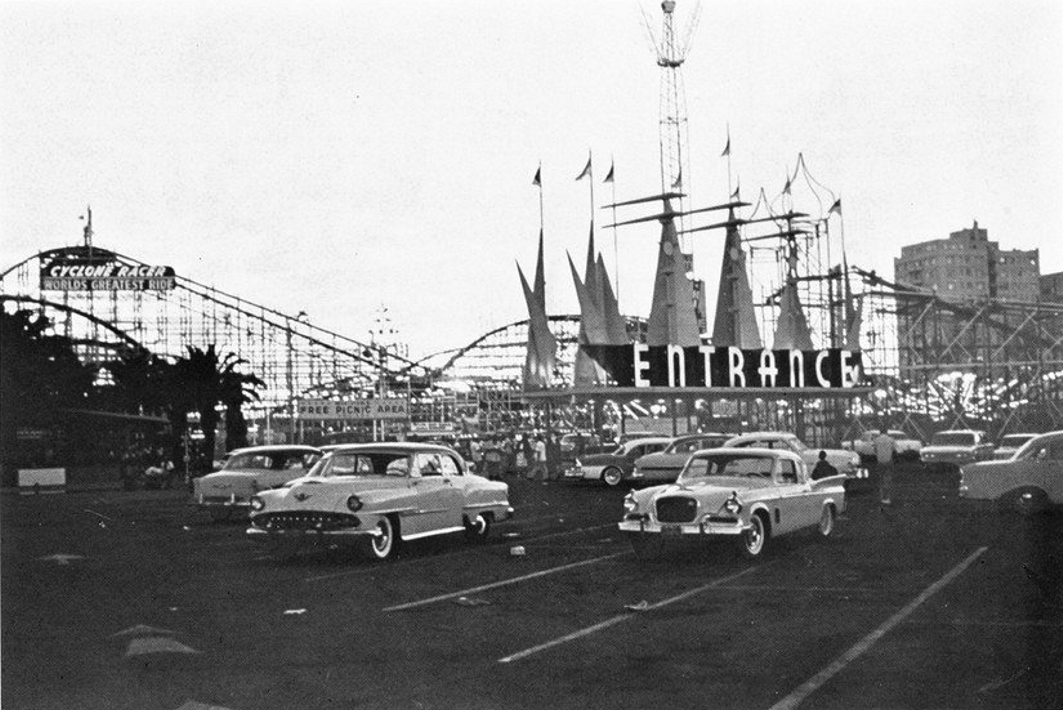
The Pike
In 1976, a film crew renting a prop from a Long Beach funhouse made an unsettling discovery. The 'mummy' they had borrowed for their haunted attraction had a real arm bone sticking out of its costume. Examination revealed it to be the actual preserved body of Elmer McCurdy, a train robber who had been shot dead in Oklahoma in 1911 and had been passed from carnival to carnival for decades, exhibited as a curiosity, until he ended up in The Pike. McCurdy's story — death, mummification, carnival display, accidental rediscovery — is one of the stranger subplots in American popular entertainment. That it happened at The Pike was somehow appropriate. The place had always been a little strange.
The Beginning: Boardwalk to Bathhouse
The Pike began in 1902 as a simple boardwalk connecting the Long Beach Municipal Pier to the Plunge, a large indoor swimming pool and bathhouse. The path along the shoreline south of Ocean Boulevard was lined almost immediately with the portable commerce of American popular entertainment: food stands, gift shops, arcades, games of chance. The Looff Carousel arrived in 1911, a hand-carved masterpiece from the workshop of Charles Looff, one of the greatest carousel makers in America. Carnival operators recognized what they had — a beachfront captive audience in a growing California city — and the Pike expanded accordingly. By the 1910s it was a genuine amusement zone, the kind of place that smelled of popcorn and salt air and machine oil.
The Cyclone Racer
The Pike's most legendary attraction was the Cyclone Racer, a dual-track wooden roller coaster that opened in 1930 and operated until 1968. What made the Cyclone Racer remarkable was its location: the tracks were built on pilings over the water, so that riders traveled out over the Pacific Ocean on a wooden structure that was, architecturally, more pier than building. At the turns and drops, with the ocean visible on all sides and the surf audible below, the experience was genuinely vertiginous. Two trains ran simultaneously on parallel tracks, racing each other — the 'racer' of the name. Passengers could see their friends on the adjacent track. The combination of speed, height, ocean exposure, and friendly competition made it one of the most beloved coasters in California history.
The Tattoo Parlors and the Sailors
The Pike's particular character came partly from its waterfront location near the Long Beach Naval Station, which brought a steady stream of sailors on shore leave to the amusement zone. Tattoo parlors clustered along the Pike's main drag, serving the Navy trade and contributing to The Pike's reputation as simultaneously a family destination and an adult entertainment district. The tattoo culture that developed around the Pike was influential: the artists who worked there, adapting and developing the flash art styles that defined American tattooing, shaped the visual vocabulary of the craft. Pike Avenue became synonymous with a kind of working-class California carnival culture that persisted through decades of urban change around it.
The Films and the Decades
Hollywood discovered The Pike early. The waterfront amusement zone appeared in dozens of films through the twentieth century, serving as a ready-made backdrop for chase sequences, romance scenes, and atmospheric establishing shots. The distinctive visual of a California pier amusement zone — rides extending over water, neon reflected in the surf, the mix of light and shadow in covered walkways — was exactly what filmmakers needed and didn't have to build. The Pike's film appearances were steady through the 1950s and 1960s, by which point the real attraction had begun to decline. Urban renewal pressure, changing entertainment preferences, and the competition from Disneyland and other theme parks gradually eroded The Pike's customer base.
The Last Years and the Mummy
The Cyclone Racer closed in 1968, and The Pike's days were numbered from that moment. The amusement zone contracted through the 1970s, losing attractions and tenants to decay and disinterest. The mummy of Elmer McCurdy — discovered in 1976 when a television crew found a real bone in a prop corpse — was perhaps the most fitting final story. McCurdy had died in 1911 and spent sixty-five years being moved from carnival to carnival, his identity forgotten. The Los Angeles County coroner identified him from medical records and he was finally buried in Oklahoma in 1977. The Pike itself followed: it closed in 1979, ending seventy-seven years of waterfront entertainment. The land was redeveloped as Pike Place, later rebuilt as The Pike Outlets. The Cyclone Racer's pilings were pulled from the harbor floor. Nothing remained.
From the Air
Located at approximately 33.77°N, 118.19°W along the Long Beach waterfront, south of Ocean Boulevard near the Long Beach Convention Center and the Queen Mary. The area is now occupied by The Pike Outlets shopping complex and the Shoreline Village waterfront development. Long Beach Airport (KLGB) is approximately 3 miles north. Approach from the west over the harbor for best orientation to the waterfront location where the Cyclone Racer's pilings once extended over the Pacific.