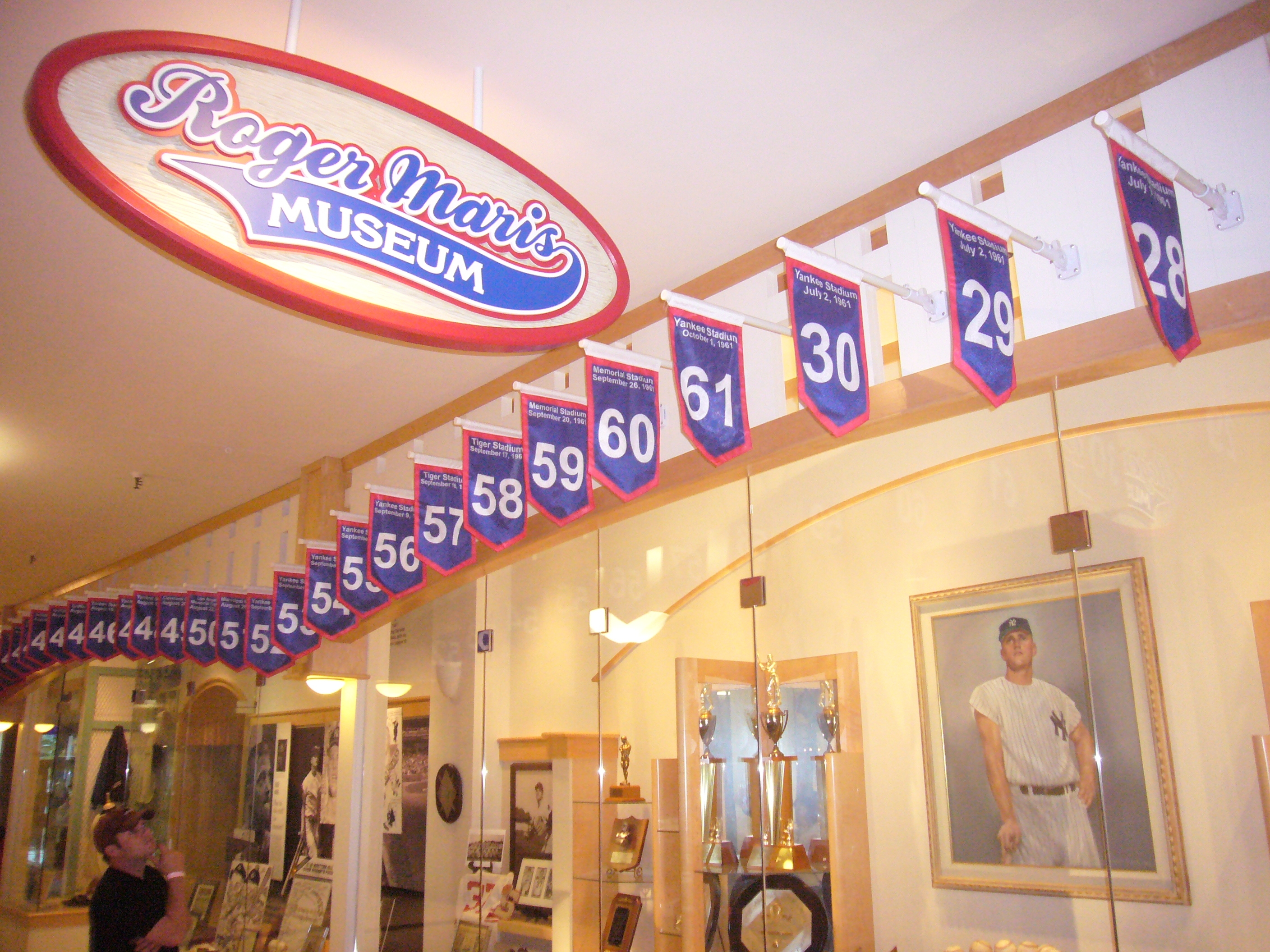
The Roger Maris Museum
Sixty-one home runs in a single season, and the man who hit them wanted nothing for it. When Fargo American Legion members Robert Smith and James McLaughlin approached Roger Maris about building a museum in his honor, the slugger's first answer was no. His second answer came with conditions: the museum had to be free, open to everyone, and displayed in a public space. No ticket booth, no velvet ropes, no capitalizing on what a bat and a ball had given him. Maris personally chose the location -- West Acres Shopping Center in his adopted hometown of Fargo, North Dakota -- and on June 23, 1984, the Roger Maris Museum opened inside the mall's southeast wing. It remains there today: a 70-foot glass display case that shoppers stumble upon between department stores, a shrine to baseball's most reluctant hero.
A Kid from the Northern Plains
Roger Eugene Maris was born in Hibbing, Minnesota, on September 10, 1934, but Fargo claimed him. His family moved to North Dakota when he was twelve, and he grew up playing ball at Shanley High School, where he and his brother Rudy starred as outfielders on Fargo's American Legion team. The northern plains shaped the quiet, no-nonsense demeanor that would later baffle New York sportswriters expecting flash and charisma. Maris never gave them what they wanted. He gave them something better: two consecutive American League MVP awards, in 1960 and 1961, and a Gold Glove in 1960. But it was that single autumn -- October 1, 1961, fourth inning, Yankee Stadium, a pitch from Boston's Tracy Stallard -- that fixed his name in history. Home run number 61 broke Babe Ruth's single-season record. The crowd of 23,154 watched the ball sail into the right field bleachers, where a fan named Sal Durante caught it and kept it.
The Weight of an Asterisk
The record should have been a coronation. Instead, it became a controversy. Commissioner Ford Frick, a former ghostwriter for Babe Ruth, declared that because the 1961 season was 162 games long rather than Ruth's 154, Maris's record would carry a distinctive notation -- popularly understood as an asterisk. The ruling haunted Maris. The stress of the chase was so intense his hair fell out in clumps during the season. New York's press corps, many of whom preferred his charismatic teammate Mickey Mantle, treated Maris with open skepticism. He endured it with the same stoic determination he brought to right field. The so-called asterisk was removed in 1991 by Commissioner Fay Vincent, six years after Maris died of lymphoma on December 14, 1985, at age 51. He was buried at Holy Cross Cemetery in Fargo, back on the northern plains where nobody needed him to be anything other than himself.
Yankee Stadium Seats in a Shopping Mall
The museum is an exercise in compressed grandeur. Within its 70 feet of glass, visitors find actual seats salvaged from the original Yankee Stadium, a replica of Maris's 1961 locker, his game-worn uniforms, both MVP award plaques, Sultan of Swat Crowns, home run baseballs, and memorabilia spanning from his American Legion days to his final years. A small theater screens documentary footage of the 1961 season. The setting is deliberately unpretentious -- fluorescent mall lighting, the murmur of shoppers, kids pressing their faces to the glass. That juxtaposition is the point. Maris did not want a monument on a hilltop. He wanted ordinary people to walk past his story on their way to buy shoes. The museum was remodeled in 2003 during a broader West Acres renovation, but its essential character remained unchanged: accessible, unhurried, free.
The Night the Trophies Vanished
At approximately 2:15 a.m. on July 26, 2016, burglars broke into the museum and stole irreplaceable artifacts, including Maris's 1960 American League MVP Award plaque and the Hickok Belt he received as 1961's top professional athlete. The thieves transported the awards to Pennsylvania, where they were melted down and sold as raw precious metal -- gold and silver reduced to anonymous weight on a scale. The crime went unsolved for seven years. In June 2023, nine suspects were arrested and charged. Three members of the burglary ring were convicted in February 2025, while five others pleaded guilty. The melted awards can never be recovered, but replicas now stand in their place, and the museum endures. The theft, perversely, underscored what Maris always understood: the value of these objects was never monetary. It was the story they carried.
From the Air
Located at 46.86N, 96.84W in West Acres Shopping Center on the south side of Fargo, North Dakota. The nearest airport is Hector International Airport (KFAR), approximately 5 miles northwest of the museum. Fargo sits on the western bank of the Red River of the North, which forms the Minnesota-North Dakota border; the river and its agricultural floodplain are visible landmarks. The flat Red River Valley terrain means the city grid is clearly visible from altitude. Best viewed from 3,000-5,000 feet on approach to KFAR. Moorhead, Minnesota lies directly across the river to the east.