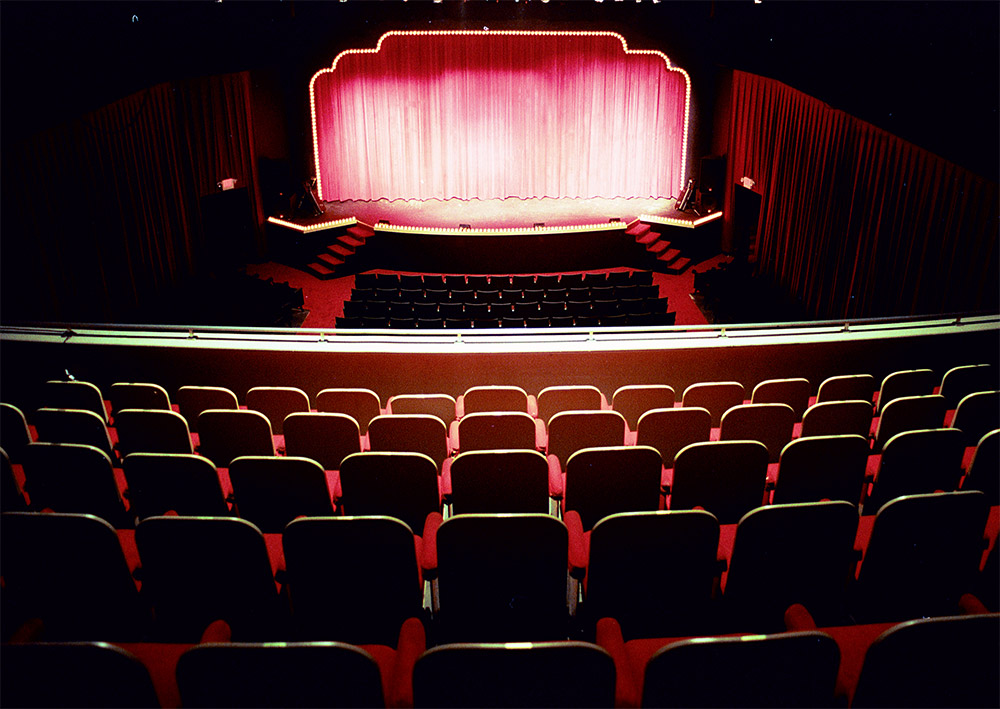
The Savannah Theatre
At 5:30 in the evening on December 4, 1818, the curtain rose on a production of "The Soldier's Daughter" and the Savannah Theatre entered American history. The building on Bull Street at Chippewa Square was designed by the same young English architect, William Jay, who had given Savannah the Telfair mansion and the Owens-Thomas House. But where those buildings would age gracefully behind their stucco facades, the theatre would be torn apart and rebuilt so many times that almost nothing of Jay's original structure survives. A hurricane ripped sections of its roof off in 1898. Fires gutted it in 1906 and again in 1948. Each time, Savannah rebuilt. The current building wears an Art Deco skin that dates from that last reconstruction -- a far cry from Jay's Regency elegance, but no less alive. It is one of the oldest continually operating theatres in the United States, and it has never stopped finding an audience.
The Stage That Hosted History
The Savannah Theatre's early decades placed it at the intersection of entertainment and politics. During the 1850s and 1860s, the building was sometimes known as the Athenaeum. On March 21, 1861, Alexander H. Stephens delivered the Cornerstone Speech from its stage, an address that would become one of the most infamous orations in American history. But the theatre was built for performance, and its roster of 19th-century talent was staggering. Sarah Bernhardt performed there. So did W. C. Fields, Tyrone Power, and Lillian Russell. In February 1876, Edwin Booth -- the most celebrated Shakespearean actor of his age and older brother of John Wilkes Booth -- played several engagements, taking on Hamlet, Iago, and King Lear. Whether Edwin's notorious younger brother ever trod the same boards remains unknown.
Barracks, Baseball, and a Failed Troupe
Not every chapter in the theatre's story involves applause. In 1832, during the sickly season, troops from Cantonment Oglethorpe relocated into the city, and enlisted men of Company E, Second Regiment of Artillery, were billeted inside the Savannah Theatre itself while officers stayed in nearby homes. The City Council allowed the soldiers to temporarily fence the space between the theatre and the grounds of the neighboring Chatham Academy. Two decades later, the New York Dramatic Company leased the theatre briefly, bringing a young Joseph Jefferson -- whose most famous role would be Washington Irving's Rip Van Winkle -- to Savannah audiences. But the company's "lineup of standard hits failed to tempt Savannah audiences," and the engagement flopped. The theatre's most improbable guest arrived in November 1911, when baseball player Ty Cobb appeared in a production of "The College Widow."
Hurricanes, Fires, and Reinvention
The Savannah Theatre has been destroyed and rebuilt with a persistence that borders on stubbornness. The first blow came on August 31, 1898, when a hurricane tore sections of the roof off the building and flooded the auditorium. The structure was repaired, only to be gutted by fire in 1906. That reconstruction produced a new brick facade with cast terra cotta panels and filled in many of the original windows. When fire struck again in 1948, the building emerged in its current form: a sleek Art Deco exterior that bears no visible trace of William Jay's Regency design. The 1948 rebuild was a statement that Savannah valued the institution more than the architecture -- that the life of a theatre lives in its programming, not its walls. It is a philosophy the building continues to prove.
Still Playing Tonight
Since 2002, when the music revue "Lost in the '50s" launched a new era of regular live performance, the Savannah Theatre has operated as a venue for variety shows and musical productions. The building sits on Chippewa Square along Bull Street, one of the five "Crown Jewel" squares that form the ceremonial spine of Savannah's Historic District. From the sidewalk, its Art Deco marquee announces the evening's show in a neighborhood where 19th-century townhouses and iron balconies set the visual tone. The contrast is part of the theatre's charm: it is the one building on the square that wears its scars openly, each architectural layer a record of survival. Over two centuries, the Savannah Theatre has been a playhouse, a barracks, a lecture hall, and a movie palace. What it has never been, for more than a few months at a time, is dark.
From the Air
Coordinates: 32.076N, 81.092W. The Savannah Theatre is located on Bull Street at Chippewa Square, one of the central squares in Savannah's Historic District grid. From the air, Bull Street runs north-south through the heart of the square system; Chippewa is the middle of the five Crown Jewel squares. The Art Deco building is distinctive among the surrounding 19th-century architecture. Nearest airport: Savannah/Hilton Head International (KSAV), approximately 8 nm northwest. Hunter Army Airfield (KSVN) is about 5 nm south. Best viewed at 1,500-3,000 feet AGL.