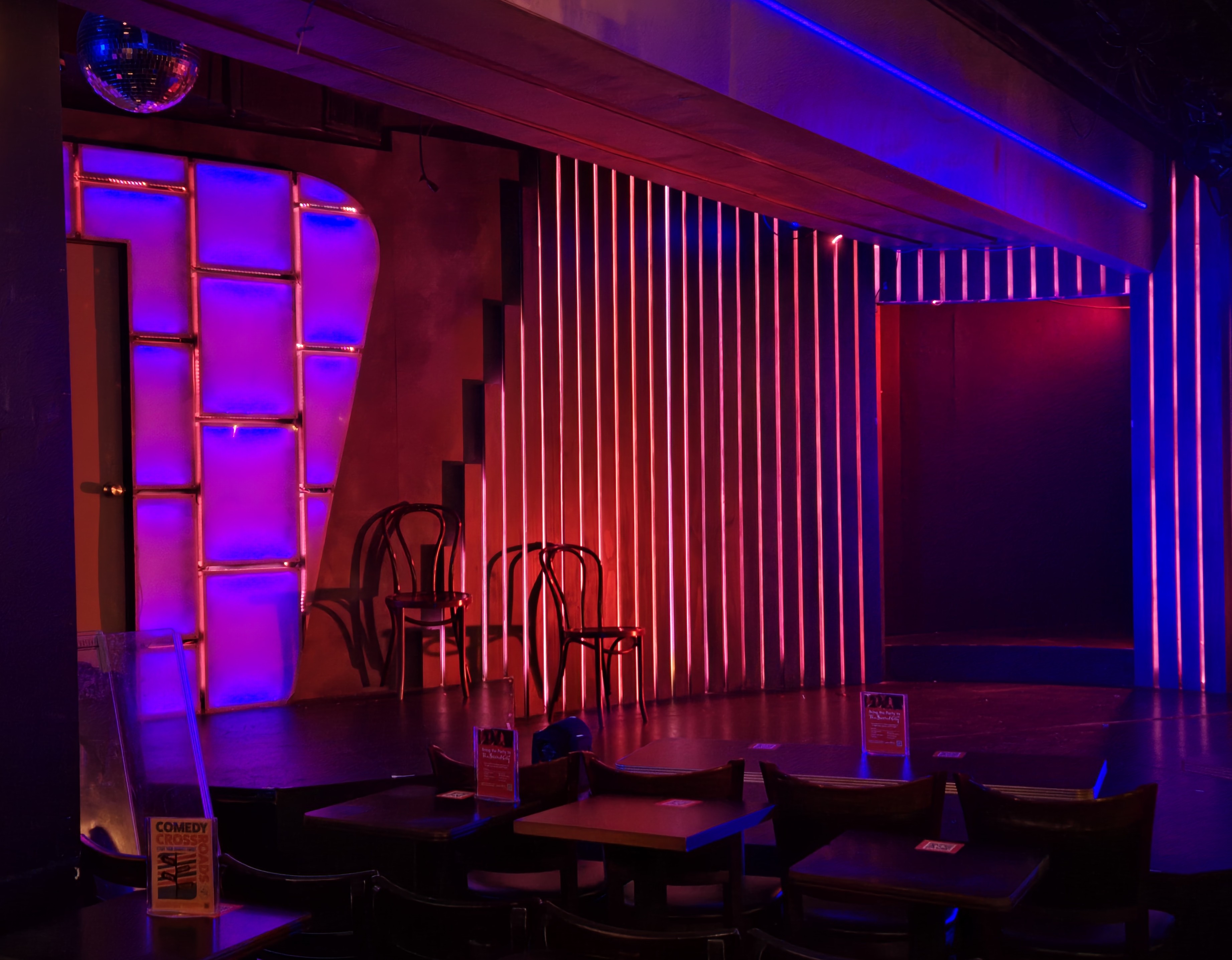
The Second City
Admission was $1.50, and the founders were flipping burgers in the kitchen. On December 16, 1959, The Second City opened its first revue at 1842 North Wells Street in Chicago, with Barbara Harris singing 'Everybody's in the Know' to a small audience that had no idea they were witnessing the birth of an institution. The name was borrowed from a mocking series about Chicago by New Yorker writer A. J. Liebling, turned into a badge of defiant humor. From that improvised beginning on the Near North Side, The Second City became the single most important incubator of American comedy talent in the twentieth century, a factory of fearlessness where performers learned to build scenes from nothing and trust the audience to keep up.
The Compass Points the Way
The roots of The Second City reach back to the summer of 1955, when University of Chicago students David Shepherd and Paul Sills began performing improvisational theater at The Compass bar in Hyde Park. They called themselves the Compass Players and based their work on 'theater games' developed by Viola Spolin, who happened to be Sills's mother. Spolin had been devising exercises for actors since the 1940s, techniques that asked performers to build scenes spontaneously, without scripts. The Compass Players tested these ideas on audiences, moved to occasional shows on the Near North Side, and eventually dissolved. But Sills carried the method forward. In 1959, he joined with Bernard Sahlins and Howard Alk to found The Second City, a cabaret-style theater where satire, audience suggestion, and razor-sharp social commentary replaced the scripted revue. By 1961, the company had sent a cast to Broadway, earning Tony Award nominations for Severn Darden and Barbara Harris.
The Assembly Line of Laughter
The list of performers who passed through The Second City's doors reads like a history of American and Canadian comedy itself: Joan Rivers, Alan Arkin, Harold Ramis, Bill Murray, Gilda Radner, John Candy, John Belushi, Dan Aykroyd, Eugene Levy, Catherine O'Hara, Chris Farley, Mike Myers, Tina Fey, Amy Poehler, Stephen Colbert, Steve Carell, Jordan Peele, Keegan-Michael Key, Jason Sudeikis, and dozens more. These performers did not simply pass through; the theater shaped how they thought about comedy. The Second City's method - building scenes from scratch through improvisation, listening to scene partners, finding the game in every moment - became the foundation of sketch comedy, late-night television, and comedic filmmaking for decades. Saturday Night Live's cast has drawn so heavily from Second City alumni that the pipeline from Wells Street to Studio 8H in Rockefeller Center became an unwritten career path in American entertainment.
SCTV and the Small Screen
In 1976, the Toronto troupe of The Second City spawned its own television show: Second City Television, known as SCTV. The series ran for eight years and became a landmark of sketch comedy, built around the fictional television station of Melonville. Joe Flaherty played the station's greedy owner, Guy Caballero, who sat in a wheelchair 'only for respect.' John Candy became the bloated variety star Johnny La Rue. Andrea Martin donned leopard-skin as station manager Edith Prickley. Catherine O'Hara played the narcissistic Lola Heatherton. Martin Short debuted his Ed Grimley character on the show before bringing it to Saturday Night Live. SCTV won Emmy Awards and earned a devoted following that persists decades after its final episode. It proved that The Second City's improvisational instincts could translate beyond the stage, influencing a generation of comedy writers and performers who went on to shape film and television.
The Training Ground
In the mid-1980s, The Second City formalized what had always been its informal strength: teaching. The Second City Training Center grew into one of the largest comedy education programs in the world, with locations in Chicago, Toronto, and Los Angeles. The Chicago center alone enrolls over 5,000 students in disciplines ranging from improvisation to comedy writing. Under the mentorship of instructors like Martin de Maat and Sheldon Patinkin, the Training Center became a destination for aspiring performers. Steve Carell, Tina Fey, Amy Poehler, Chris Farley, and Halle Berry all studied there. In 2016, the program expanded to include the Harold Ramis Film School, dedicated to comedy in filmmaking and named for one of the theater's most celebrated alumni. In 2007, a Comedy Studies collaboration with Columbia College Chicago offered students a full academic immersion in the art and craft of making people laugh.
Wells Street and Beyond
The Second City moved a few blocks south to 1616 North Wells Street in 1967, and the venue became a pilgrimage site for comedy fans. A touring company was created that same year, initially featuring Harold Ramis and Joe Flaherty, which eventually led to the establishment of the theater's second stage, the e.t.c., in 1982. The company has been honored with thirty-seven Joseph Jefferson Awards in Chicago and ten Canadian Comedy Awards in Toronto. In December 2009, the fiftieth anniversary celebration brought together alumni from across the decades: an SCTV reunion show, panels, and performances that stretched across a weekend. The theater has weathered leadership changes, cultural reckonings, and a 2021 sale to the private equity firm ZMC. Through it all, the fundamental proposition has endured: walk onto a bare stage, ask the audience for a suggestion, and build something from nothing. That willingness to risk failure in real time, night after night, is what made The Second City the most influential comedy institution in the English-speaking world.
From the Air
Located at 41.912°N, 87.635°W on North Wells Street in Chicago's Old Town neighborhood, on the Near North Side. The theater is a small venue not distinguishable from high altitude, but Wells Street runs parallel to the lakefront and is identifiable as part of the dense urban grid north of the Chicago River. The neighborhood sits between Lincoln Park to the north and the Loop to the south. Nearby airports include Chicago O'Hare International (KORD, 13 nm northwest) and Chicago Midway International (KMDW, 10 nm southwest). Best viewed at lower altitudes in clear conditions.