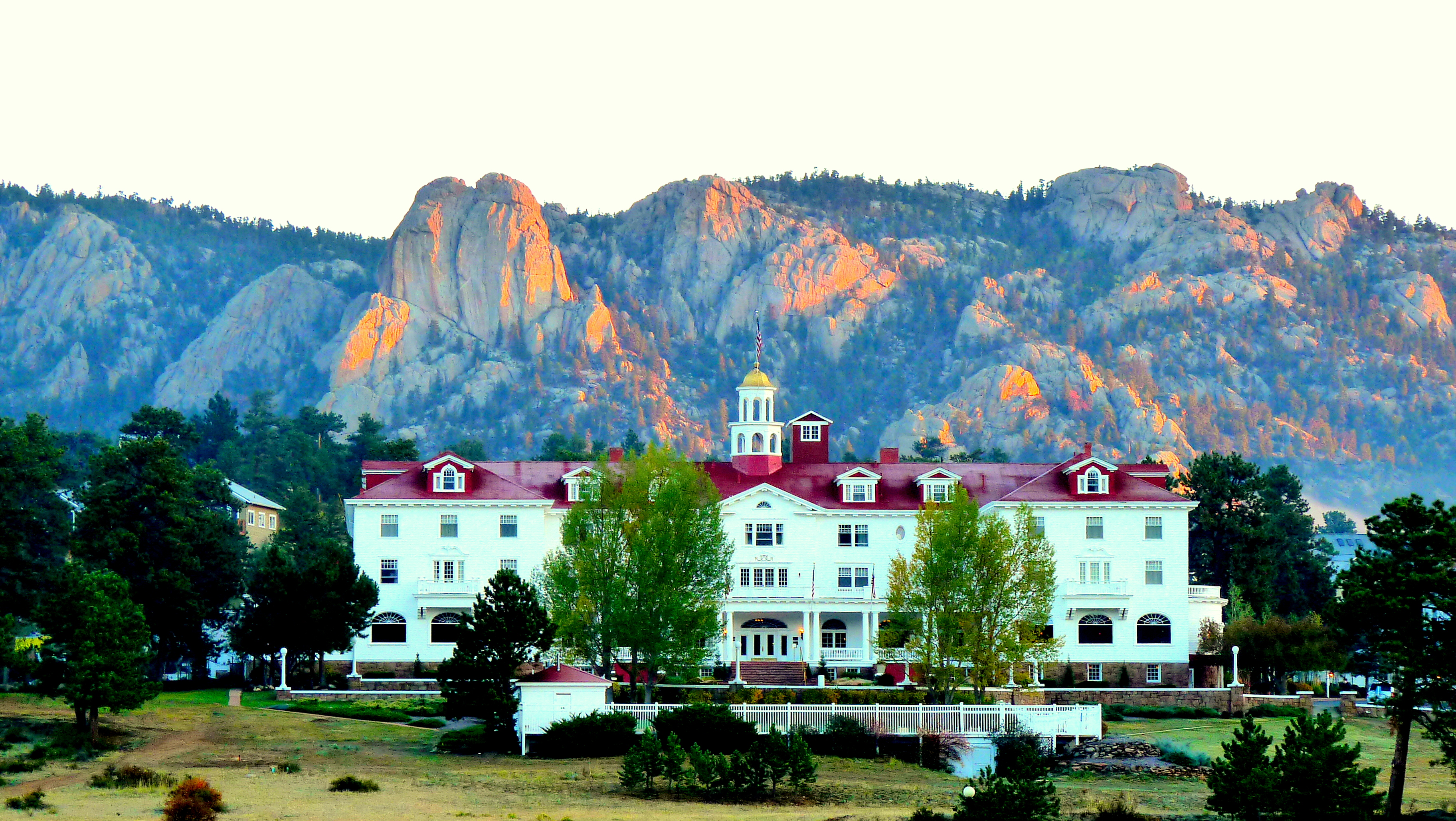
The Stanley Hotel
Stephen King checked into the Stanley Hotel on a night in 1974 when every other guest was checking out. The hotel was closing for winter, and King found himself wandering empty corridors, drinking alone at a bar tended by a man named Grady. That night he dreamed of his three-year-old son running through those hallways, eyes wide, screaming, chased by a fire hose. By the time his cigarette burned down, the bones of The Shining had formed in his mind. But the hotel's story begins sixty-five years earlier, with another man seeking something in these mountains: not horror, but a cure.
The Lunger's Cure
In 1903, steam-powered car inventor Freelan Oscar Stanley was dying of tuberculosis. Doctors prescribed the standard treatment of the era: fresh mountain air, sunlight, and hearty food. Stanley and his wife Flora traveled to Denver in March, then followed Dr. Sherman Grant Bonney's recommendation to Estes Park for the summer. His health improved so dramatically that Stanley decided to stay, and then to build. The Stanley Hotel opened on July 4, 1909, designed not just as a luxury resort but as an optimal environment for pulmonary health. The Fort Collins Weekly Courier reported that Estes Park had long been a place for doctors to send patients who needed "the keen air and the considerable altitude," but lacked suitable accommodations. Stanley would provide them.
New England in the Rockies
The Georgian Revival hotel stands in sharp contrast to the rustic lodges that defined mountain architecture before and after its construction. Its two-stage octagonal cupola, Palladian windows, fanlights, and paired Tuscan columns evoke Boston and Newton, Massachusetts, where Stanley had lived. Originally painted yellow ocher with white trim, the 140-room hotel was one of the first in the country to be fully electrified. Stanley built the Fall River Hydroplant specifically to power his creation, bringing electricity to Estes Park for the first time. Every room had a telephone. Pairs of rooms shared en suite bathrooms with running water from Black Canyon Creek. The lumber came from Bierstadt Lake and Hidden Valley in what would become Rocky Mountain National Park; the granite was quarried locally near the Big Thompson River.
Designed to Breathe
The hotel was never officially a sanitarium, but Dr. Bonney's principles shaped every aspect of its design. With no central heating or ventilation, the structure relied on natural airflow: a Palladian window at the top of the grand staircase could be opened to create cross-breezes, French doors in all public spaces led to verandas, and two curving staircases prevented stagnant air in guest corridors. The building provided the ample porches, southern exposure, and appetizing food that Bonney recommended for tuberculosis patients. Stanley himself was photographed for Bonney's medical textbook Pulmonary Tuberculosis, and is acknowledged in its preface for his assistance with photographic illustrations.
Rooms and Ghosts
The hotel that inspired The Shining now embraces its haunted reputation. Room 217, where King allegedly stayed, is now the Stephen King Suite. In 2015, management built a hedge maze in front of the hotel honoring Stanley Kubrick's film adaptation, though ironically King's novel featured topiary animals instead. The hotel hosts ghost tours and has appeared on Ghost Hunters and Ghost Adventures. A 1997 miniseries of The Shining, produced by King himself, was actually filmed here, unlike Kubrick's version. Emperor Akihito of Japan stayed in 1994. Jim Carrey and Jeff Daniels filmed Dumb and Dumber here that same year. The concert hall, built as a gift for Flora Stanley, once featured a bowling alley and resembles Boston Symphony Hall.
The Frozen Dead Guy
In August 2023, the Stanley added perhaps its strangest attraction yet. Bredo Morstol, Colorado's famous cryogenically frozen man and inspiration for the annual Frozen Dead Guy Days festival, was relocated from a shed in Nederland to the Stanley's ice house. The Alcor Life Extension Foundation assisted with setting up a new cryonic chamber, and the hotel christened the facility the International Cryonics Museum. Visitors can now tour both the corridors that haunted Stephen King's dreams and the frozen remains of a Norwegian grandfather who refused to stay dead. In May 2025, the century-old hotel was acquired for $400 million by a public-private partnership, ensuring that Stanley's creation will continue welcoming guests seeking something in these mountains, whether that something is health, horror, or simple wonder.
From the Air
Located at 40.383N, 105.519W in Estes Park at approximately 7,500 feet elevation, directly visible when approaching Rocky Mountain National Park from the east. The white Georgian Revival structure stands out against the mountain backdrop. Lake Estes is immediately visible to the south. Nearest airports: KFNL (Fort Collins-Loveland Municipal, 25nm southeast), KBJC (Rocky Mountain Metropolitan, 35nm south), KDEN (Denver International, 55nm southeast). Longs Peak (14,259 feet) dominates the western skyline.