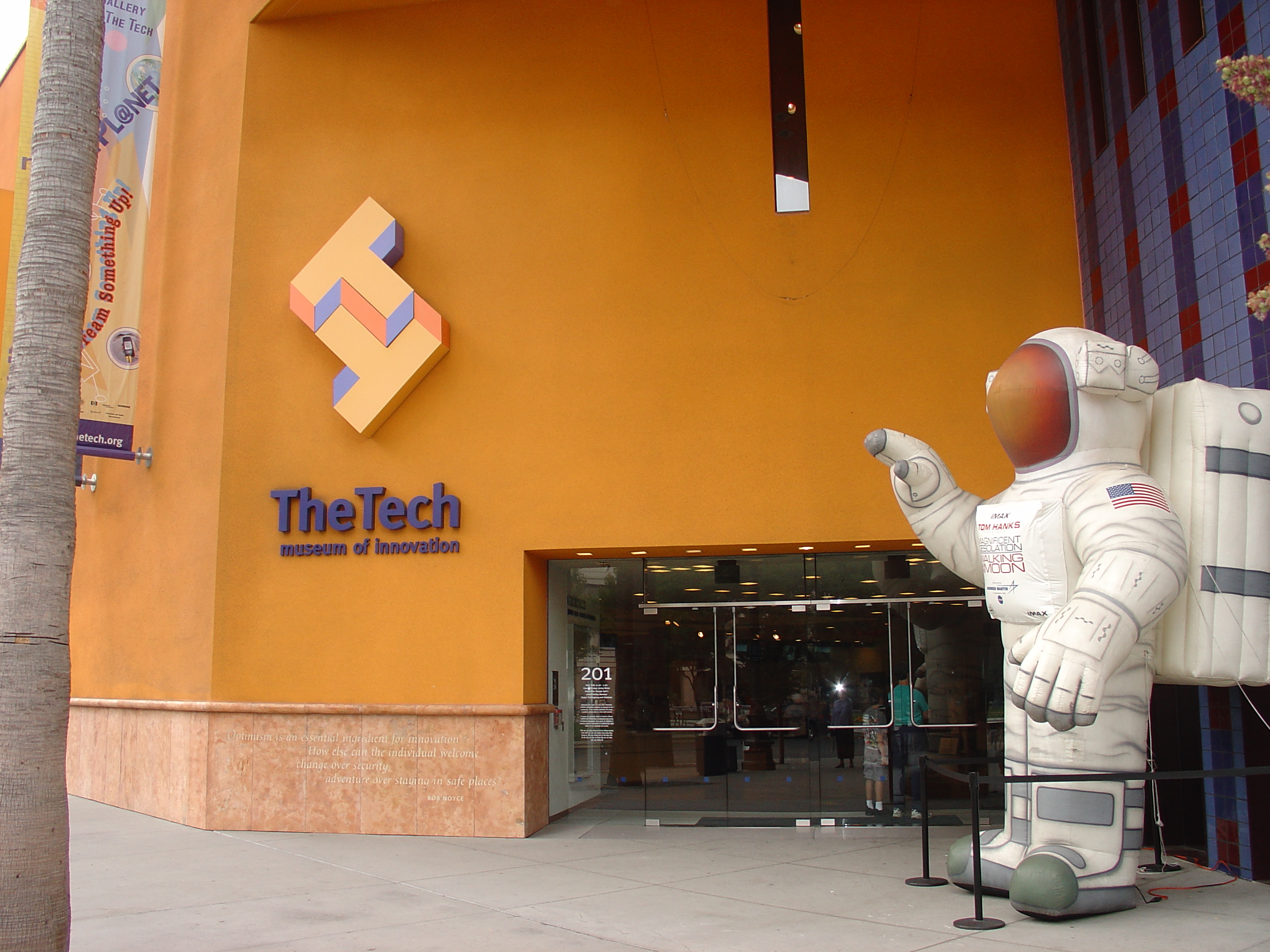
The Tech Interactive
The building glows like a ripe mango against San Jose's downtown skyline. Designed by the celebrated Mexican architect Ricardo Legorreta, The Tech Interactive announces itself in bold geometry and saturated color -- a deliberate counterpoint to the glass-and-steel campuses that line the valley just north of here. Inside, a 45-foot cylindrical tower houses a multi-story sculpture called Origin, tracing the tangled roots that connect art, technology, and the natural world. It is a fitting centerpiece for a place that has spent decades arguing, through hands-on experience, that science belongs to everyone.
From Junior League Dream to Silicon Valley Landmark
The Tech's origin story begins not in a venture capitalist's office but at a 1978 Junior League meeting in Palo Alto. Members envisioned a technology center that could make the innovations happening behind closed doors in the valley accessible to the public. The City of San Jose promised funding in the 1980s for what was then called the Technology Center of Silicon Valley, but progress crawled. It took two decades of planning, fundraising, and civic wrangling before the museum finally opened in 1998, anchoring the south end of the Plaza de Cesar Chavez with five inaugural galleries covering everything from genetics to global communications. In 2019, the organization rebranded as The Tech Interactive and partnered with Discovery Education, signaling a shift from passive exhibits toward active problem-solving.
Where Kids Build What Engineers Only Imagine
Walk through the lower level and you will find children crouched over circuit boards, wiring sensors into homemade robots. Nearby, the Body Motion exhibit tracks visitors' movements to reveal how physical activity shapes emotional health. Upstairs, Body Worlds Decoded pairs plastinated human specimens with augmented reality overlays, letting visitors peer inside their own anatomy without a scalpel. The Biodesign Studio invites guests to tinker with synthetic biology. None of this is behind glass. The Tech's philosophy is tactile -- if you cannot touch it, press it, or accidentally break it, it probably belongs in a different museum. Since 1988, the annual Tech Challenge has sent teams of fourth-through-twelfth graders home with sore hands and sharper minds after building hovercrafts, earthquake-resistant structures, and water delivery devices from scratch.
The Oscars of Silicon Valley
For years, the museum hosted The Tech Awards, a ceremony that earned the nickname 'the Oscars of Silicon Valley.' Rather than celebrating the latest app or acquisition, the awards honored people who used technology to improve the human condition -- innovations in vaccine delivery, solutions to homelessness, tools to combat wildlife poaching. In 2016, the program evolved into Tech for Global Good, a year-round initiative that weaves laureate stories into classroom lesson plans and museum exhibits. Each year focuses on a single theme, from healthcare to data ethics, turning abstract global problems into tangible challenges that students can wrestle with. The message is pointed: the valley's most important product is not software. It is the next generation of problem-solvers.
Teaching the Teachers
The Tech Academies program, launched in 2014 in partnership with San Jose State University's College of Science, tackles a problem that no exhibit can solve alone: the shortage of confident STEM educators. Through a two-year fellowship, teachers learn to integrate engineering and computer science into their existing curricula, with a particular focus on reaching students underrepresented in technical fields. The program has earned recognition from the American Alliance of Museums and the California Association of Museums. Field trip scholarships extend the museum's reach to under-resourced schools, ensuring that a student's zip code does not determine whether she ever holds a soldering iron. During the COVID-19 pandemic, when the physical doors closed in March 2020, the museum pivoted to bilingual online resources -- The Tech Interactive at Home and The Tech Interactive en Casa -- so that learning did not stop when visits did.
Color Against the Gray
Standing at the corner of South Market and Park, the building's mango walls catch the late-afternoon sun and throw warm light across the plaza. George Rhoads' rolling ball sculpture, Science on a Roll, clicks and spirals near the entrance, drawing crowds who stop to watch steel spheres navigate an elaborate track -- a mechanical meditation on cause and effect. In a region where billion-dollar companies rise and collapse within a product cycle, The Tech Interactive has endured for more than a quarter century by betting on something unfashionable: patience. Building a robot takes longer than downloading an app. Understanding your own body takes longer than a TikTok. The museum's gamble is that if you give people time, tools, and permission to fail, curiosity does the rest.
From the Air
Located at 37.3316N, 121.89W in downtown San Jose, adjacent to Plaza de Cesar Chavez. The distinctive mango-and-azure building is visible from lower altitudes. Nearest airport: San Jose International (KSJC), approximately 3 nm northwest. Reid-Hillview Airport (KRHV) lies 5 nm east. Best viewed at 2,000-3,000 ft AGL for context among downtown San Jose's grid of streets and parks.