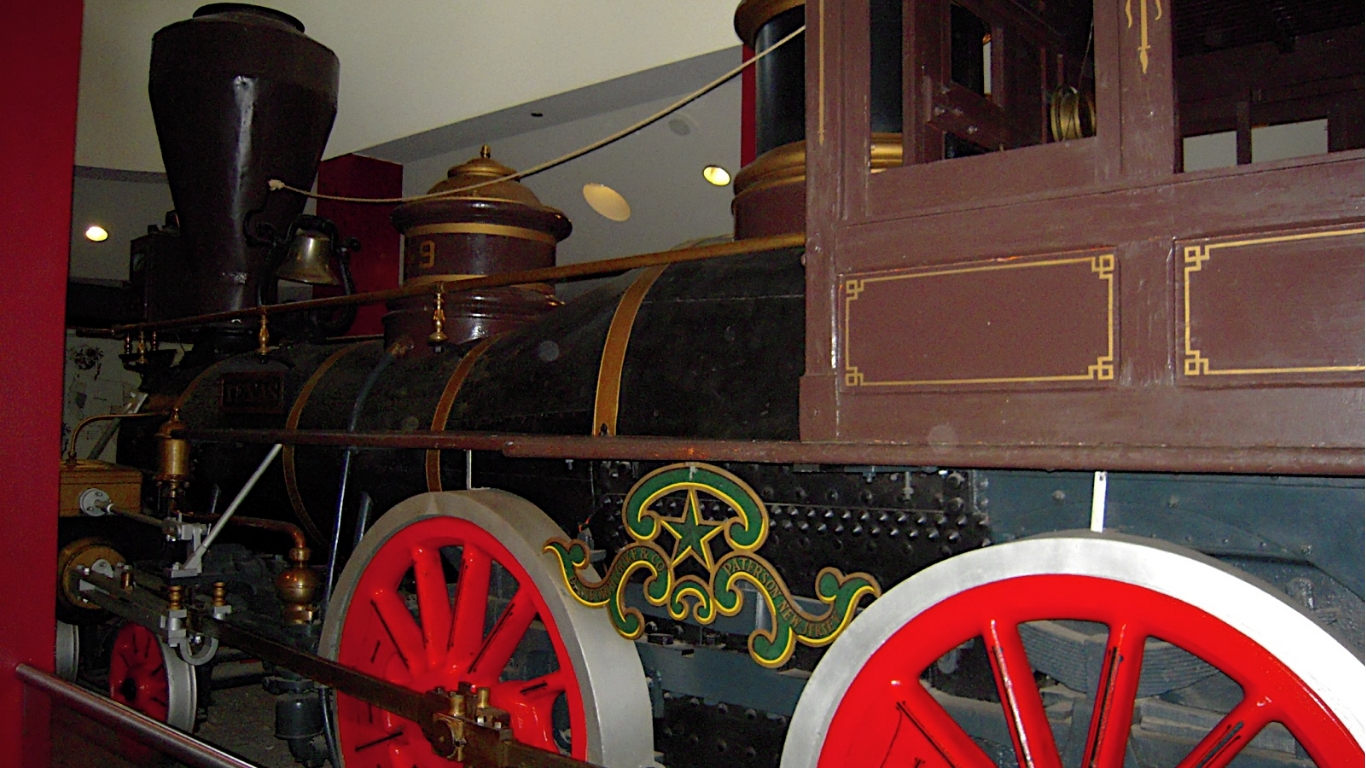
The Texas (Locomotive)
On the morning of April 12, 1862, engineer Peter Bracken was hauling 21 freight cars southbound from Dalton when the order came: drop everything and give chase. Union spies had stolen the General, and they were tearing up track and burning bridges in a brazen attempt to sever the Western & Atlantic Railroad -- the Confederacy's vital supply artery between Atlanta and Chattanooga. Bracken jettisoned his freight cars and threw the Texas into reverse, steaming backward at full speed into one of the Civil War's most improbable episodes. The 51-mile pursuit that followed would make both locomotives famous. But while the General got the Hollywood treatment, the Texas spent the next century and a half fighting a quieter battle -- for its own survival.
Born in Paterson, Forged in Georgia
The Texas rolled out of the Danforth, Cooke and Company works in Paterson, New Jersey, in October 1856. It was a 4-4-0 -- the "American" type locomotive that had become the workhorse of railroads across the expanding nation. Shipped by sea to the Port of Savannah, then ferried overland via connecting railroads, the engine arrived at the Western & Atlantic Railroad's headquarters in Atlanta as unit number 49. For the next five years, the Texas hauled freight and passengers along the 138-mile main line between Atlanta and Chattanooga, Tennessee, a corridor that would soon become one of the most strategically contested stretches of railroad in the war. Nothing about those early runs hinted at the drama ahead.
Fifty-One Miles in Reverse
The Great Locomotive Chase began when James J. Andrews and a band of Union soldiers disguised as civilians boarded a northbound train at Marietta, Georgia. When the crew stepped off for breakfast at Big Shanty, the raiders uncoupled the General and roared north, cutting telegraph wires and pulling up rails as they went. Conductor William Allen Fuller, who had been eating in the station, gave chase -- first on foot, then by handcar, then aboard the Texas, which he commandeered on the tracks near Adairsville. What followed was a running duel played out over 51 miles of single-track railroad. The Texas, running backward with its tender leading, closed the gap as the raiders ran low on fuel and options. Two miles north of Ringgold, Georgia, Andrews and his men abandoned the General and scattered into the woods. Bracken calmly towed the captured locomotive back to Adairsville, collected his original 12 freight cars, and steamed into Atlanta -- well behind schedule, but with good reason.
Captured, Forgotten, Nearly Lost
The chase occupied barely a few hours of the Texas's half-century career, but the years that followed were far harder on the engine. Loaned to the East Tennessee & Virginia Railroad in 1863 to haul salt from Saltville, Virginia, the Texas was captured by the U.S. Military Railroad. After the war, it returned to the W&A and ground out decades of unglamorous service. By 1903, it was pulling freight on a branch line serving a corn mill in Emerson, Georgia. It was retired in 1907 and shunted to a rail yard in Atlanta, rusting on a siding. An article in the Atlanta Constitution that August sounded the alarm about the engine's deteriorating state, but neither the railroad nor the state moved to protect it. A grassroots coalition -- the United Daughters of the Confederacy, the Inman Park Students' Club, and the Atlanta Woman's Club -- finally secured the locomotive for the city. On February 17, 1908, the Nashville, Chattanooga and St. Louis Railway formally donated the Texas to the 'Ladies of Atlanta.'
A Long Vigil in the Cyclorama's Basement
Even after the donation, the Texas sat exposed to Georgia weather in Grant Park for years. Artist and historian Wilbur G. Kurtz campaigned relentlessly in the pages of the Atlanta Constitution, and in 1927 the locomotive was finally moved into the basement of the newly built Cyclorama building, home to the massive panoramic painting of the Battle of Atlanta. There it sat, unrestored, for nearly a decade before Kurtz himself oversaw a cosmetic restoration in 1936 that gave the engine an approximation of its wartime appearance -- balloon smokestack, strap-iron cowcatcher, boiler nameplates. The basement was cramped and dim, making the engine hard to view, and proposals to relocate it to Atlanta Union Station, Underground Atlanta, and Stone Mountain Park all went nowhere. The Cyclorama building was renovated in 1979-1982, finally giving the Texas a proper display space, but the locomotive remained in the same building it had entered more than half a century earlier.
A New Identity at the Atlanta History Center
In 2014, Atlanta announced the entire Cyclorama collection -- painting, locomotive, and artifacts -- would move to the Atlanta History Center in Buckhead. The Texas was pulled from the building in December 2015, its first time outside those walls since 1927. Steam Operations Corporation, the same firm that had restored the legendary Norfolk and Western no. 611, gave the engine a full cosmetic overhaul at the North Carolina Transportation Museum. But the restored Texas that emerged in April 2017 surprised people. Instead of the Civil War-era balloon stack, it wore an 1880s diamond smokestack and bore its 1870s number, 12. The choice was deliberate: as Atlanta History Center curator Gordon Jones put it, the Texas served for fifty years -- the Great Locomotive Chase occupied only a few hours. The General already tells that story. The Texas now tells a different one. The engine arrived at the Atlanta History Center on May 5, 2017, and its railroad exhibit opened on November 17, 2018 -- 162 years after the locomotive first rolled out of Paterson.
From the Air
Located at 33.84N, 84.39W at the Atlanta History Center in the Buckhead neighborhood of Atlanta. Nearest airports: DeKalb-Peachtree Airport (KPDK) approximately 7nm east, Fulton County Airport-Brown Field (KFTY) approximately 6nm west, Atlanta Hartsfield-Jackson International (KATL) approximately 14nm south. The original Great Locomotive Chase route ran along the Western & Atlantic Railroad corridor from Marietta through Kennesaw, Adairsville, and up to Ringgold near the Tennessee border -- visible as the CSX rail line from moderate altitude. The Cyclorama's former home in Grant Park is about 6nm southeast. Best viewed at 2,000-3,000 feet AGL.