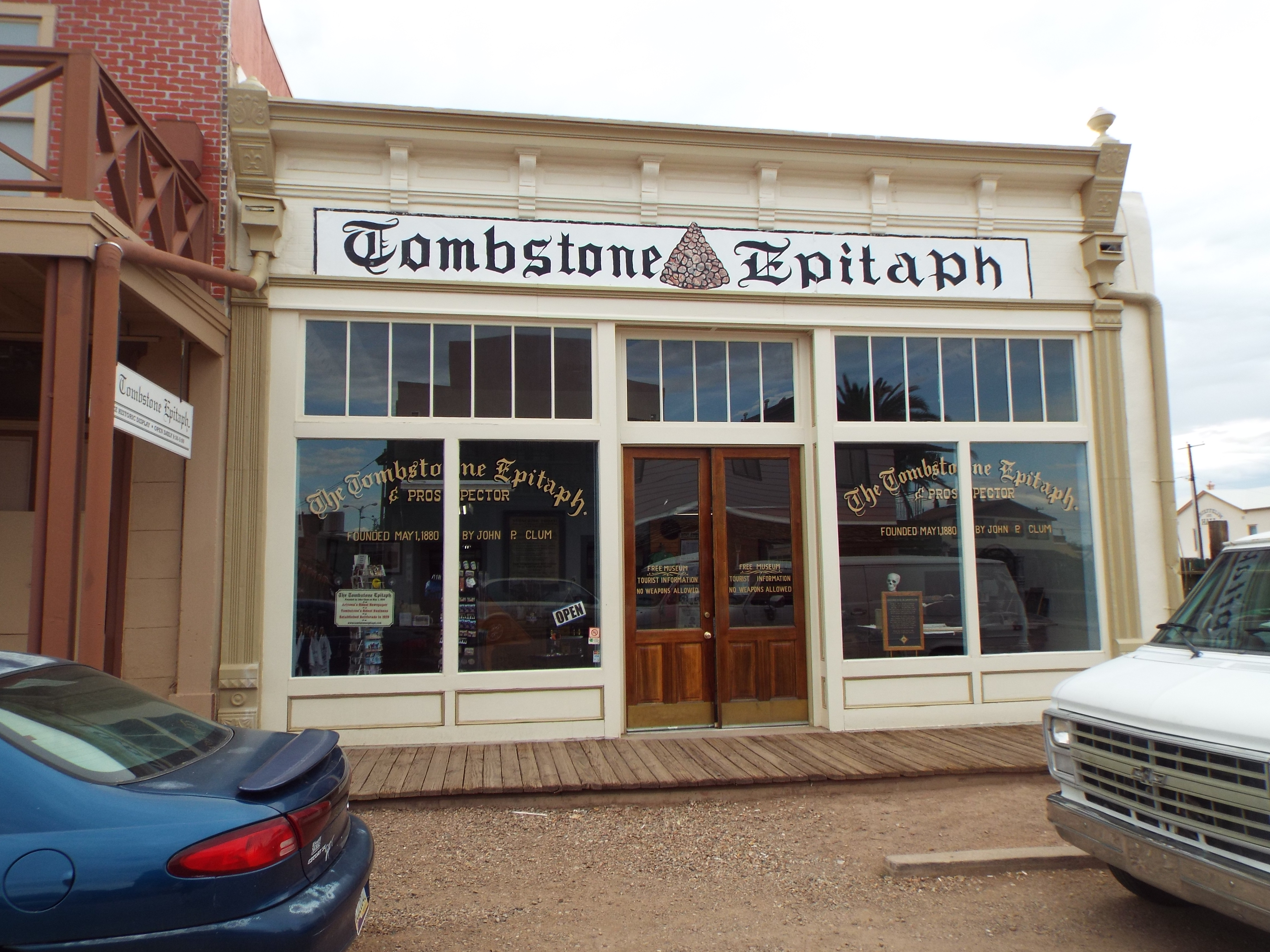
The Tombstone Epitaph
His friends teased him mercilessly. Moving to a town called Tombstone to start a newspaper? They said he would write an epitaph, not a newspaper. John Philip Clum took the joke and ran with it, launching The Tombstone Epitaph in May 1880. That sardonic name would become legendary, for the newspaper would chronicle one of the bloodiest chapters in frontier history and outlast the very boomtown that gave it birth. Today it stands as Arizona's oldest continuously published newspaper, a survivor of silver busts, changing technologies, and 146 years of American history.
The Frontiersman's Quill
John Clum was no ordinary newspaper publisher. Before arriving in Tombstone, he had served as the U.S. government agent at San Carlos Apache Reservation, where he accomplished something no military commander ever managed: capturing Geronimo. The legendary Apache leader was later released and would not finally surrender to the U.S. Army until 1886, but Clum remained the only civilian authority to bring him in. When Clum relocated from Tucson, where he had already published the Tucson Citizen, to the exploding silver boomtown of Tombstone, he brought frontier credentials few editors could match. He also brought political convictions. As a Republican publisher in a town riven by faction, Clum found himself naturally aligned with the Earp brothers in their attempts to bring law and order to a place where stage robberies had become routine events.
Thirty Seconds in October
On the cold afternoon of October 26, 1881, near the O.K. Corral, tensions that had been building for months exploded in thirty seconds of gunfire. Wyatt Earp, his brothers Virgil and Morgan, and their tubercular friend Doc Holliday faced off against the Clanton-McLaury faction known as the Cowboys. When the smoke cleared, three young cowboys lay dead or dying: Frank and Tom McLaury, and Billy Clanton. The Epitaph covered the shooting and the subsequent inquest that ruled the killings justified. But public opinion in Tombstone sided with the dead men, and Clum's paper found itself defending an increasingly unpopular cause. Within months, both the Earps and Clum himself had left town. In 2005, The Epitaph revealed a remarkable artifact: a hand-drawn sketch of the gunfight scene made by Wyatt Earp himself shortly before his death, a piece of frontier history long hidden from view.
Surviving the Silver Bust
The year 1886 marked the beginning of the end for boomtown Tombstone. Silver prices collapsed and the mines filled with water, transforming a city of seven thousand into a near ghost town. The Epitaph survived, though it could never recapture the prominence of its early years. Subsequent editors predicted a return to prosperity that never came. Instead, they discovered a different path forward: the town's violent past, mild desert climate, and emerging automobile tourism of the 1920s. Editor William Kelly orchestrated the first Helldorado celebration in 1929, turning Tombstone's bloody history into its greatest asset. The newspaper chronicled this transformation from mining hub to tourist destination, adapting alongside the town it had always championed.
From Frontier Press to Living Museum
The Epitaph's offices on Allen Street house more than a working publication. Inside Tombstone's oldest continuously operated business, visitors find the Washington flatbed press that printed early issues, a museum devoted to the era of hot metal printing, and rare photographs from the frontier days. In 1975, new owners split the paper into two editions: a local weekly and a national historical monthly that reaches an international audience of Old West enthusiasts. The Society of Professional Journalists designated it a national journalistic landmark. The University of Arizona Journalism Department partnered to produce the local edition until 2018, giving generations of students hands-on experience with a living piece of American press history.
The Name That Endured
Television brought Tombstone into American living rooms during the late 1950s. The series Tombstone Territory featured a fictionalized version of The Epitaph and its editor in many episodes from 1957 to 1960, while The Life and Legend of Wyatt Earp devoted episodes to both the newspaper's rivalry with the competing Nugget and to Fighting Editor John Clum himself. These shows cemented the paper's place in Western mythology. What began as a joke about a newspaper destined for obscurity became a name synonymous with Old West journalism. The Epitaph still publishes today, no longer announcing gunfights and mining strikes, but preserving the stories of an era when the Arizona desert ran with silver and blood.
From the Air
Located at 31.71N, 110.07W in Tombstone, Arizona, elevation approximately 4,540 feet. The historic district is visible from the air as a compact grid of buildings in the high Sonoran Desert. Nearest airports include Tombstone Municipal (P31) just north of town and Bisbee-Douglas International (DUG) approximately 25 nm southeast. Sierra Vista Municipal (FHU) offers larger facilities 25 nm west. The town sits in a valley surrounded by the Dragoon Mountains to the east and Huachuca Mountains to the west, making for dramatic approach scenery.