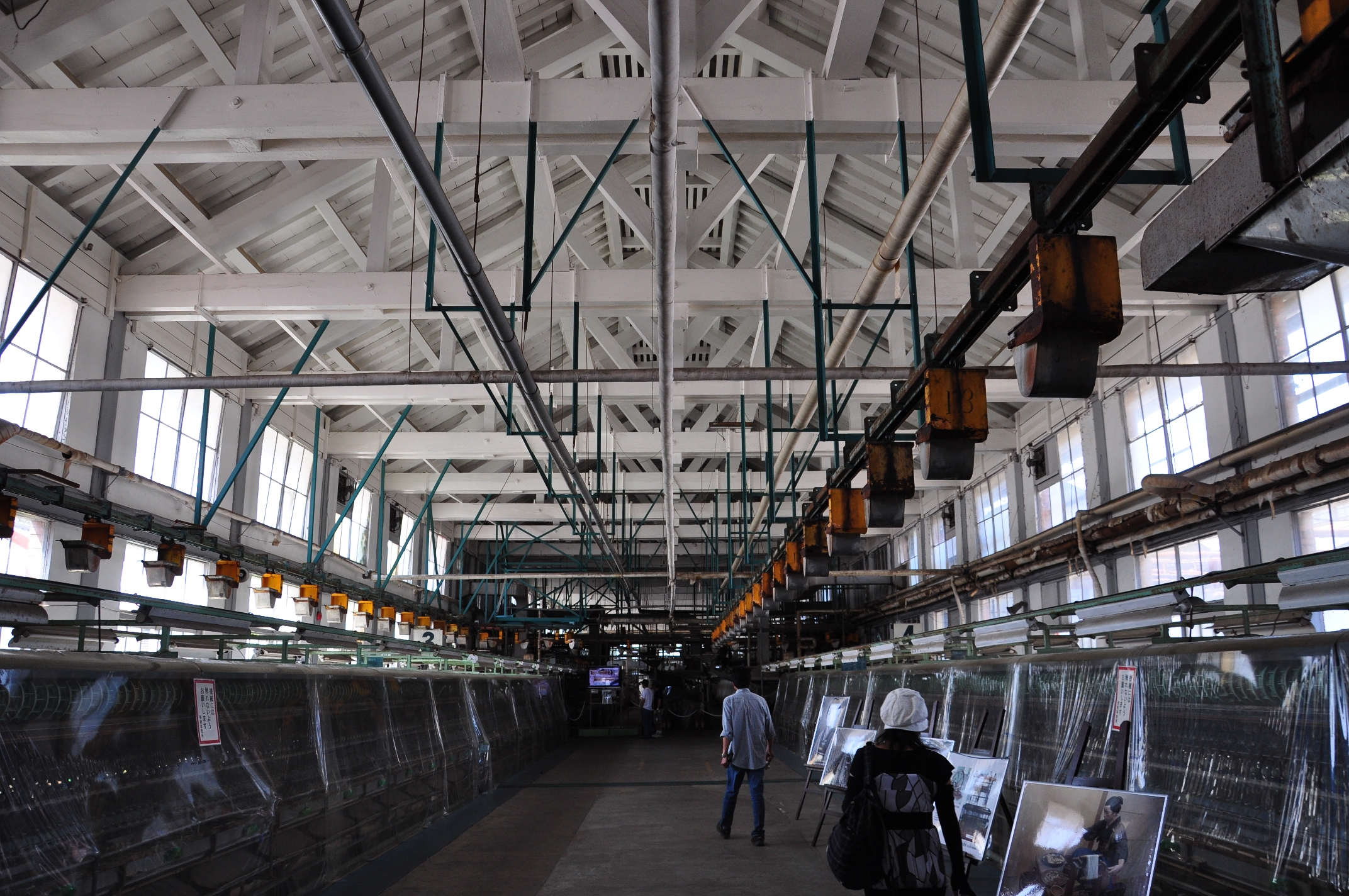
Silk, Steam, and Ice: Gunma's World Heritage Industrial Landscape
Japan's transformation from feudal isolation to industrial power happened in a single generation, and the thread that pulled it forward was literal: raw silk. In Gunma Prefecture, the mountains northwest of Tokyo, an entire landscape was reshaped by the silkworm. In 2014, UNESCO inscribed four sites here as a World Heritage group -- not for any single factory or monument, but for the way these places collectively document an industry's complete arc, from raising worms on mulberry leaves to shipping finished thread across the Pacific. The Tomioka Silk Mill and Related Sites is a story told in buildings, farmhouses, schools, and mountainside caves.
The Mill That Started It All
The centerpiece of the UNESCO inscription is the Tomioka Silk Mill, constructed in 1872 as a government model factory. The Meiji government needed exports to fund Japan's modernization, and silk was the obvious candidate -- in 1862, raw silk and silkworm cocoons accounted for 86% of Japan's exports. French engineer Paul Brunat designed and supervised the construction of a massive timber-framed brick complex with 300 reeling machines, twice the capacity of the largest mills in France or Italy. Tomioka was not merely a factory; it was a technology transfer station, training hundreds of young women who then dispersed to private mills across Japan, carrying the techniques with them.
The Farmer, the Teacher, and the Mountain
What makes this UNESCO inscription unusual is its scope. Beyond the mill itself, three other sites complete the picture. The Tajima Yahei Sericulture Farm preserves the home and facilities of a pioneering silk farmer who developed improved techniques for raising silkworms and ventilating cocoon-drying buildings. The Takayama-sha Sericulture School, an educational institution with nationwide influence, trained farmers in modern sericulture methods and worked to improve cocoon quality and yields across the country. And the Arafune Cold Storage, a natural cave on the slopes of Mount Arafune, was used to store silkworm eggs at controlled temperatures -- an ingenious use of mountain geology to manage the biological timing of silk production.
From Worm to World Market
Together, these four sites document every stage of the silk production chain as it existed in Meiji-era Japan. The farms grew mulberry trees and raised silkworms. The schools taught improved methods to farmers across the nation. The cold storage facilities controlled the lifecycle of eggs for optimal hatching. And the mill reeled the cocoons into finished thread for export -- first to France, and eventually to the United States, which became Japan's largest silk market. When the original ten sites were proposed for UNESCO consideration in 2007, the list was refined to these four, which best represented the complete industrial ecosystem. The inscription was formally accepted on June 21, 2014, at the 38th World Heritage Committee.
A Landscape of Industry
Gunma Prefecture became the heart of Japanese sericulture not by accident but by geography. The mountainous terrain with its mulberry-friendly climate, the cool cave systems for egg storage, and the river systems that powered early machinery all contributed. Flying over this landscape, the connections become visible: the valley town of Tomioka where the great brick mill stands, the rural farmsteads in the surrounding hills where mulberry fields once dominated, and the forested slopes of Mount Arafune where cold-air vents kept silkworm eggs dormant until the season demanded. This is industrial heritage at landscape scale -- not a single building preserved behind velvet ropes, but an entire region shaped by one commodity and the determination to master its production.
From the Air
The four UNESCO sites are distributed across Gunma Prefecture, centered roughly at 36.26°N, 138.89°E. The Tomioka Silk Mill is located in the city of Tomioka in the Kabura River valley, visible as a cluster of long brick buildings with distinctive red rooflines. The surrounding sites -- Tajima Yahei Farm, Takayama-sha School, and Arafune Cold Storage -- are scattered through the mountainous terrain to the west and south. The Arafune Cold Storage sits on the slopes of Mount Arafune at higher elevation. Best viewed at 3,000-5,000 feet AGL to appreciate the geographic spread of the heritage sites across the valley and mountain landscape. Nearest airports include RJAH (Ibaraki Airport) approximately 120 km east and RJTT (Tokyo Haneda) approximately 130 km south-southeast.