The Villages, Florida
Fifty-six golf courses. Over 100 recreation centers. More than 3,500 resident-led clubs. Golf cart bridges spanning state highways. A population of 79,077 where 81.6 percent of residents are over 65, and children under 19 are effectively barred from permanent residence. The Villages is not a town in any conventional sense. It is an experiment - the largest age-restricted master-planned community in the United States, sprawling across Sumter, Marion, and Lake counties in central Florida, governed not by a mayor and city council but by 17 community development districts. It began in the 1960s as a mail-order land scheme run by a Michigan businessman. Today it is a self-contained universe where retirees from the Midwest and Northeast come to reinvent the final act of American life, complete with fabricated historical markers that give the place a past it never had.
From Mail-Order Lots to a Private Empire
The Villages started with a hustle. In the 1960s, Michigan businessman Harold Schwartz began selling parcels of central Florida scrubland through mail-order advertisements. When a 1968 federal law banned real estate sales by mail, Schwartz and his partner Al Tarrson pivoted, developing Orange Blossom Gardens - a modest mobile home park in northwestern Lake County that had sold roughly 400 units by the early 1980s. The transformation came in 1983, when Schwartz bought out Tarrson and brought in his son, H. Gary Morse. Inspired by Del Webb's Sun City in Arizona, Morse understood that retirees would pay not just for housing but for a lifestyle. He added golf courses, recreation centers, and commercial development, rebranding the community as 'the Villages' in 1992. By the early 1990s, 8,000 people lived there. Between 2010 and 2019, it was the top-selling master-planned community in the entire country, moving 24,440 homes. The Morse family's company controls the development, the commercial real estate, and even the local media.
The Invented Past
Walk through the Villages' three town centers - Spanish Springs, Lake Sumter Landing, Brownwood Paddock Square - and you encounter historical plaques mounted on buildings, recounting colorful tales of frontier settlers, shipwrecks, and pioneer commerce. None of it happened. The plaques are fiction, the architectural details deliberately aged, the whole atmosphere a carefully constructed illusion of small-town heritage. One historian described it plainly: 'The Villages' faux history gives a patina of stability and continuity to a highly volatile region and stage of life.' Critics have compared the approach to Disney theme parks, noting that the fabricated narratives avoid any mention of ethnic minorities or conflict. The fictitious markers are not hidden - residents generally know they are invented - but they serve a psychological purpose, anchoring a brand-new community in the comforting aesthetics of an imagined American past. It is nostalgia for a place that never existed, built for people starting over in a place that barely existed a generation ago.
A World on Golf Carts
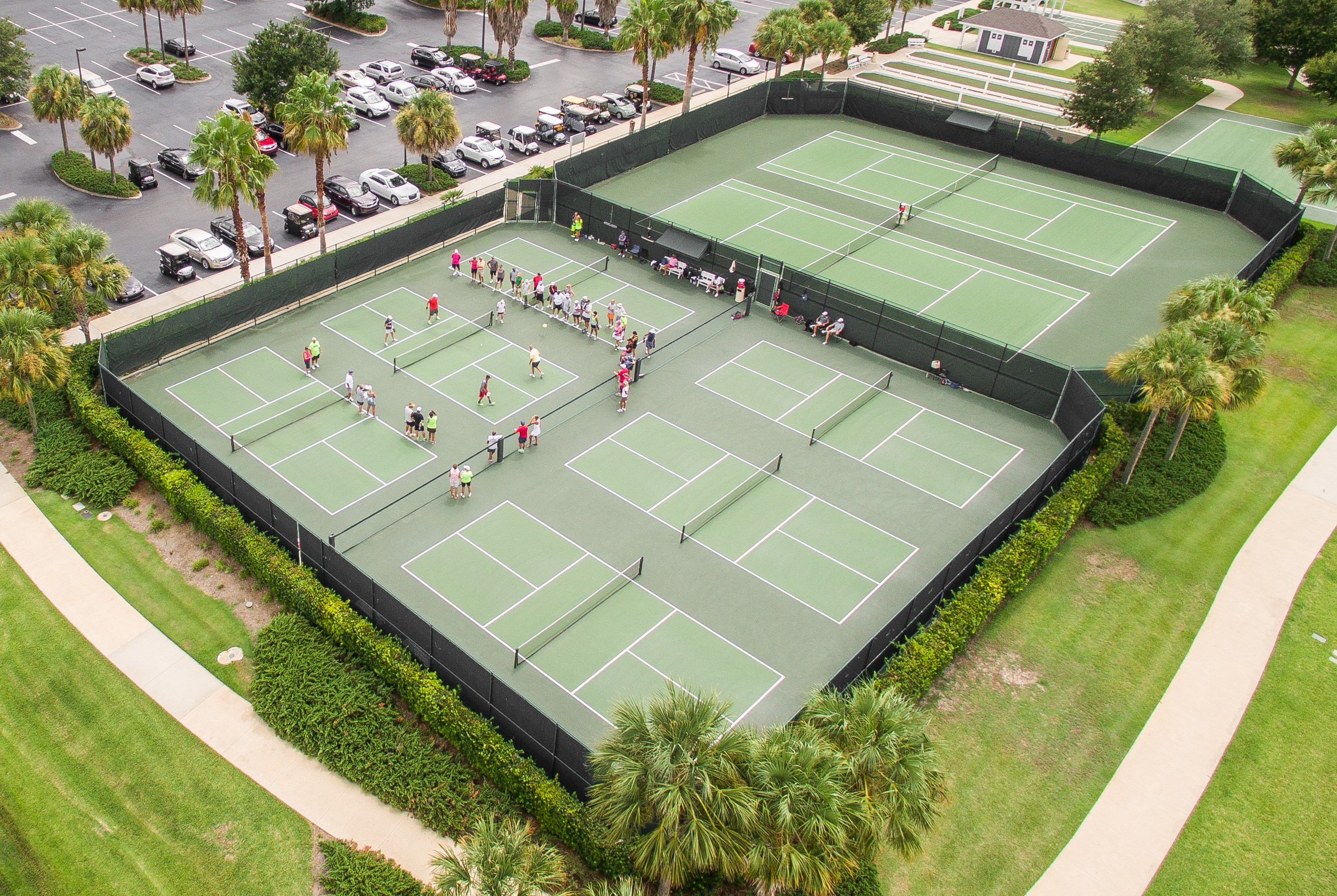
The Villages operates 56 golf courses with 729 holes - 42 nine-hole executive courses, 12 championship courses, and two specialty putting courses. Golf is free on the executive courses for residents who pay the monthly amenities fee of approximately $189. But the golf cart is more than a recreational vehicle here; it is the primary mode of transportation. The community has built dedicated golf cart bridges over state highways: the Chitty Chatty Bridge crossing State Road 44 opened in 2020, the Brownwood Bridge followed that December, and the Water Lily Bridge over Florida's Turnpike opened in March 2021. A fourth, the Southern Oaks Bridge, also crossing the Turnpike, opened in August 2023. The infrastructure creates a parallel transportation network where residents can drive their carts from home to shopping to entertainment without ever touching a public road. Over 100 recreation centers offer pickleball, tennis, bocce, shuffleboard, swimming, archery, air gun ranges, and more. Each April, roughly 2,000 residents compete in the Senior Games.
The Politics of Paradise
The Villages is a political force. With approximately 80 percent voter turnout and registered Republicans outnumbering Democrats two-to-one, the community commands attention from national campaigns. It holds the largest veteran population of any community in the United States without a military base, with 16.3 percent of residents having served. The demographic profile is striking: residents are overwhelmingly white, predominantly from the Midwest and Northeast, with a significant contingent from Staten Island. Median household income sits at $63,841. The community is governed by its 17 CDDs rather than traditional municipal government, a structure that drew IRS scrutiny in 2013 when the agency ruled that $426 million in bonds issued by one district did not qualify for tax-exempt status, costing residents roughly $750,000 in legal fees. Two documentaries have examined life inside the Villages: Some Kind of Heaven in 2020 and The Bubble in 2021, both exploring the tension between the community's utopian promise and the complexities of aging, isolation, and reinvention that play out behind the manicured landscaping.
From the Air
Located at 28.90°N, 81.99°W in central Florida, spanning portions of Sumter, Marion, and Lake counties. From altitude, the Villages is unmistakable: an enormous grid of residential development, golf courses, and retention ponds stretching across what was recently open Florida scrubland. The community is bounded roughly by US-27/US-441 to the east, US-301 to the west, County Road 42 to the north, and CR-468 to the south, and continues expanding. Look for the distinctive pattern of uniform rooftops interspersed with the green of golf course fairways and the blue of small lakes. The three town centers - Spanish Springs, Lake Sumter Landing, and Brownwood - appear as denser commercial clusters. Leesburg International Airport (KLEE) is approximately 10nm east. Ocala International Airport (KOCF) is about 25nm north. The Villages itself has no airport, but the extensive golf cart bridge network is visible from lower altitudes.