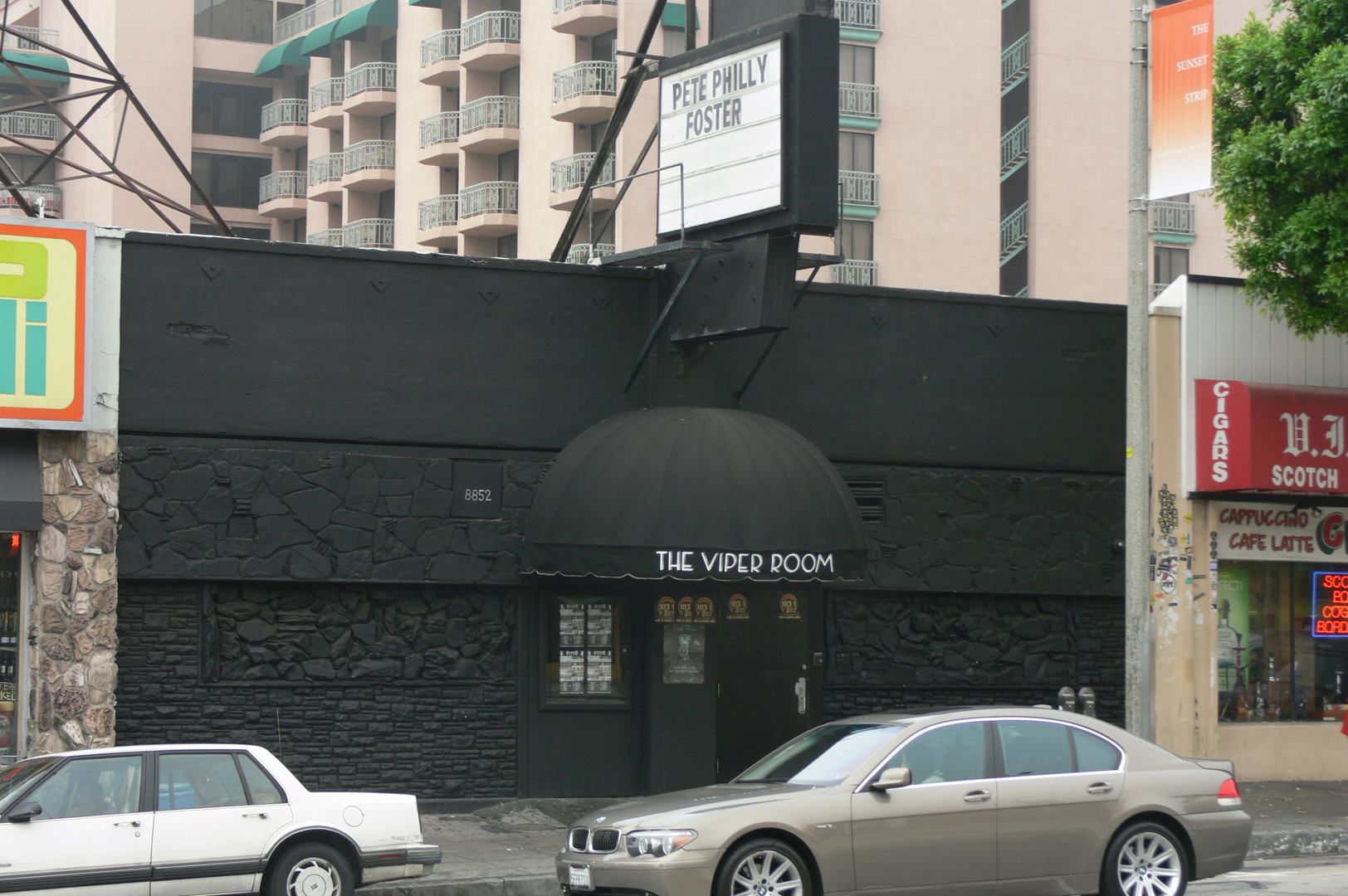
The Viper Room
There is a stretch of Sunset Boulevard where the pavement remembers everything, where ghosts press against the velvet rope alongside the living. The Viper Room stands at 8852 Sunset, occupying a building that has been a grocery store, a gambling den, and a jazz club in its long life. But the name it carries now belongs to a single terrible night in 1993, and to the strange, luminous decades that came before and after.
A Building with Many Lives
The address predates Hollywood's mythology by a generation. In 1921 it opened as a grocery store, a mundane beginning for a place destined for anything but. Through the 1940s it ran as the Cotton Club — not the famous Harlem original, but a West Coast echo of it — and later transformed into the Greenwich Village Inn. Jazz gave way to rock and roll and the building became the Melody Lounge, then Filthy McNasty's, then The Central. Each incarnation attracted its own tribe of the devoted and the desperate. By the time Johnny Depp and his partner Sal Jenco acquired it, the address had already absorbed a century of Los Angeles nights.
Depp opened the Viper Room on August 14, 1993, with Tom Petty playing the inaugural show. It was designed as an intimate space — capacity around 250 — where musicians could perform without the pressure of a stadium or the sterility of a corporate venue. The décor leaned dark, the lighting stayed low, and the stage belonged to whoever dared claim it.
The Night River Phoenix Died
Seventy-eight days after the grand opening, everything changed. On October 31, 1993 — Halloween — River Phoenix collapsed on the sidewalk just outside the front door. He was 23 years old, an actor widely considered one of the most gifted of his generation. He had been inside the club that evening, and the drugs in his system when paramedics arrived included cocaine and morphine at fatal concentrations.
His brother Joaquin called 911 from a payphone on the street. His sister Rain held him as he convulsed on the pavement. Phoenix was pronounced dead at Cedars-Sinai Medical Center a few hours later. The loss devastated the film world and became one of those cultural demarcations that people remember exactly where they were when they heard. It also attached an indelible association to the Viper Room — one the club has never fully escaped, no matter what else has happened on its stage.
Music History Made in a Small Room
And a great deal else has happened there. Johnny Cash performed at the Viper Room during the sessions for his American Recordings album in 1993 — the Rick Rubin-produced comeback that would resurrect his career and define the final chapter of his life. Hearing Cash's voice fill that small, dark space, in front of a few hundred people, was the kind of intimate musical encounter that money alone cannot manufacture.
Adam Duritz of Counting Crows bartended at the club in 1994 and 1995 while his band's debut album was climbing the charts — a surreal arrangement that only Los Angeles could produce. The club has also hosted Iggy Pop, Scarlett Johansson, and dozens of other artists who chose the Viper Room for its lack of pretense. The room is close enough that you can see the sweat, hear the breath between notes.
Change, Preservation, and Threatened Demolition
Johnny Depp sold his interest in the club in 2004, and the Viper Room passed through other hands while retaining its name and its reputation. The building itself — that 1921 structure that survived Prohibition, multiple reinventions, and one of the most public tragedies in Hollywood history — has faced a more fundamental threat in recent years. Plans announced in the 2020s called for the demolition of the existing building to make way for a mixed-use development, with the Viper Room brand potentially relocated or retired.
The prospect prompted a wave of protest from musicians, fans, and preservationists who argued that the physical space itself matters — that the stories embedded in those walls cannot simply be transferred to a new address. The Sunset Strip has lost many of its iconic venues over the decades to development pressure. Whether the Viper Room survives in its current form remains an open question, but the argument for its survival is rooted in something that cannot easily be quantified: the irreplaceable weight of a specific place.
From the Air
The Viper Room sits on the Sunset Strip in West Hollywood, adjacent to Los Angeles (KLAX, 34.0522 N, 118.2437 W). At typical cruising altitude over the LA basin, the Strip's continuous neon corridor is visible as a bright east-west seam in the city grid, running roughly parallel to and north of Wilshire Boulevard. The Santa Monica Mountains rise immediately to the north, creating the natural northern boundary of the city's westside neighborhoods.