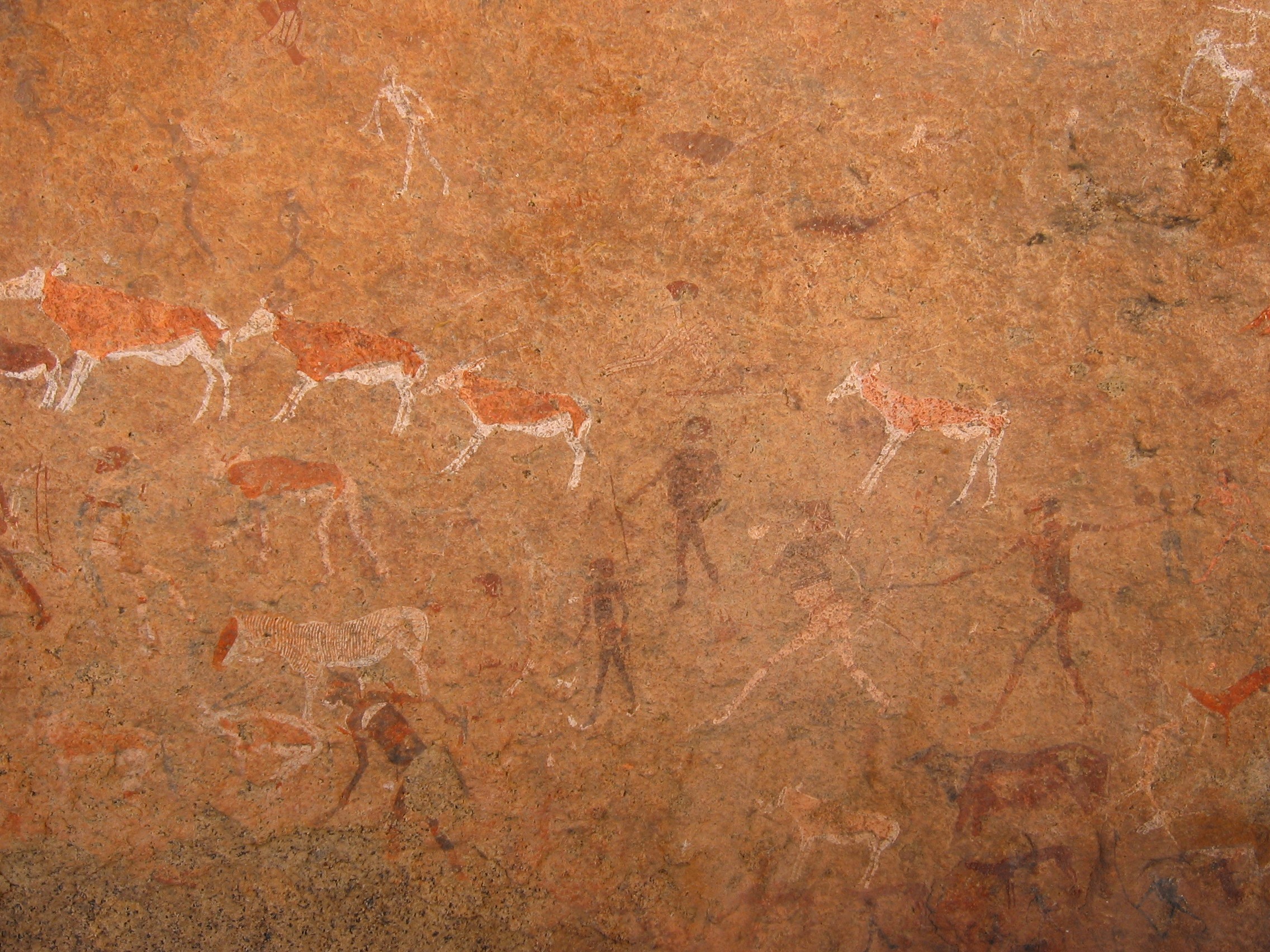
The White Lady (Namibia)
To reach the White Lady, you walk. There is no road, no cable car, no shortcut. From the trailhead near the settlement of Uis, a 45-to-60-minute hike follows the gorge of the Tsisab -- a river that is almost always dry -- over rough terrain into the heart of the Brandberg massif. Namibia's highest mountain is a granite monolith that the local Damara people named for the way it glows red at sunset: 'Brandberg' means 'fire mountain' in German. Deep inside, in a shallow overhang called Maack Shelter, a rock panel measuring roughly 5.5 by 1.5 metres holds a group of painted figures. The most detailed among them -- a figure about 40 centimetres tall with white-painted limbs, holding a bow in one hand -- is the White Lady. She is at least 2,000 years old, and the arguments about who she is have lasted almost as long as the walk to find her.
Ochre, Charcoal, and Blood Serum
The White Lady is not alone. She is the central figure in a composition that includes multiple human forms and several oryxes -- one of which, strangely, has human legs. The other figures are simpler, painted entirely in black or white, but the White Lady herself is rendered with care that suggests she held particular significance. Her white limbs may represent body paint or decorative attachments worn during ceremony. The object in her other hand may be a goblet. Because of the bow and the oryxes, some researchers have read the scene as a hunt; others see a ritual dance, with the White Lady as a shaman. The pigments were mixed from ochre, charcoal, manganese, and hematite, bound with blood serum, egg white, and casein. These were not casual materials. They were chosen and prepared with knowledge passed between generations of San artists who painted across more than a thousand sites on the Brandberg alone.
A Theory Built on Racism
In 1948, the French archaeologist Henri Breuil published his interpretation of the painting. He argued that the figure was not African at all -- that it showed Mediterranean or Phoenician influence, evidence that sophisticated art in sub-Saharan Africa must have originated elsewhere. Breuil's theory did not emerge in a vacuum. It aligned neatly with the racial ideology of the South African government, which was in the process of formalizing apartheid. The notion that Black Africans could not have produced complex artwork served a political purpose: it denied the deep cultural achievements of the San and other indigenous peoples, making dispossession easier to justify. Similar arguments were applied to Great Zimbabwe, whose stone architecture was attributed to Phoenicians, Arabs, or anyone other than the Shona people who actually built it. These claims were not science. They were colonial mythology dressed in academic language.
Reclaiming the Painting
By the second half of the twentieth century, the Mediterranean theories crumbled under the weight of actual evidence. Pigment analysis, stylistic comparison with thousands of other San rock art sites across southern Africa, and ethnographic research all pointed to the same conclusion: the White Lady was painted by the San people, using techniques and symbolic systems consistent with their spiritual and artistic traditions across the subcontinent. The figure is now understood as part of a tradition of trance-related rock art in which shamans, animals, and the spirit world intersect on stone surfaces. The reclamation of the painting's authorship matters beyond archaeology. For decades, the San people were alienated from their own ancestral art by scholars who refused to credit their ancestors with the capacity for complex expression. Acknowledging the truth -- that the White Lady is a San masterwork -- is a correction that carries moral as well as academic weight.
The Walk and What It Teaches
The Brandberg hosts more than a thousand painted rock shelters, making it one of the richest concentrations of rock art in Africa. But the White Lady remains the most visited, partly because of her fame and partly because the walk to reach her filters out the casual. The Tsisab gorge is dry, rocky, and shadeless. The heat can be severe. Guides from the local community accompany visitors, and their knowledge of the mountain -- its geology, its art, its wildlife -- transforms the hike from a tourist excursion into something closer to a pilgrimage. At the shelter, the paintings are unprotected by glass or barriers. You stand close enough to see individual brushstrokes made by a hand that moved across this rock two millennia ago. The intimacy is startling. There is no museum between you and the art -- just granite, desert air, and the accumulated silence of centuries.
From the Air
Located at 21.11S, 14.66E on the Brandberg massif in Namibia's Erongo region. The Brandberg is Namibia's highest mountain (Konigstein peak, 2,573 m) and is visible from altitude as a massive granite dome rising from the surrounding plains. The painting site is deep within the mountain's gorge system and not visible from the air. The settlement of Uis, at the base of the Brandberg on the C35 road, serves as the trailhead. Nearest airport with scheduled service is Walvis Bay (FYWB), approximately 200 km to the south-southwest. The Brandberg's distinctive flat-topped profile and reddish granite colour make it an unmistakable landmark from cruising altitude.