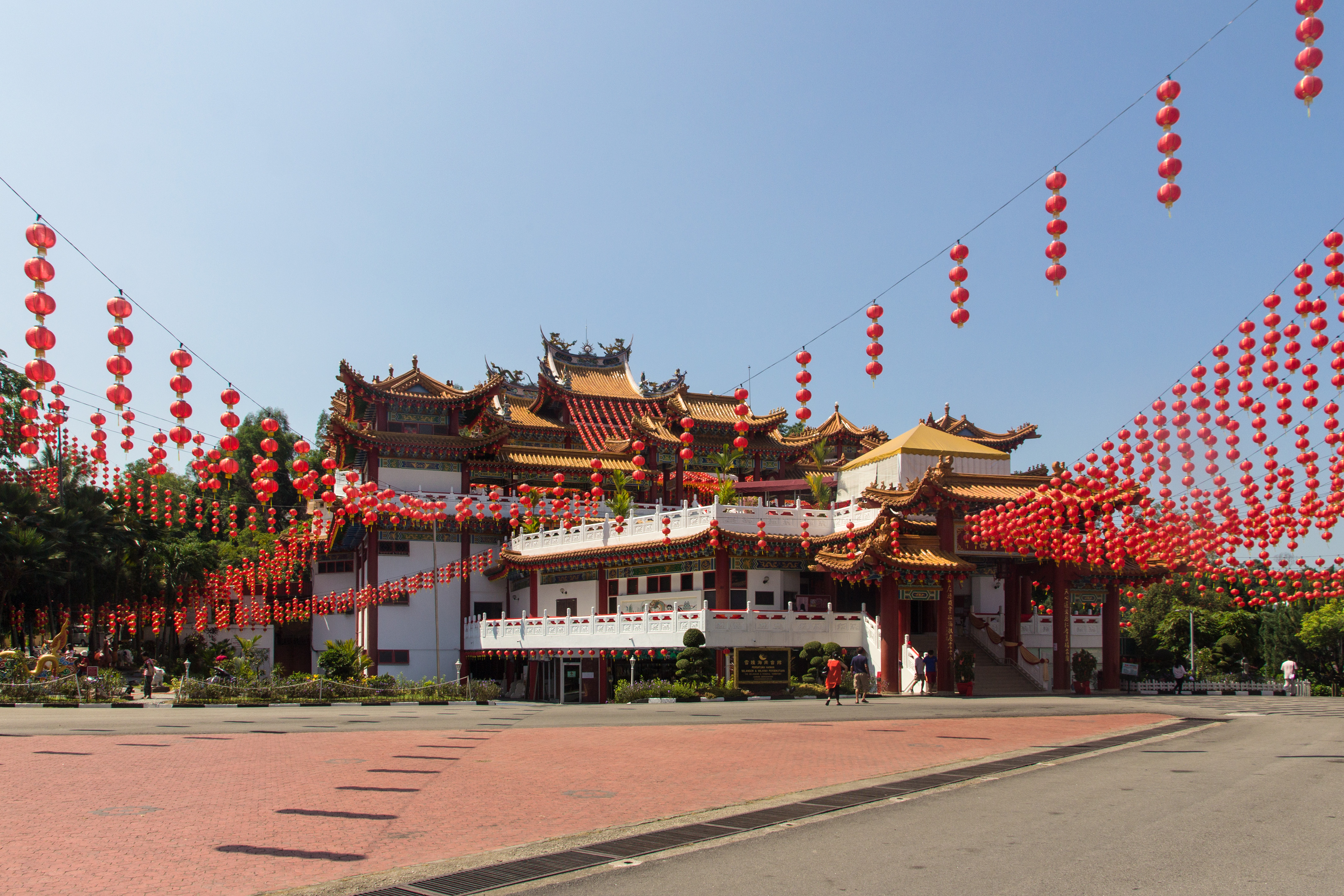
Thean Hou Temple
On a hilltop in Kuala Lumpur, six tiers of curved rooflines and red lanterns rise above the surrounding city like a beacon from another century. The Thean Hou Temple is dedicated to Mazu, the Chinese sea goddess who protects sailors and fishermen -- a patron deity carried across the South China Sea by Hainanese immigrants who settled in Malaya and never forgot the waters they crossed. Completed in 1987 after six years of construction and officially opened in 1989, the temple cost approximately RM7 million, funded by the Selangor and Federal Territory Hainan Association. It is one of the largest Chinese temples in Southeast Asia, but its significance runs deeper than scale. Thean Hou is where a diaspora community built permanence, fusing Buddhist, Taoist, and Confucian traditions into a single architectural statement on a Malaysian hill.
A Hainanese Story
The Hainanese people -- from Hainan Island off the southern coast of China -- were among the later waves of Chinese immigrants to the Malay Peninsula, arriving after the Hokkien, Cantonese, and Teochew communities had already established themselves. Often working as cooks, coffee shop proprietors, and domestic servants in colonial households, the Hainanese built their community networks quietly and persistently. The Selangor and Federal Territory Hainan Association became the institutional backbone of that community, and Thean Hou Temple became its most visible expression. Construction began in 1981 on Robson Heights, a hilltop location that gives the temple both prominence and a sweeping view of Kuala Lumpur's skyline. The choice of Mazu as the primary deity was deliberate: she is the patroness of seafarers, the goddess who calms storms, and for an island people who had crossed the sea to build new lives, her protection was not abstract theology. It was personal memory.
Three Faiths Under One Roof
Thean Hou Temple does not belong to a single religion. Its main prayer hall houses the altar of Tian Hou -- Mazu herself -- but the temple also venerates Guanyin, the Buddhist goddess of mercy, and the Goddess of the Waterfront. Statues of Yue Lao, the god of marriage and love, draw couples seeking blessings. This layering of Buddhist, Taoist, and Confucian elements is characteristic of Chinese folk religion as practiced across Southeast Asia, where doctrinal boundaries blur into something more fluid and practical. Visitors enter past a large statue of Guanyin set among rocks and cascading water, her hand dispensing blessings from a jar. Inside, incense smoke curls through a hall painted in deep reds and golds. Outside, a Chinese Medicinal Herbs Garden, a Wishing Well, and a Tortoise Pond create spaces for reflection that are secular in feel but sacred in intent. Twelve large statues representing the animals of the Chinese zodiac line the grounds, each one polished smooth by the hands of visitors seeking the blessing of their birth year.
The Festival Calendar
The temple comes most alive during festivals. Grand birthday celebrations for Goddess Tian Hou, Goddess Kuan Yin, and the Goddess of the Waterfront mark the religious calendar with processions, offerings, and community gatherings. Wesak Day, celebrating the birth of the Buddha, brings Buddhist chanting sessions that fill the prayer hall. The Mid-Autumn Festival during the eighth lunar month transforms the grounds with lanterns, mooncakes, and children's processions. Chinese New Year is the annual crescendo -- the temple strung with thousands of red lanterns, firecrackers echoing off the hillside, families crowding the steps for prayers and photographs. In 2019, the Malaysian federal government allocated RM30,000 to the temple specifically to encourage more cultural events, a formal recognition of the temple's role as a cultural anchor for Kuala Lumpur's Chinese community and a destination that draws Malaysians of all backgrounds.
More Than a Temple
What distinguishes Thean Hou from many religious sites is its embrace of functions that extend well beyond worship. The temple offers marriage registration services -- couples can formalize their union in the shadow of Mazu's altar, then pose for photographs on the ornate balconies overlooking the city. Fortune-telling services draw visitors seeking guidance through traditional Chinese divination methods. In the temple compound, qigong and tai chi classes are held regularly, connecting the spiritual space to physical practice. Wushu martial arts training sessions attract younger practitioners, grounding the temple in contemporary community life rather than confining it to ritual. From the upper tiers, Kuala Lumpur spreads out below -- the Petronas Towers visible in the distance, modern highways threading through older neighborhoods. The temple occupies that tension gracefully: ancient forms on a hilltop, a modern city at its feet, and a community that needs both.
From the Air
Thean Hou Temple (3.1219N, 101.6876E) sits on Robson Heights, a hilltop in Kuala Lumpur visible by its distinctive multi-tiered red-and-gold roofline. The temple is approximately 5km south of the Kuala Lumpur city center and the Petronas Towers. Nearest airports are Sultan Abdul Aziz Shah Airport (WMSA/SZB) about 20km to the west and Kuala Lumpur International Airport (WMKK/KUL) approximately 55km to the south. The hilltop location makes it identifiable from moderate altitudes when approaching KL from the south or west. Tropical climate with afternoon thunderstorms common; morning flights offer best visibility of the temple grounds and surrounding residential neighborhoods.