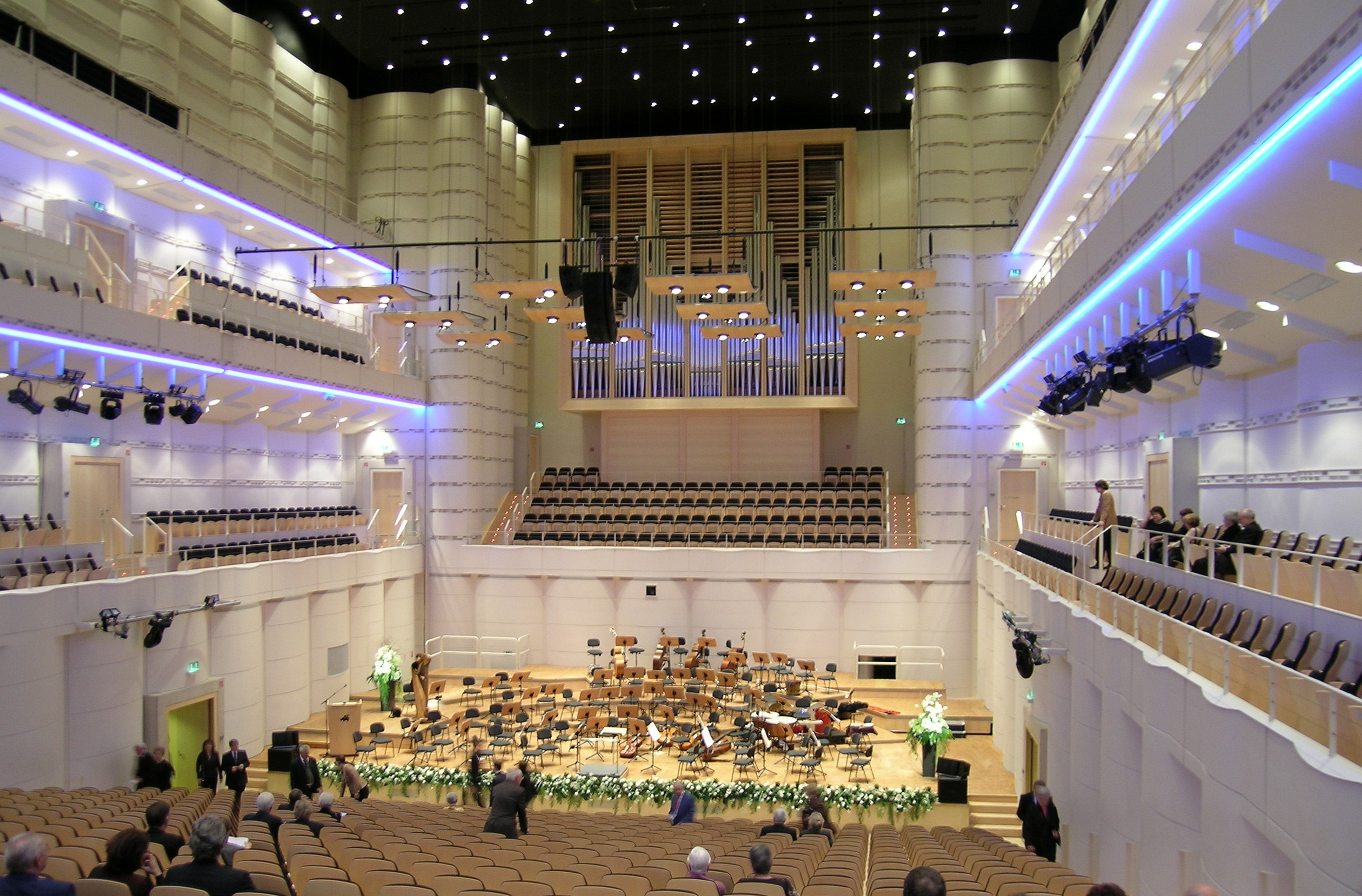
Theater Dortmund
On 17 December 1904, the curtain rose for the first time on Theater Dortmund and the audience heard Wagner's Tannhauser. On 1 September 1944, the curtain came down for the last time on that building when Joseph Goebbels' Ministry of Public Enlightenment and Propaganda closed every theatre in Germany. Five weeks later, on 6 October, an Allied air raid finished the job that Goebbels' decree had started: the original Stadttheater was rubble. The story of Theater Dortmund is the story of how a city decided, again and again, that a stage was worth rebuilding.
Martin Dulfer's First House
The original theatre was the work of Martin Dulfer, one of the leading Jugendstil architects of his era, who designed it between 1902 and 1904. Dortmund was at the peak of its industrial boom, doubling its population every generation, and a coal-and-steel city did what coal-and-steel cities did: it built itself a temple to culture to prove it was more than smokestacks. The inaugural Tannhauser set the tone. Two decades later, in 1925, the house staged Busoni's monumental Doktor Faust. For forty years Dulfer's theatre functioned as the cultural heart of Westphalia. Then came 1 March 1943, when an aerial bombing left the building badly damaged but operational. It limped on for another eighteen months before the Goebbels decree silenced it, and the second raid finished it altogether.
Fidelio Among the Ruins
On 12 September 1950, with most of central Dortmund still flattened, an interim theatre opened with a performance of Beethoven's Fidelio, an opera about prisoners being freed from darkness. The choice was not subtle, and it was not meant to be. The new Intendant was P. Walter Jacob, who had fled Germany in 1933 and now returned to a city that needed him. Jacob conducted Wagner's Lohengrin in his first season and Die Meistersinger the next, and he insisted that the post-war stage do new work too. He staged Hans Pfitzner's Das Herz, premiered Erich Wolfgang Korngold's Die stumme Serenade in 1954, and brought Nelly Sachs's drama Eli, written by a Jewish poet who had escaped to Sweden, to the same boards that had been silenced by the regime that drove her out. In 1955 Jacob staged Franz Werfel's Jacobowski und der Oberst and took a leading role himself. The company called itself Stadtische Buhnen Dortmund, the City Stages of Dortmund.
The 1966 Opera House
The interim was a means, not a destination. In 1966 a new permanent opera house, the Opernhaus Dortmund, opened on the site of the old synagogue that the Nazis had destroyed in 1938, a choice that some critics admired and some thought ought to have been more loudly acknowledged. The opening work was Strauss's Der Rosenkavalier under Wilhelm Schuchter, with the Dortmunder Philharmoniker in the pit. A year later Schuchter conducted the premiere of Walter Steffens's opera Eli, a commission of the city based again on the Nelly Sachs drama. The opera house carried both the operas and the orchestra's symphonic concerts for the next thirty-six years.
The Konzerthaus Era
When the dedicated Konzerthaus Dortmund opened in 2002 under planning director Ulrich Andreas Vogt, the city finally had a hall built for symphonic acoustics, and the Opernhaus could concentrate on opera and ballet. The Schauspielhaus, the spoken-theatre arm, had moved into the post-war opera building in 1968 and continued from there. The Konzerthaus quickly drew the kind of programming that smaller European cities rarely get. Rebecca Saunders was composer-in-residence for the 2005-06 season; in December 2008 the Thomanerchor of Leipzig and the Gewandhausorchester, led by Thomaskantor Georg Christoph Biller, performed Bach's Christmas Oratorio. Ignat Solzhenitsyn conducted Mozart's Great Mass in C minor a year later. And in June 2010, Cecilia Bartoli sang Bellini's Norma in concert for the very first time, restoring the title role to its original mezzo-soprano range, with Thomas Hengelbrock conducting.
A Capital, Briefly
In 2010 the entire Ruhr district was European Capital of Culture under the banner RUHR.2010, and Theater Dortmund was one of the lead partners in the music, theatre, and dance programmes. For a year, the coal-blackened cities of the Ruhr were the official cultural face of Europe, and the theatre Goebbels had closed sat at the centre of it. The buildings have changed three times. The institution has not. From Wagner in 1904 to Bartoli in 2010, Theater Dortmund has been a public argument for why a working city builds a stage in the first place.
From the Air
Theater Dortmund's complex (Opernhaus, Schauspielhaus, Konzerthaus) sits at 51.5111 degrees north, 7.4617 degrees east, just south of Dortmund Hauptbahnhof. From above, the cluster reads as a band of distinctive modernist roof shapes between the station and the German Football Museum on the city's culture mile. Dortmund Airport (EDLW / DTM) is 13 km east; Düsseldorf International (EDDL / DUS) is 60 km southwest. Recommended viewing altitude 1,000 to 2,000 metres.