Theatre of Van Campen
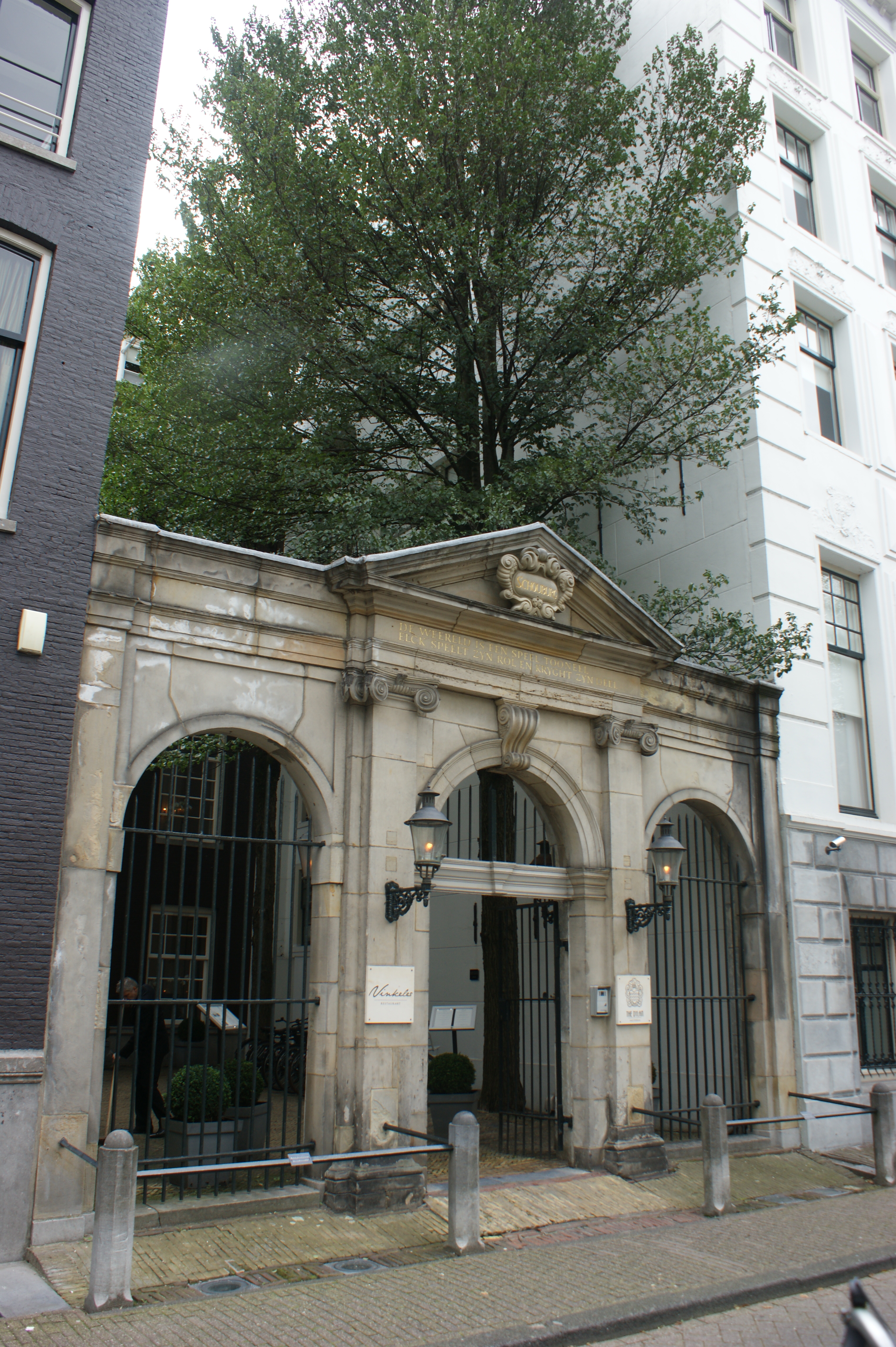
There is a phrase carved above a doorway at Keizersgracht 384, the only piece of the building still in its original place. "De weereld is een speeltoneel," it reads. "Elck speelt zijn rol en krijght zijn deel." The world is a theatre; everyone plays their role and gets their part. Joost van den Vondel wrote it for the opening of the Schouwburg van Van Campen on January 3, 1638 - the day the Netherlands got its first real public theatre, and the day a fierce church council lost a fight it had been certain it would win. The building behind the inscription is gone. Burned. The architrave, somehow, survives.
Before the Theatre
The story begins not with a theatre but with a science school. In 1617, a doctor named Samuel Coster and his friend the playwright Gerbrand Adriaensz Bredero founded the Duytsche Academy on this same plot. Their idea was radical for its moment: deliver scientific lectures in Dutch instead of Latin, so ordinary Amsterdammers could understand them. They built a wooden hall in the Italian model and filled it with lectures, painting competitions, and performances by the Rederijkers - the chambers of rhetoric who, through their patient study of poetic texts, were quietly inventing modern Dutch theatre. Both Coster and Bredero belonged to a chamber called "In Liefde Bloeyende," Blooming in Love. By the 1630s the wooden academy was tired and Amsterdam was rich, deep in the Golden Age, and ready for something more permanent.
The Architect of the Palace
Jacob van Campen took the commission. Today he is remembered mostly for one thing: the enormous classical building on Dam Square that is now the Royal Palace of Amsterdam but began life, in 1648, as the city's town hall - the grandest civic structure in the Dutch Republic. The Theatre of Van Campen came first. He coined the word Schouwburg, viewing-building, for what he was making, and he based it on Andrea Palladio's Teatro Olimpico in Vicenza. Where the Royal Palace would announce Amsterdam's wealth in heavy stone and Corinthian columns, the Schouwburg was a quieter exercise - a small, dignified hall of brick and wood. Same architect, two registers: the public theatre of art and the public theatre of power, designed by the same hand within a decade of each other.
A Church Council Defeated
The Calvinist church council of Amsterdam did not want a theatre. The kerkeraad considered playgoing a temptation, public performance a kind of fraud, and they petitioned vigorously to stop the opening. The opening was scheduled for December 26, 1637, with Vondel's specially-written play Gijsbrecht van Aemstel. The kerkeraad got the date pushed back. They did not get the building cancelled. On January 3, 1638, the doors opened, the audience filed in, and Vondel's verse drama - a story drawn from Amsterdam's own medieval mythology - filled the room. For more than a century, Gijsbrecht van Aemstel was performed annually at this theatre on New Year's Day. The church council's defeat became a Dutch tradition.
The Theatre That Followed
Van Campen's hall served Amsterdam until 1664, when the city decided the building was too small and too plain for the new Baroque taste. The theatre temporarily closed at the outbreak of the Second Anglo-Dutch War, and a replacement - twice the size, freshly ornate - opened on the same site on May 26, 1665. That second building burned in 1772 when a theatre servant carrying an open candle from the stage lighting set the building alight after a performance, taking with it more than a century of accumulated theatre history. The plot sat in various uses for the next two centuries. Since 1999, the address has been the Dylan Amsterdam, a five-star boutique hotel, and guests pass under Vondel's inscription on the way in. The world is a theatre. Everyone plays their role. Even, apparently, the architrave.
From the Air
The original theatre site sits at 52.369 N, 4.884 E on the Keizersgracht canal in central Amsterdam, between Leidsestraat and Spiegelstraat. From the air, look for the broad concentric arcs of the canal ring - Keizersgracht is the third ring out from the city center. Nearest airport: Amsterdam Schiphol (EHAM), 11 km southwest. Best viewed at 2,500-4,000 feet to see canal geometry clearly.