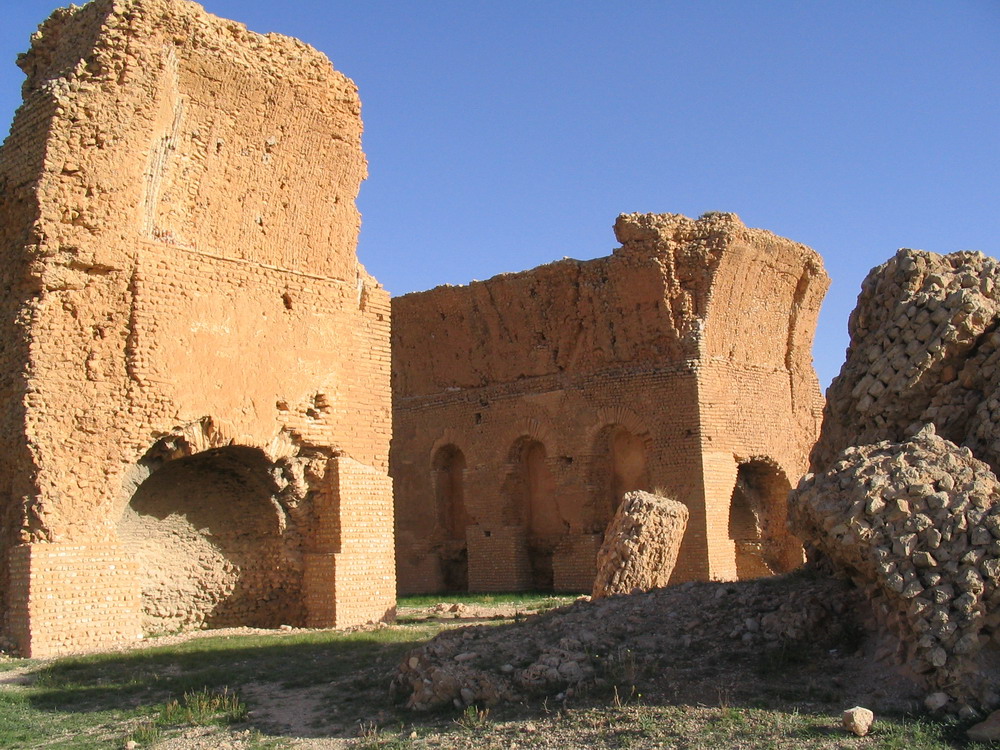
Thelepte
Ten churches. Archaeologists have found the remains of ten churches among the ruins of Thelepte, a city that has been dust and rubble for centuries. One of them had a nave and four aisles, a scale of worship that suggests a community punching well above its weight. For a provincial city in what is now western Tunisia, five kilometers north of modern Feriana, that concentration of sacred architecture tells a story of faith, power, and connectivity that once radiated outward along Roman roads to Carthage, Gafsa, and Gabes.
Crossroads of Empire
Thelepte held the rank of colonia, the highest municipal status in the Roman administrative system. That distinction was earned through geography: the city sat at the nexus of an important road network linking it to Cilium and Theveste to the north and Gafsa and Gabes to the south. Trade flowed through Thelepte in both directions, connecting the Mediterranean coast with the North African interior. By the sixth century, the city's strategic value had grown to the point where it became the residence of the military governor of the entire province of Byzacena. The historian Procopius records that Emperor Justinian ordered the city fortified, a mark of imperial investment in a settlement that Rome considered essential to holding its North African territories.
A City of Bishops
The ecclesiastical history of Thelepte reads like a who's who of early African Christianity. Bishop Julianus attended the Council of Carthage in 256, called by Cyprian to debate the thorny question of how to treat Christians who had lapsed under persecution. Donatianus, a later bishop, appeared at the contentious Council of Carthage in 411, where Catholic and Donatist bishops argued the schism that had divided North African Christians for a century. As senior bishop of Byzacena, Donatianus convened his own council of provincial bishops in 418. Bishop Frumentius was among the Catholic clergy whom the Arian Vandal king Huneric summoned to Carthage in 484 and then sent into exile. Each name represents a chapter in the theological battles that consumed late antique North Africa, and Thelepte was at the center of them all.
Birthplace of a Saint
Thelepte's most famous son was Fulgentius, born here before becoming the bishop of Ruspe, a city whose exact location historians have never definitively established. Fulgentius emerged as one of the most important Latin Christian theologians of the late fifth and early sixth centuries, a defender of orthodox Trinitarian doctrine against the Arian theology that the Vandal rulers of North Africa imposed on their subjects. That a figure of his intellectual stature came from Thelepte speaks to the city's cultural depth. This was not a backwater garrison town but a place where education, religious debate, and literary culture flourished alongside military administration and trade.
What the Ruins Remember
Today the ruins of Thelepte spread across the landscape at Medinet el-Kedima, a little north of Gafsa. A Byzantine citadel occupies the center of what was once the city, though it stands in utter ruin. Around it, the remains of baths and a theater sketch the outlines of Roman civic life, while those ten churches map a Christian community that grew from a persecuted minority into the dominant cultural force of the region. The diocese of Thelepte survived long enough to appear in the Notitiae Episcopatuum compiled during the reign of Byzantine Emperor Leo VI the Wise, who ruled from 886 to 912. By then the city itself was long gone, but its ecclesiastical memory persisted in the administrative records of Constantinople, a ghost diocese haunting the official lists of a vanished empire.
From the Air
Located at 34.98°N, 8.59°E in western Tunisia, approximately 5 km north of the modern town of Feriana and 30 km southwest of the provincial capital Kasserine. The ruins are visible from altitude as scattered archaeological remains amid agricultural land. Nearest airport is Gafsa-Ksar (DTTF). Approach from the east at 3,000-5,000 ft AGL. The Algerian border lies just to the west, marked by the rising terrain of the Atlas Mountains.