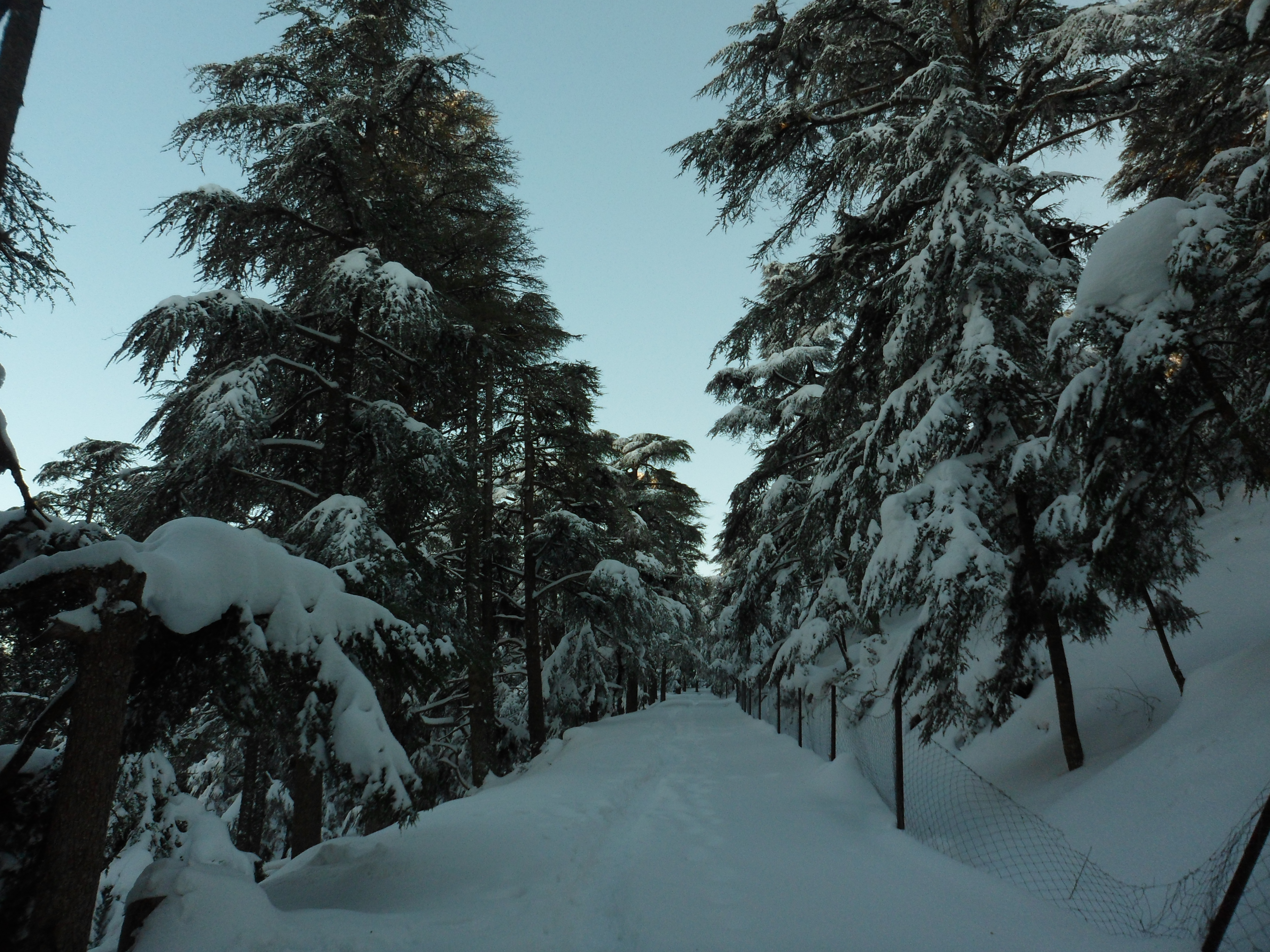
Theniet El Had National Park
Guy de Maupassant visited in the 1880s and never quite got over it. Writing in L'Echo de Paris in 1889, he described "the afternoon walks along the slightly wooded paths on these rolling hillsides from where one overlooks an immense undulating and tawny country from the blue sea to the Ouarsenis mountain range which bears on its peaks the cedar forest of Teniet-el-Had." The forest he loved is still here. Locals call it El Meddad, and in 1983 Algeria made it the country's first protected national park. The cedars that captured a French writer's imagination now anchor a 3,424-hectare sanctuary in the heart of the Tell Atlas.
The Sylvan Nobility
The Atlas cedar has been called the "sylvan nobility" of North Africa, and at Theniet El Had the title fits. The forest occupies the Ouarsenis Massif, a portion of the Atlas Tellien range, where 1,000 of the park's 3,424 hectares are covered in cedars -- some centuries old, their canopies forming a continuous green roof over the ridgeline. The park's highest point, Ras El Braret, reaches 1,787 meters. Just three meters lower stands Kef Siga, distinguished by a massive rock formation crowned by a single giant "parasol" cedar that stands out conspicuously against the sky. From the clearing known as Rond Point at 1,461 meters, both summits dominate the horizon.
Springs and Stone
Beneath the cedar canopy, the geology asserts itself. The park contains multiple ferruginous carbonate springs, their water emerging at a cool 12 degrees Celsius. These mineral-rich springs -- Ain Harhar, Tirsout, Ouertane, Djedj El-Ma, and the sulphurous waters of Sidi Abdoun -- have long been valued for their supposed therapeutic properties. The park entrance begins at a wide clearing beside the town of Theniet El Had, encircled by ancient cedars that create what visitors often describe as a sea of greenery. Near this clearing stands the Chalet Jourdan, a woodland house built in 1887 by M. Jourdan, the financial representative of the district, a remnant of colonial-era tourism that predates formal conservation by nearly a century.
Life Among the Cedars
The park's forests are layered like a living textbook. Atlas cedars mix with cork oaks and pines in the upper canopy. Below, between two and seven meters, holm oaks shade the northern slopes while cade junipers and gall oaks prefer the warmer southern exposures. The forest floor supports alexanders, geraniums, violets, ivy, and chrysanthemums. Seventeen species of mammals inhabit the park, nine of them protected, along with 97 bird species -- 60 percent of which actively breed within the park boundaries. The diversity reflects the park's position at a crossroads of Mediterranean and North African biogeographic zones, where European and African species overlap.
First Among Parks
The area's protection has deep roots. As early as 1929, an Algerian government order bounded 1,500 hectares of the cedar forest as a protected zone. But it was not until July 23, 1983, that decree No. 83-459 formally established Theniet El Had as a national park -- Algeria's first. The park's modern headquarters sits within an impressive structure of contemporary design, rising at 1,100 meters above the surrounding landscape, nestled in the cedar forest with a cedar wood cottage adorning its internal courtyard. The building itself is a statement: conservation in Algeria begins here, with these trees, on this mountain. Maupassant would recognize the view.
From the Air
Located at 35.85N, 1.97E in the Ouarsenis Massif of Algeria's Tell Atlas range, within Tissemsilt Province. The cedar-covered ridgeline is visible from altitude, with the highest point at 1,787 meters. Best viewed at 4,000-7,000 feet AGL. Nearest airport: DAOB (Tiaret - Abdelhafid Boussouf), approximately 80 km southwest. The park appears as a distinct green patch of forest against the surrounding semi-arid terrain.