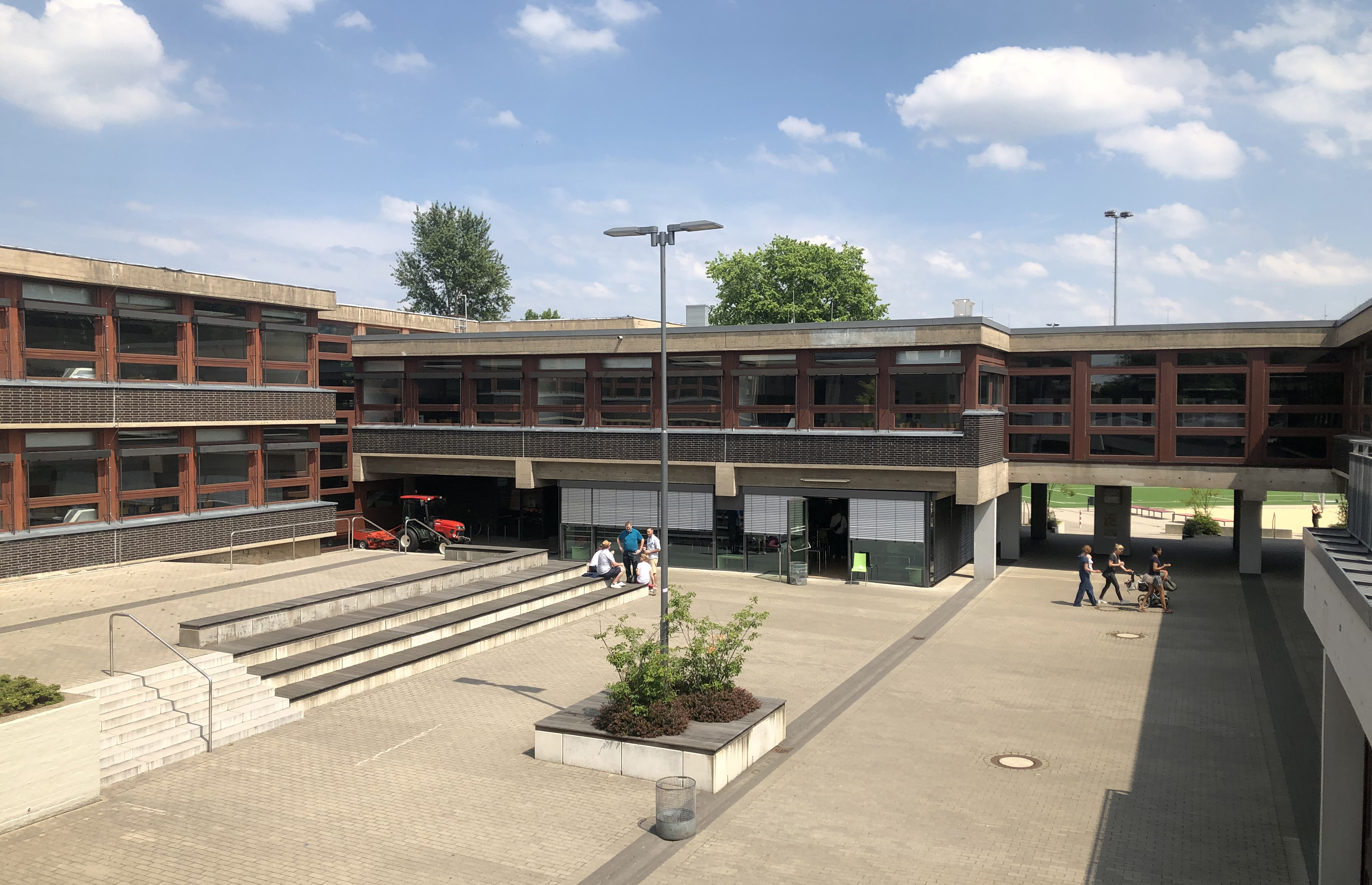
Theodor-Fliedner-Gymnasium
Most schools trace themselves back to a building, a benefactor, or a royal decree. The Theodor-Fliedner-Gymnasium in the Kaiserswerth district of Düsseldorf traces itself back to a marriage. In October 1836, a Lutheran pastor named Theodor Fliedner and his wife Friederike opened an Educational Institute for Deaconesses in this old Rhine town, training Protestant women for nursing, teaching, and social work at a time when respectable German society offered them almost nothing else. Their experiment changed European nursing - one of their trainees was a young Englishwoman named Florence Nightingale, who arrived in Kaiserswerth in 1851 - and almost two centuries later, in the same complex of pavilion-style buildings beside the Rhine, around 1,250 students still file in each morning beneath the legacy of those two reformers.
From Deaconesses to a Gymnasium
The Fliedners' institute spun off a higher girls' school in 1908, and that school, broadening over the decades, eventually became the modern co-educational Gymnasium. The Evangelical Church in the Rhineland still operates it - one of the largest Protestant schools in Germany - but the doors are open to students of every denomination and faith. The continuity is unusual. Few German schools can claim an unbroken thread back to the social reform networks of the 1830s, and fewer still operate on the original Kaiserswerth site, surrounded by buildings that once served as a hospital, an asylum, and a training centre for the women who would carry deaconess work across Europe and North America.
An Architecture Prize Among Schoolyards
The current school complex was built between 1962 and 1967 to designs by the Düsseldorf architect Christoph Parade. He laid the buildings out as a pavilion campus - one to three storeys, flat roofs, a children's wing for the youngest students, a separate main building for upper grades, laboratories and an auditorium of their own. It was unusual enough as school architecture that the Association of German Architects awarded it second prize in their 1970 schools competition. Four decades later, Claudia Gehse's 2009 to 2012 renovation - adding a cafeteria, swimming pool with an adjustable floor, climbing wall, and modernized labs - won the Schulbaupreis Nordrhein-Westfalen in 2013. Few Gymnasien get awarded twice for the same campus, separated by half a century.
Three Countries, Three Friendships
International partnerships at Theodor-Fliedner-Gymnasium read like a deliberate map of post-war reconciliation. Since 1970, the school has maintained an exchange with Ha'emek Hama'aravi Regional High School in Yifat, Israel - a connection that runs back to the years when German-Israeli ties were still tender and contested. Since 1993, students have travelled to a high school in Działdowo, Poland, a town with its own complicated history under German occupation. Since 2005, there has been a third partnership with a school in Nijmegen, just across the Dutch border, a city that lived through the autumn of 1944 and remembers it. For a Protestant school in the Rhineland, this triangle is more than a curriculum item. It is, quietly, a stance.
Who Walked the Halls
The most famous name on the alumni list is Margarethe von Trotta, born 1942, who passed her Abitur here in 1960 before becoming one of the leading figures of the New German Cinema. Her films - Marianne and Juliane, Rosa Luxemburg, Hannah Arendt - returned again and again to women navigating ideology, conviction, and the German twentieth century, which is perhaps not an accident for someone who grew up between a Protestant educational tradition and the rubble of post-war Düsseldorf. Carola Gräfin von Schmettow, born 1964, went on to lead HSBC Trinkaus & Burkhardt as CEO. The school has also produced a current Bundesliga-grade American football team, occasional rarity in a country where the sport remains a niche, and that team has won regional championships.
Held in Demand
In the mid-2020s, Düsseldorf families talk about Theodor-Fliedner-Gymnasium in the careful, slightly anxious way that parents talk about oversubscribed schools everywhere. City statistics for the 2025/26 enrollment cycle showed 230 first-choice applications recorded in February 2025, placing TFG among the most contested Gymnasien in the city. The boarding school that operated alongside the Gymnasium from 1954 - one of very few urban boarding programs in Germany - closed in July 2021, its building now used for other services of the Kaiserswerther Diakonie. But the school itself has only grown. From a higher girls' school of 1908 to a co-ed campus of more than a thousand students, the institution has done what its founders cared most about: it has kept teaching, kept evolving, and kept open.
From the Air
The Theodor-Fliedner-Gymnasium sits at 51.31°N, 6.75°E in the Kaiserswerth district on the right (east) bank of the Rhine, in the far north of Düsseldorf. From the air the district is recognizable by the medieval ruin of the Kaiserpfalz Kaiserswerth - the riverside imperial palace once held by Frederick Barbarossa - and the dense cluster of nineteenth-century deaconess institution buildings just inland. Nearest major airport: Düsseldorf International (EDDL), about 6 km south, with the school directly under the northern approach pattern.