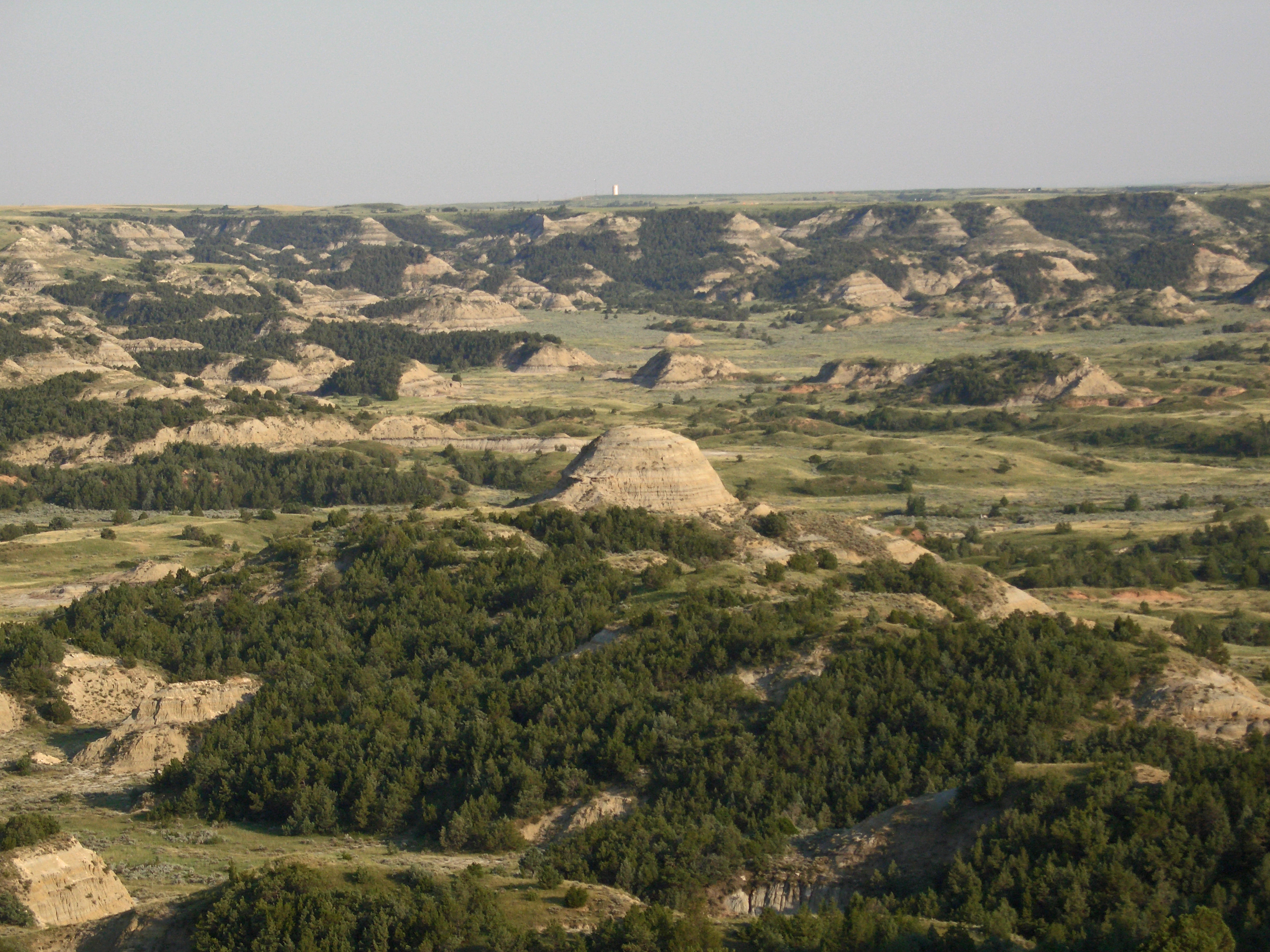
Theodore Roosevelt National Park
Five million years of erosion carved these badlands into spirals, summits, and valleys that look almost designed. The Sioux people hunted buffalo here for generations, producing warriors like Red Cloud and Crazy Horse. Then came Theodore Roosevelt, a bespectacled New York politician seeking to shoot a bison. He found something more. "I never would have been President," Roosevelt later declared, "if it had not been for my experiences in North Dakota." Today, 70,448 acres of this landscape bear his name, protecting the terrain that transformed him from a grieving widower into America's greatest conservationist president.
Deep Time in the Badlands
The rocks beneath Theodore Roosevelt National Park tell stories spanning 70 million years. Fossil hunters like the famed paleontologist Edward Drinker Cope and legendary rockhound Barnum Brown scoured these badlands, discovering specimens of Tyrannosaurus and Ornitholestes, along with mammals like Hyaenodon horridus and countless oreodonts, the sheep-like creatures of the Oligocene epoch. The fossils range from the Cretaceous to the Oligocene, laid down in ancient river systems and floodplains long before the region's dramatic uplift began. Five million years ago, that uplift triggered the erosion that sculpted today's landscape. Layer by layer, water and wind carved the striped buttes and tortured ravines that drew Roosevelt west in 1883.
The Sioux and the Homesteaders
Before Roosevelt arrived, the Sioux people lived as nomadic horsemen across these plains, their survival intertwined with the buffalo herds. They were formidable warriors. Red Cloud became the only Native American leader to win a war against the United States. Crazy Horse earned legendary status for his bravery in mounted combat. But the world was changing around them. Buffalo hunters arrived with the railroads, shooting the great herds from train windows to clear the land. The Homestead Act of 1862 brought settlers from Scandinavia, Germany, the Midwest, and the Eastern Seaboard. The land grants that worked for family farms in wetter climates proved barely survivable in the semi-arid badlands. By the 1870s, the Sioux had been forced onto reservations at Pine Ridge and Crow Creek.
Roosevelt's Transformation
Theodore Roosevelt owned and operated two ranches in what was then Dakota Territory during the 1880s: the Maltese Cross and the Elkhorn. He arrived as a wealthy easterner looking for adventure. He left as something different. The vigorous outdoor life, the camaraderie with working cowboys, the stark beauty of the landscape all shaped him profoundly. When Roosevelt became the 26th president in 1901, his conservation agenda reflected those formative years. During his presidency, he created five national parks, established the U.S. Forest Service, and signed the Antiquities Act that enabled the creation of national monuments. After his death in 1919, supporters searched the badlands for a site to memorialize him. The park was assembled over decades, finally achieving national park status in 1949.
Three Units, Two Time Zones
The park divides into three distinct units spread across the badlands. The South Unit is the most visited, featuring wildlife viewing and a scenic drive through rolling terrain. The North Unit offers rugged wilderness and peculiar geology. The remote Elkhorn Ranch Unit preserves the site of Roosevelt's second ranch, accessible only by unpaved roads that become impassable after rainfall. Visitors should note the time zone boundary: the North Unit operates on Central Time while the South Unit follows Mountain Time. More than 475,000 visitors explore the park each year. Native grasses support bison, elk, pronghorn antelope, white-tailed and mule deer, bighorn sheep, and feral horses. Prairie dog towns attract burrowing owls, golden eagles circle overhead, and rattlesnakes occupy abandoned burrows.
Walking in Roosevelt's Footsteps
Over 100 miles of trails wind through the park, from short walks to multi-day treks. More than 40 percent of the park, nearly 30,000 acres, is designated backcountry wilderness open to cross-country travel. The Maltese Cross Cabin, Roosevelt's first Dakota home, now stands at the South Unit visitor center, restored and furnished with period pieces and some of his personal effects. The badlands remain notorious for severe and unpredictable weather. Bison roam freely and can be dangerous when approached. Prairie dogs carry diseases. Rattlesnakes sun themselves on trails. Roosevelt would have appreciated these hazards. "It was a fine, healthy life," he wrote of his ranching years. "It taught a man self-reliance, hardihood, and the value of instant decision. I enjoyed the life to the full."
From the Air
Located at 46.95N, 103.455W in western North Dakota. The park's South Unit is accessible via Interstate 94 near Medora (exits 23, 27, and 32 for Painted Canyon). The North Unit entrance is on U.S. Highway 85 south of Watford City. Nearest airports include Dickinson Theodore Roosevelt Regional (KDIK), approximately 35 miles east of the South Unit, and Williston Basin International (KXWA) to the north. The distinctive badlands terrain with colorful striped buttes and the meandering Little Missouri River provide excellent visual landmarks. The park appears dramatically different from surrounding prairie when viewed from altitude.