The Eruption of Thera: The Volcano That May Have Destroyed Atlantis
Around 1600 BC - give or take a century - the volcanic island of Thera in the Aegean Sea exploded. The eruption was one of the largest in human history, ejecting roughly 60 cubic kilometers of material and creating a caldera that is now one of the Mediterranean's most beautiful harbors. The explosion buried the Minoan city of Akrotiri under volcanic ash - a Bronze Age Pompeii perfectly preserved for 3,600 years. Tsunamis struck Crete and coastlines across the eastern Mediterranean. The Minoan civilization, the first great civilization of Europe, never recovered. And some scholars believe the eruption inspired Plato's legend of Atlantis - a great civilization destroyed by the gods.
The Island
Thera - known today as Santorini - was a volcanic island in the Aegean Sea, about 70 miles north of Crete. In the Bronze Age, it was home to a thriving Minoan settlement at Akrotiri. The Minoans were the first great European civilization, with sophisticated art, advanced plumbing, and trading networks spanning the Mediterranean.
Akrotiri was a prosperous town, with multi-story buildings, paved streets, and beautiful frescoes depicting ships, dolphins, and daily life. The residents apparently had warning of the coming eruption - no bodies have been found at the site, suggesting an evacuation. But they could not escape what came next.
The Eruption
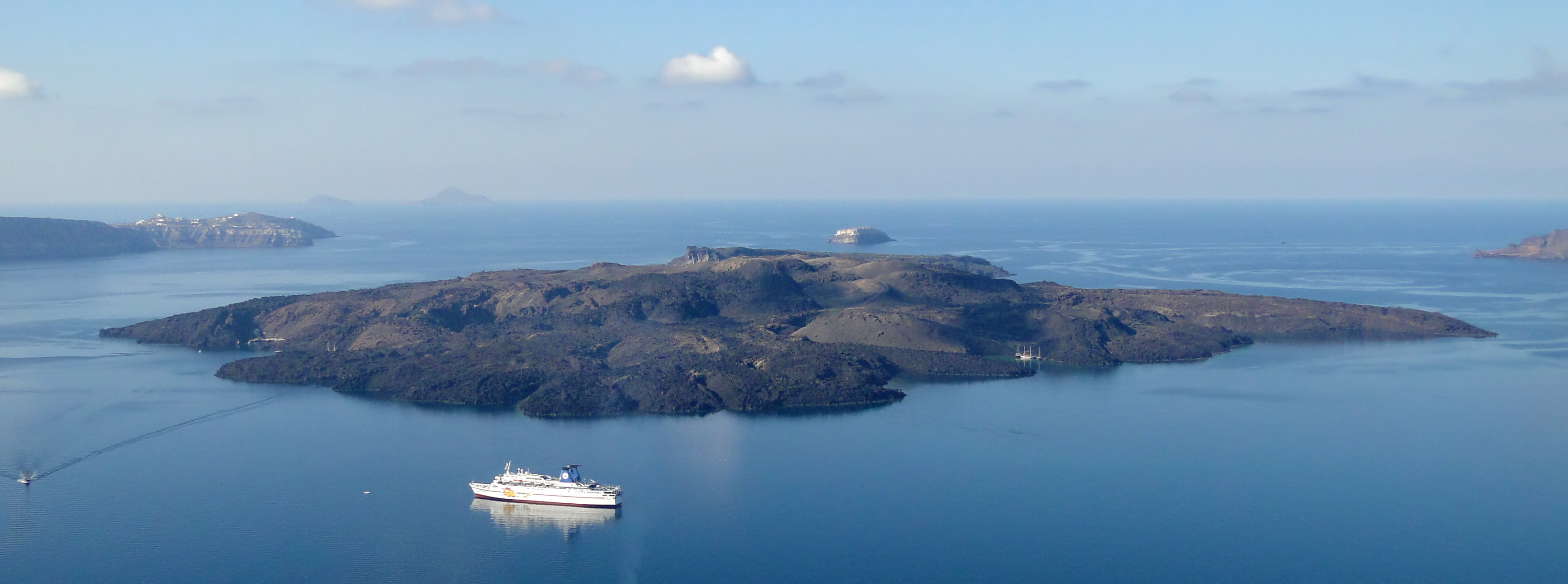
The eruption occurred in multiple phases over several days or weeks. The initial phase ejected pumice and ash high into the atmosphere. The main explosive phase then destroyed the island's center, creating a massive caldera - the crater that now forms Santorini's famous crescent shape and deep harbor.
The eruption was between VEI 6 and 7 - comparable to Krakatoa or larger. The ash cloud would have darkened skies across the eastern Mediterranean. Volcanic deposits from Thera have been found in Turkey, Egypt, and the Black Sea. The world changed in a matter of days.
The Tsunamis
The caldera collapse generated massive tsunamis. Waves possibly 35 feet high struck the north coast of Crete, 70 miles to the south. Coastal settlements were devastated. Some researchers believe the tsunamis were the primary cause of the subsequent Minoan decline.
The Minoan civilization on Crete, which had flourished for centuries, went into rapid decline after the Thera eruption. Within a century, Mycenaean Greeks had taken control. Whether this was directly caused by the eruption or merely accelerated by it remains debated. But the temporal correlation is striking.
The Preservation
Akrotiri was buried under volcanic ash like Pompeii would be 1,700 years later. The ash preserved buildings, frescoes, pottery, and artifacts in extraordinary detail. Excavations that began in 1967 have revealed a sophisticated Bronze Age city frozen in time.
The frescoes at Akrotiri are among the finest surviving Bronze Age artworks - scenes of spring flowers, boxing boys, ships in harbors, and dolphins leaping. They show a civilization of remarkable refinement, snuffed out in its prime by the volcano that had sustained its agriculture with fertile soil.
The Legend
Some scholars believe the Thera eruption inspired Plato's story of Atlantis - a great civilization destroyed by the gods and sunk beneath the sea. Plato's account places Atlantis beyond the Pillars of Hercules (the Strait of Gibraltar), but his description of a circular island with concentric rings of water fits the pre-eruption shape of Thera.
The connection remains speculative. Plato wrote 1,200 years after the eruption. His Atlantis was a moral fable, not a historical account. But the coincidences are suggestive: a great civilization, technologically advanced, destroyed by divine wrath, swallowed by the sea. Whether or not Thera was Atlantis, its destruction was real - and its ruins still emerge from the volcanic ash, a reminder of a world that ended in fire.
From the Air
Santorini (Thera) (36.42N, 25.43E) lies in the southern Aegean Sea, 200km southeast of Athens. Santorini Airport (LGSR) is on the island. The caldera is visible from the air as a dramatic crescent-shaped island surrounding a deep bay. The Akrotiri archaeological site is on the southern tip. Volcanic activity continues - the small islands of Nea Kameni in the caldera are still active.