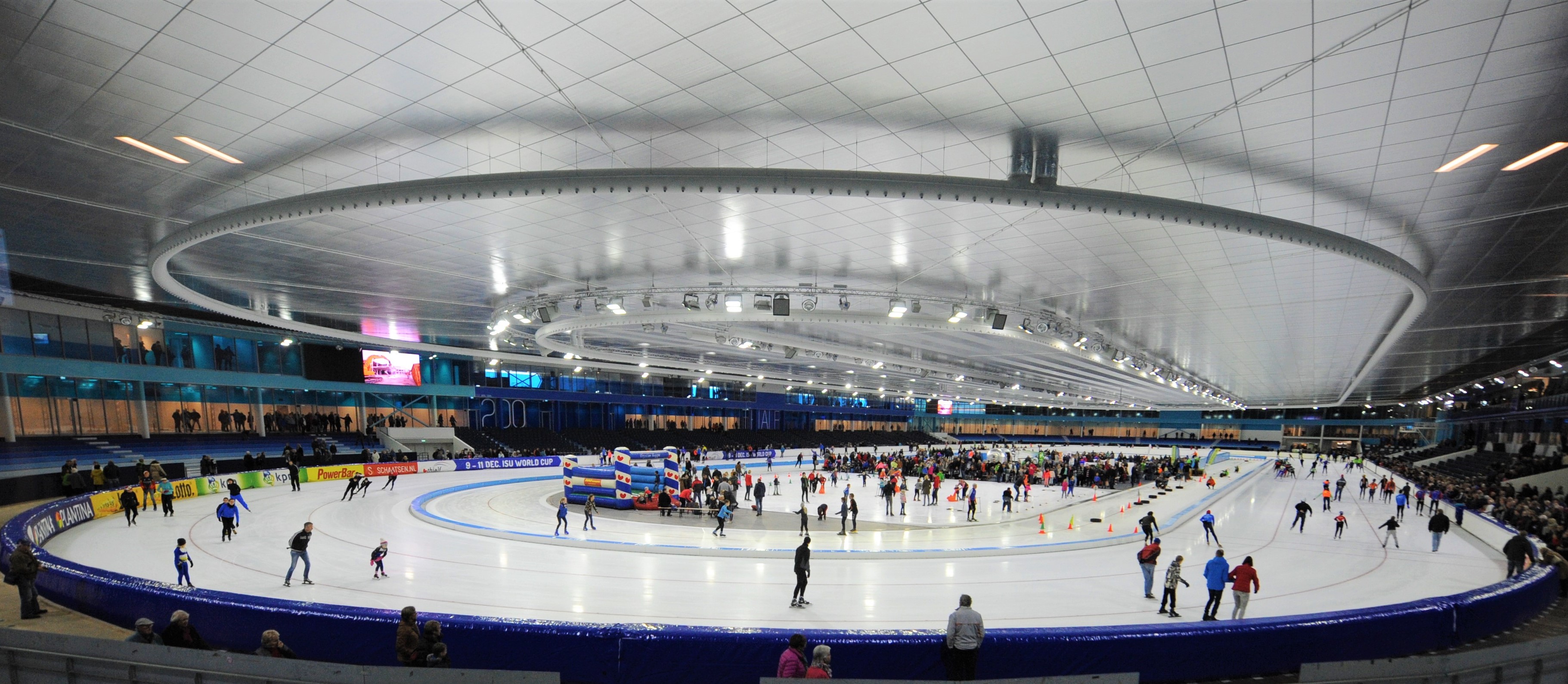
Thialf
Thialfi was the servant who outraced a giant. In the Norse myth, Thor and his companions arrive at the hall of Utgard-Loki, and the giant-king proposes a series of contests. Thialfi, the swift one, is chosen for the footrace. He loses three times to a runner called Hugi, whose name turns out to mean Thought, because no leg, no matter how strong, can outrun the mind itself. The Dutch who built the third artificial 400-metre ice oval in the Netherlands, just outside Heerenveen, gave it that runner's name. It opened on October 14, 1967, under the hand of Princess Christina of the Netherlands, and it has been chasing time ever since.
The Open Sky Years
For nearly two decades, Thialf was an outdoor track. Wind raked across the polders, snow blew sideways, and Dutch winters that could not always be relied upon supplied just enough cold to keep the ice firm with the help of refrigeration coils underneath. Only one world record was ever set on the open rink: Andrea Schoene, an East German skater, took the women's 5,000 metres in 1983. The outdoor years produced a generation of Dutch skaters who learned to read weather the way sailors do, who knew which gust would help on the back straight and which would punish the final turn. Then, in 1986, somebody built a roof.
A Season of Falling Records
The covered Thialf opened on November 17, 1986, a year after the first 400-metre indoor oval at Sportforum Hohenschonhausen in Berlin. With climate control, the engineers could now choose the temperature of the ice and the humidity of the air. The result was extraordinary. In that first indoor season, almost every world record in long-track speed skating was broken at Thialf. For a brief, wonderful stretch, this was simply called the fastest ice in the world. Then, two years later, Calgary opened an indoor oval at altitude, and Salt Lake City did the same. Thin air at 1,000-plus metres turned out to beat sea-level engineering. Thialf lost the title, but it kept the records, and it kept the crowds.
Twelve and a Half Thousand Voices
The current stadium, renovated in 2016, seats 12,500 for skating events and packs them in for the Dutch, European, and World championships every winter, plus one or two Speed Skating World Cup weekends each season. When the Netherlands is racing for medals, the noise inside the bowl is something close to a physical force. The 2,500-seat ice hockey rink next door hosts the Heerenveen Flyers, one of the country's most successful hockey clubs. Beyond skating, the building has hosted concerts by Whitney Houston, Tina Turner, TOTO, Prince, and Andre Rieu, and several editions of the national Miss Universe competition. Almost nothing about it is glamorous from the outside. The drama is on the ice.
The 2030 Question
As of April 2025, the French organisers of the 2030 Winter Olympics were openly considering Thialf as the venue for long-track speed skating. If it happens, it will be the first Olympic events held in the Netherlands in 102 years, a striking return for a country that has never hosted the Winter Games but that produces an outsized share of every Olympic medal in the sport. The economic case is straightforward. The Alps are warming faster than anyone wants to admit, and ready-made ovals at sea level, with full federation support and a city that lives and breathes the sport, are not common. Thialfi the servant lost his footrace against Thought. The Frisian Thialf, four kilometres outside Heerenveen, has spent six decades being faster than expected.
From the Air
Thialf sits at 52.94N, 5.94E on the south side of Heerenveen, immediately recognisable from altitude as a long, low, dark-roofed industrial shape next to the Abe Lenstra football stadium. From 3,000 to 5,000 feet, the two big sports buildings stand out clearly against the flat green Frisian polderland, with the A32 motorway curving past to the west. The nearest GA field is Drachten Airport (EHDR), about 25 kilometres northeast; Groningen Airport Eelde (EHGG) sits further northeast for IFR traffic. Friesland's reliably flat horizon and gridded canals make for easy visual navigation in clear weather.