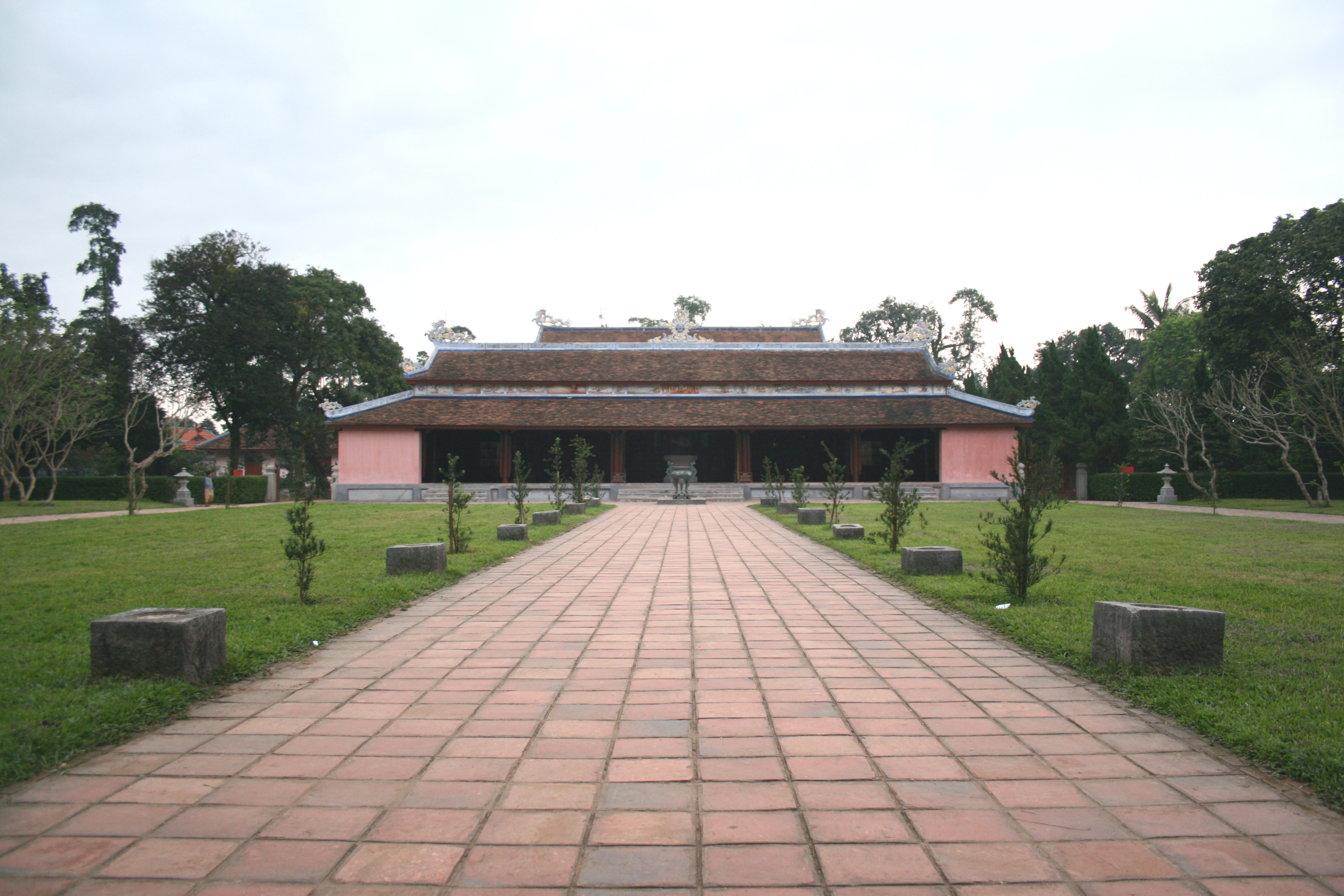
Thiên Mụ Temple
A woman in red and blue sat on a hill above the Perfume River, rubbing her cheeks, and told anyone who would listen that a lord would come to build a pagoda here. Then she vanished. In 1601, Nguyễn Hoàng -- the governor of Thuận Hóa and the first of the Nguyễn lords who would shape central Vietnam for centuries -- heard this legend while touring the area and ordered a temple built on the spot. Four centuries later, the seven-story Phước Duyên pagoda that crowns Hà Khê hill remains the most recognizable silhouette on Huế's skyline, and the temple it belongs to still carries the name of that ghostly woman: Thiên Mụ, the Celestial Lady.
A Lord's Wager on a Ghost Story
Nguyễn Hoàng was officially a governor serving the Lê dynasty in Hanoi. In practice, he was the de facto independent ruler of central Vietnam, founding a political line that would endure for generations and eventually produce the Nguyễn dynasty -- the last to rule a unified Vietnam. His decision to build Thiên Mụ Temple was more than piety. Erecting a pagoda on a prominent hill overlooking the Perfume River, roughly five kilometers from what would become the Citadel of Huế, was a declaration of permanence. The original structure was modest, but in 1665, Nguyễn Lord Nguyễn Phúc Tần undertook a major expansion that gave the complex much of the grandeur visitors encounter today. Over the centuries, successive rulers refurbished and enlarged the temple, layering architectural styles atop one another like sediment -- each generation adding its mark to a site that predated them all, since the hill already held a pre-existing shrine when Hoàng arrived.
Seven Stories Above the River
The Phước Duyên pagoda, the seven-story octagonal tower that serves as the temple's centerpiece, rises from the hilltop like a punctuation mark against the sky. Each of its tiers was dedicated to a different Buddha. Around it, the temple grounds hold a monolithic drum carved from jackfruit wood, stone steles chronicling the tower's construction, and the main hall where monks still chant in the early morning hours. The setting is as much of the experience as the architecture. Hà Khê hill sits on the northern bank of the Perfume River, and the approach by boat -- the traditional way to arrive -- reveals the pagoda gradually through river mist and foliage, a view captured in landscape paintings since at least 1845, when it appeared in the imperial painting set Thần Kinh Thập Nhị Cảnh.
The Car That Changed a War
Inside the temple compound, behind glass and ropes, sits an Austin Westminster sedan. On June 11, 1963, this car carried the monk Thích Quảng Đức from Thiên Mụ Temple to a busy Saigon intersection, where he sat down, was doused in gasoline, and set himself on fire. The self-immolation, the first by a Buddhist monk during the crisis against President Ngô Đình Diệm's regime, produced one of the most iconic and disturbing photographs of the twentieth century. It thrust the persecution of Vietnamese Buddhists onto front pages worldwide and contributed to the international pressure that helped topple Diệm's government months later. The temple preserves the car not as a relic of protest but as a reminder of what that protest cost. Thích Quảng Đức did not survive. The series of self-immolations that followed his brought global attention to a conflict that many outside Vietnam had barely noticed.
Dissent on Sacred Ground
Thiên Mụ has been a site of political tension well beyond the 1960s. In the early 1980s, after a murder near the pagoda, the temple became a focal point for anti-communist protests that shut down traffic around the nearby Phú Xuân Bridge. The government responded by arresting monks, charging them with disturbing traffic flow and public order -- a framing that fooled no one. The pattern is older than communism or colonialism. For four centuries, Thiên Mụ has occupied the intersection of spiritual authority and political power in Huế. Built by a political lord invoking a supernatural mandate, expanded by his successors as a statement of dynastic legitimacy, and repeatedly thrust into the center of national crises, the temple has never been merely a place of worship. It is a place where worship and the state have always watched each other warily across the incense smoke.
From the Air
Coordinates: 16.454°N, 107.545°E, on Hà Khê hill on the northern bank of the Perfume River in Huế. The seven-story Phước Duyên pagoda is a distinctive landmark visible from the air. Best viewed at 1,500-2,500 feet AGL approaching from the south over the river. The Citadel of Huế lies approximately 5 km to the east-southeast. Nearest airport: Phu Bai International Airport (VVPB), roughly 15 km south-southeast. The Perfume River winds prominently through the city and serves as a reliable navigation reference.