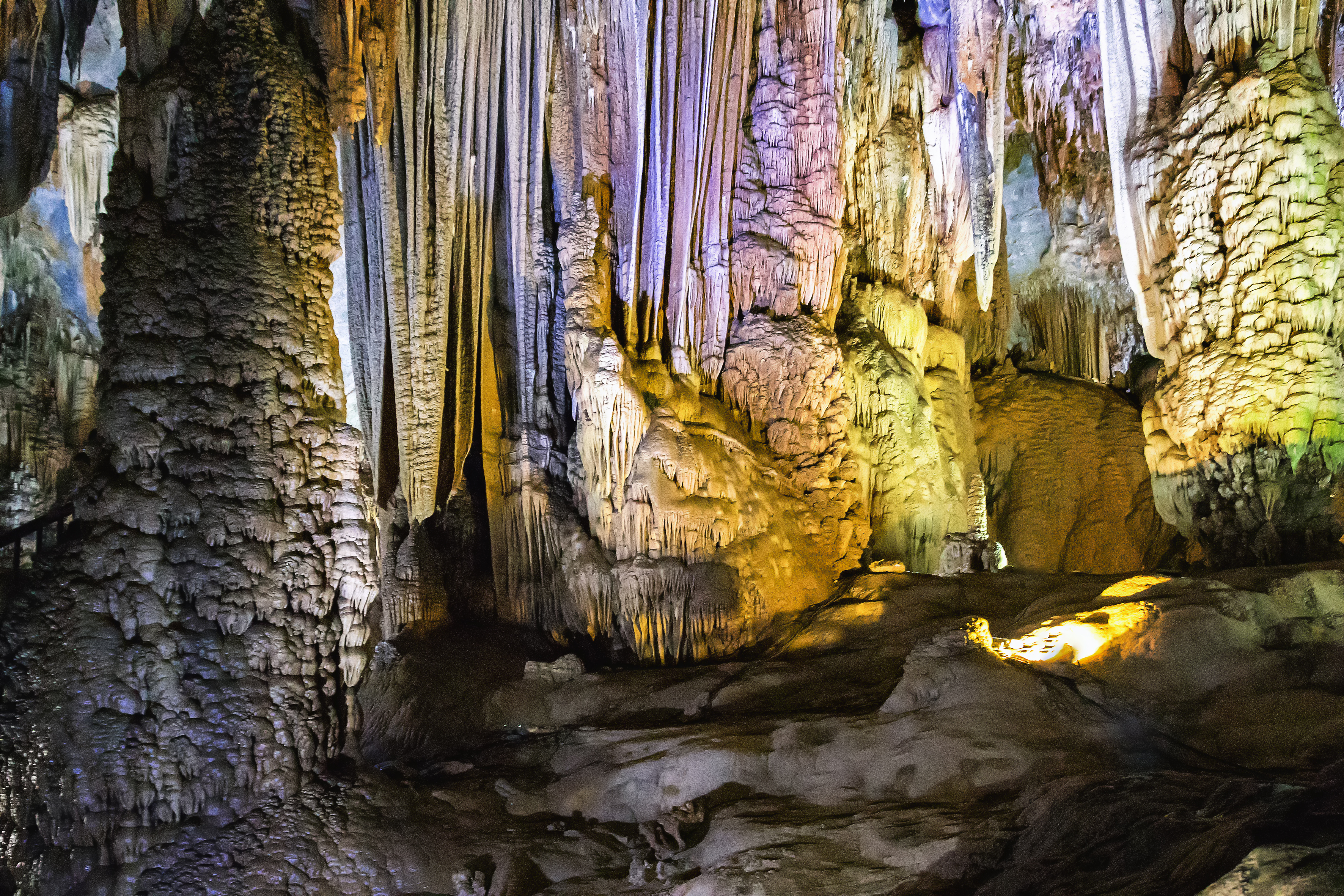
Thiên Đường Cave
The British cavers who first explored its depths did something unusual: they named it before they mapped it. Thirty-one kilometers of limestone passage, chambers rising 72 meters high and stretching 150 meters wide, stalactites and stalagmites so extravagant they looked sculpted rather than grown - the explorers from the British Cave Research Association took one look and called it Thiên Đường, Paradise Cave. In a national park already home to the world's largest cave passage, that name was not given lightly.
Found by Footstep, Mapped by Headlamp
Paradise Cave owes its discovery to a local man who found the entrance in 2005, high on a hillside 350 meters above sea level in Quảng Bình Province, central Vietnam. The cave mouth sits near the western branch of the Ho Chi Minh Highway, in Son Trach Commune of Bố Trạch District, roughly 60 kilometers northwest of the provincial capital Đồng Hới. That same year, British Cave Research Association explorers surveyed the first five kilometers. What they found kept them coming back. The full 31-kilometer extent was eventually mapped and publicly announced, making Paradise Cave longer than Phong Nha Cave, which had until then been considered the longest in the entire national park. The scale is difficult to convey in numbers alone. Imagine a cathedral nave that stretches for kilometers, its vaulted ceiling disappearing into shadow, its floor bristling with mineral formations built drop by drop over millions of years.
Inside the Limestone Cathedral
Phong Nha-Kẻ Bàng National Park sits atop one of the oldest and most extensive karst landscapes in Asia, shaped by roughly 400 million years of geological process. Paradise Cave is part of this system, carved by water dissolving its way through ancient limestone. The results are formations of bewildering variety: stalactites hanging in curtains, stalagmites rising like organ pipes, flowstone cascading down walls in frozen waterfalls. The chamber dimensions dwarf most show caves on Earth - at its widest, the passage stretches 150 meters across, and the ceiling soars to 72 meters, tall enough to swallow a twenty-story building. The cave's limestone formations are considered more spectacular than those of neighboring Phong Nha Cave, a claim that carries weight given Phong Nha's own reputation. In the permanent darkness beyond the tourist boardwalks, the cave harbors life adapted to total blackness. In 2012, scientists described a new species from within Paradise Cave: Vietbocap thienduongensis, a troglobiontic scorpion - an arachnid that has evolved to live its entire life underground, sightless and pale.
A Kingdom of Caves
Paradise Cave does not exist in isolation. Phong Nha-Kẻ Bàng National Park, a UNESCO World Heritage Site, contains a staggering concentration of caves, including Hang Sơn Đoòng - the world's largest cave by volume, with passages large enough to contain entire city blocks - and Hang Én, one of the largest cave entrances on the planet. The karst system extends across hundreds of square kilometers of jungle-covered mountains along the Vietnamese-Lao border. Rivers vanish underground for kilometers before resurfacing. Entire ecosystems thrive in the twilight zones near cave mouths, while deeper passages hold species found nowhere else. The region's remoteness, combined with the dense jungle and rugged terrain that kept it largely inaccessible for decades, means that new caves and new species are still being discovered. What makes the park exceptional is not any single cave but the density and variety of them - river caves, dry caves, vertical shafts, and horizontal galleries all packed into a relatively compact area.
Walking the First Kilometer
Since September 3, 2010, Paradise Cave has been open to visitors. The Truong Thinh Group built an access road and infrastructure, including a parking area 1.6 kilometers from the cave entrance. Visitors can ride a golf cart or walk a paved road to the cave mouth, where a wooden boardwalk leads into the first kilometer of passage - the portion open to general visitors without a guide. The boardwalk winds past illuminated formations, the air cool and damp, the silence broken only by the drip of water working its slow geology. For those wanting to go deeper, adventure tours penetrate seven kilometers into the cave, wading through underground streams and scrambling over breakdown blocks. The contrast between the two experiences is stark: the tourist kilometer offers grandeur in comfort, while the adventure route offers the rawness of exploration, mud and darkness and the knowledge that most of this cave remains as the British explorers first found it - utterly wild, stretching onward into passages that daylight has never reached.
From the Air
Located at 17.52°N, 106.22°E in Phong Nha-Kẻ Bàng National Park, Quảng Bình Province, central Vietnam. The cave entrance is on a hillside at 350 meters elevation, invisible from the air. The surrounding terrain is dramatic karst - jagged limestone peaks covered in dense tropical jungle, with rivers cutting through narrow valleys. Nearest airport is Dong Hoi Airport (VVDH), approximately 60 km to the southeast. The Ho Chi Minh Highway provides the main ground access. From altitude, the karst topography is unmistakable: a sea of dark green jungle punctuated by pale limestone towers.