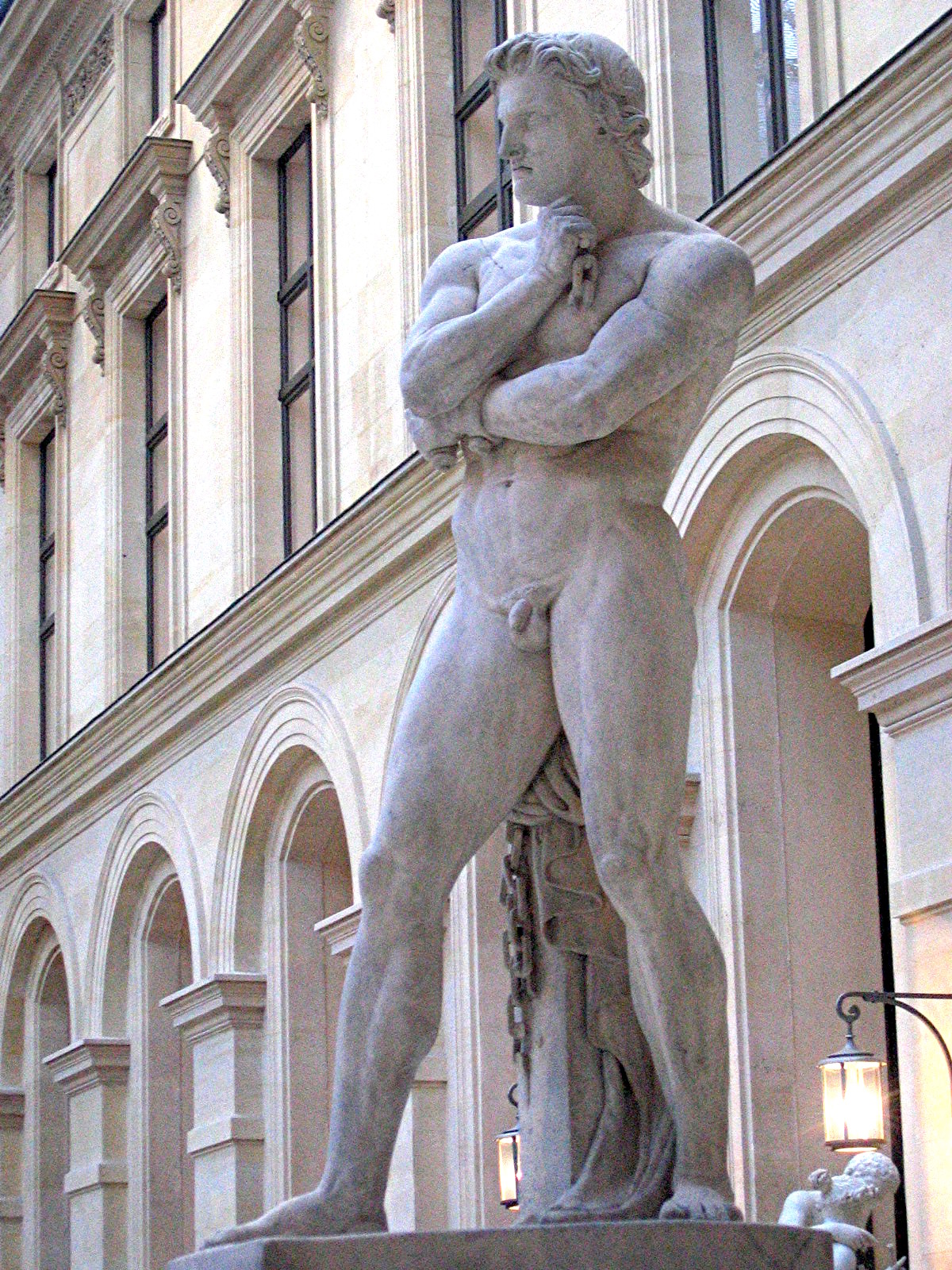
Third Servile War
It started with kitchen implements. In 73 BC, about seventy gladiators seized choppers and spits from the kitchen of Lentulus Batiatus's training school in Capua, fought their way past the guards, and hijacked several wagons of gladiatorial weapons on the road outside. Within two years, those seventy men had become an army of 120,000 -- enslaved people, shepherds, farmhands, and fugitives who defeated every Roman force sent against them, including trained legions under consular command. The Third Servile War was the only slave rebellion that directly threatened the Roman heartland, and it terrified the Republic so badly that 6,000 of the survivors were crucified along the Appian Way as a message to anyone who might try again.
The Machine That Made Spartacus
Rome's wars of conquest in the second and first centuries BC flooded Italy with enslaved people -- tens of thousands at a time from campaigns across Europe and the Mediterranean. They worked mines, farms, and the vast agricultural estates called latifundia that covered Sicily and southern Italy. Under Republican law, an enslaved person was property, not a person; owners could abuse, injure, or kill them without legal consequence. The first two Servile Wars had erupted in Sicily in 135 and 104 BC, drawing tens of thousands of participants, but Rome never considered them existential threats. The rebellions stayed on the island, far from the capital. What nobody in the Senate imagined was that a gladiator school in Campania -- where prisoners of war and condemned criminals were trained to kill each other for public entertainment -- could produce a leader capable of humiliating Rome on its own soil.
From Vesuvius to the Alps
The escaped gladiators chose three leaders: Spartacus, whose name may derive from the Thracian words for "renowned by the spear," and two Gauls, Crixus and Oenomaus. They retreated to Mount Vesuvius, and when praetor Gaius Claudius Glaber besieged them with 3,000 militia -- Rome still thought it was dealing with a crime wave, not a war -- they wove ropes from vines, rappelled down the mountain's far side, and annihilated the Roman force. A second expedition under praetor Publius Varinius fared no worse: Spartacus defeated his split forces, nearly captured Varinius himself, and seized all his military equipment. Enslaved people and shepherds poured into the rebel ranks until they numbered 70,000. They spent the winter of 73-72 BC training their recruits, manufacturing weapons, and raiding the towns of Nola, Nuceria, Thurii, and Metapontum. By the end of 73 BC, Spartacus commanded a force that could match a consular army in open battle.
Rome Sends Its Legions
The Senate dispatched both consuls for 72 BC with full legions. Gellius caught Crixus and a force of 30,000 near Mount Garganus and killed two-thirds of them, including Crixus himself. But Spartacus crushed the remaining Roman forces in sequence -- first Lentulus's legion, then Gellius's army in its turn. According to Appian, Spartacus forced 300 captured Roman soldiers to fight each other as gladiators in honor of Crixus, a grim reversal of the arena's usual power dynamics. Both consuls were recalled in disgrace. The Senate turned in desperation to Marcus Licinius Crassus, who received six new legions plus the two disgraced consular armies -- 32,000 to 48,000 troops in total. Crassus restored discipline through terror, reviving the ancient punishment of decimation: every tenth man in a unit could be beaten to death by his comrades. His legions learned quickly that their commander was more dangerous than the enemy.
The Appian Way, Lined with Crosses
Crassus pursued the rebels into the toe of Italy, built fortifications across the isthmus at Rhegium, and besieged them. Spartacus broke through and retreated, but his army was fraying. Groups of fighters broke away to attack Crassus's legions independently, and discipline was collapsing. When word came that Pompey's legions were marching from the north and Marcus Terentius Varro Lucullus was landing troops at Brundisium, Spartacus knew the trap was closing. He turned his full remaining strength against Crassus in what became the Battle of the Silarius River. The rebel army was destroyed. Ancient historians agree that Spartacus died fighting, though his body was never found. Pompey's forces intercepted 5,000 survivors fleeing north and killed them all, then sent a letter to the Senate claiming that while Crassus had won the battle, he, Pompey, had ended the war. Six thousand captured survivors were crucified along the Appian Way from Rome to Capua -- a line of crosses stretching roughly 200 kilometers. Both Crassus and Pompey parlayed their military fame into election as consuls for 70 BC, accelerating the political rot that would eventually transform the Republic into the Empire. The rebellion that had begun with kitchen knives ended by reshaping Rome itself.
From the Air
Located at 41.10N, 14.20E near ancient Capua (modern Santa Maria Capua Vetere) in the Campania region of southern Italy. The gladiator school where the revolt began was in Capua, roughly 30 km north of Naples. The rebellion ranged across much of southern and central Italy, from Mount Vesuvius in the south to Cisalpine Gaul in the north. From altitude, the flat Campanian plain is visible with Vesuvius to the south and the Apennine mountains to the east. Nearest major airport is Naples International (LIRN), approximately 30 km to the south. The Appian Way, along which the crucifixions took place, ran roughly from Rome (LIRF) south through Capua.