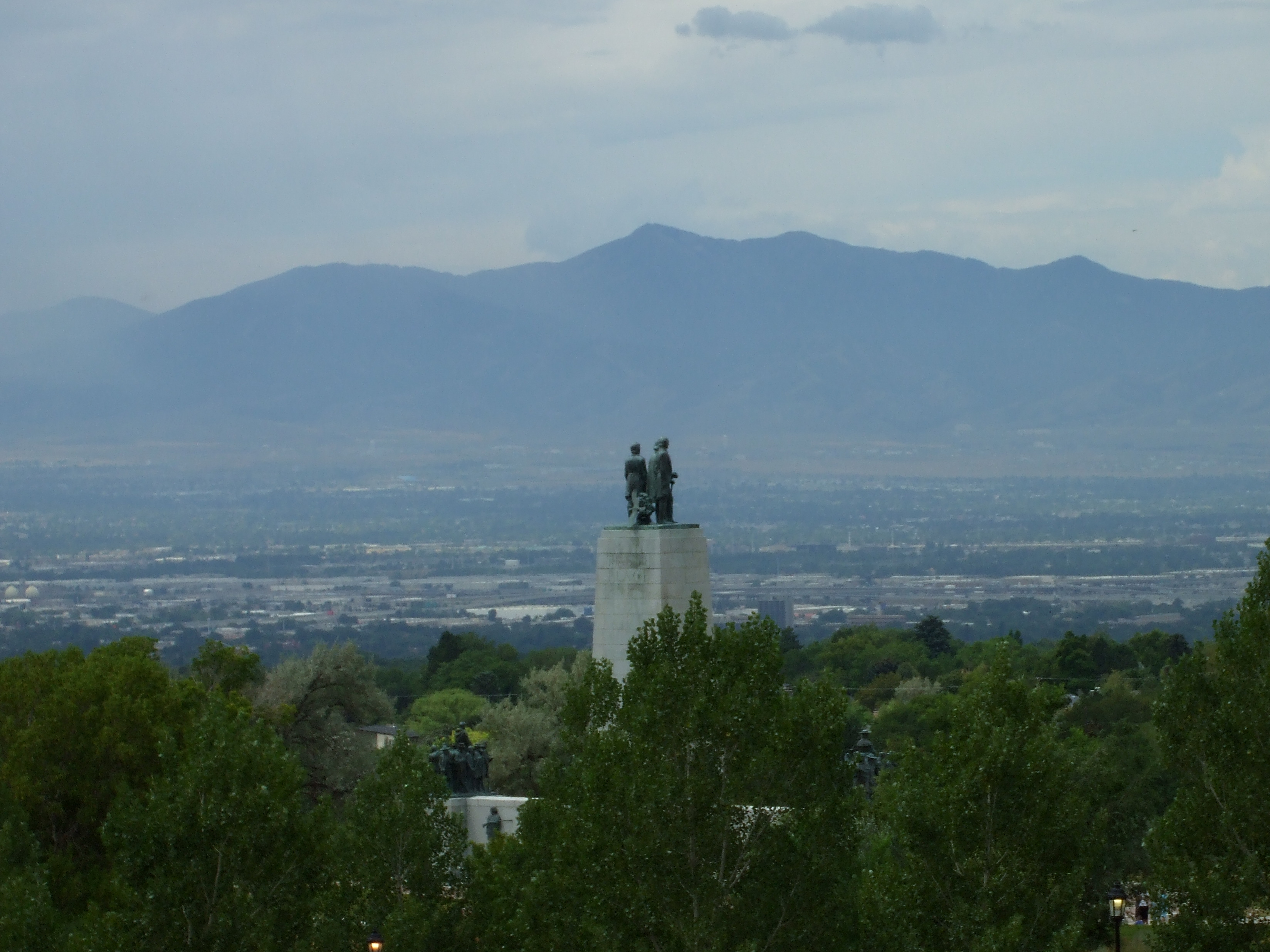
This Is the Place Monument
The words were simple: "This is the right place, drive on." On July 24, 1847, Brigham Young, weakened by Rocky Mountain spotted fever and riding in a wagon, looked out over a valley of sagebrush and salt flats bounded by mountains. The Great Salt Lake shimmered to the northwest. No trees. Little water. But Young had led his followers 1,300 miles from persecution in Illinois, and this desolate basin would become their Zion. Exactly one hundred years later, on July 24, 1947, church president George Albert Smith dedicated a monument at the spot where Young first viewed the valley. The sculptor was Mahonri M. Young, the prophet's own grandson, who spent eight years creating a bronze tribute to the pioneers.
A Grandson's Eight-Year Labor
Mahonri M. Young was already an accomplished sculptor when he received the $50,000 commission in 1939. He had studied in Paris, worked alongside Auguste Rodin, and created the Seagull Monument that had stood on Temple Square since 1913. For this larger project, he retreated to Weir Farm in Connecticut, the former estate of American Impressionist J. Alden Weir that had become an artists' colony. There, with chief assistant Spero Anargyros, Young worked from 1939 to 1947, sculpting the figures who would populate the monument. The timing was intentional: the monument would be ready for the centennial of the pioneers' arrival. Young created not just a Mormon memorial but a tribute to all who explored and settled the American West, and the figures on the monument reflect that broader vision.
The Journey Through the Canyon
The monument stands at the mouth of Emigration Canyon, the final passage of a brutal westward journey. The Mormon pioneers had followed earlier travelers, including the Donner Party, who had passed through the canyon just one year before on their doomed journey toward California. The canyon earned its name because emigrant after emigrant used this natural gap through the Wasatch Mountains to descend into the Salt Lake Valley. For the Mormons, who had faced mob violence and the murder of their founder Joseph Smith in the eastern states, the valley beyond the canyon represented refuge. Young's failing health meant he viewed it from a wagon rather than horseback, but his declaration fixed the location in history. The pioneers who followed him into the valley would transform the sagebrush basin into a city within a generation.
Faces in Bronze
The monument rises with Brigham Young, Heber C. Kimball, and Wilford Woodruff at the summit, the three men who first entered the valley. Below them, bronze figures represent the full scope of Western exploration. The Donner Party appears, commemorating their 1846 passage through this same canyon before disaster struck in the Sierra Nevada. Spanish explorers from the Dominguez-Escalante expedition of 1776 represent the first Europeans to document the region. Mountain men like Hugh Glass, Peter Skene Ogden, and Etienne Provost stand alongside fur traders from William H. Ashley's American Fur Company. Chief Washakie represents the Shoshone people who had known these valleys for generations before any European arrived. John C. Fremont, the explorer whose maps guided westward migration, takes his place among the figures. The monument names more than two dozen individuals, turning bronze into biography.
Heritage Park and Living History
In the mid-1970s, a living history museum grew beside the monument. This Is the Place Heritage Park began by relocating and restoring pioneer-era buildings from across Utah, creating a village where the nineteenth century continues. Log cabins, a blacksmith shop, and period homes line dirt streets where interpreters in historical costume demonstrate crafts and daily life from the settlement era. The park has expanded significantly since its founding, becoming a venue for school field trips, family reunions, and community events. The original monument still anchors the site, standing at the canyon mouth where wagons once emerged from the Wasatch Mountains. A smaller, earlier monument had marked the spot before Young's sculpture arrived, but the centennial project replaced it with something grander. Today, visitors can trace the same view Brigham Young saw in 1847, though the sagebrush has long since given way to a city of over 200,000.
From the Air
The This Is the Place Monument stands at coordinates 40.7532N, 111.8133W at the mouth of Emigration Canyon on Salt Lake City's eastern edge. The monument and Heritage Park are visible from the air at the point where the canyon opens into the Salt Lake Valley, with the Wasatch Mountains rising immediately to the east. Salt Lake City International Airport (KSLC) lies 10 nm west-northwest. The site sits at approximately 4,800 feet elevation. The canyon itself makes an excellent visual landmark, cutting through the Wasatch Range. Best viewed when approaching from the west, where the relationship between canyon, monument, and valley becomes clear.