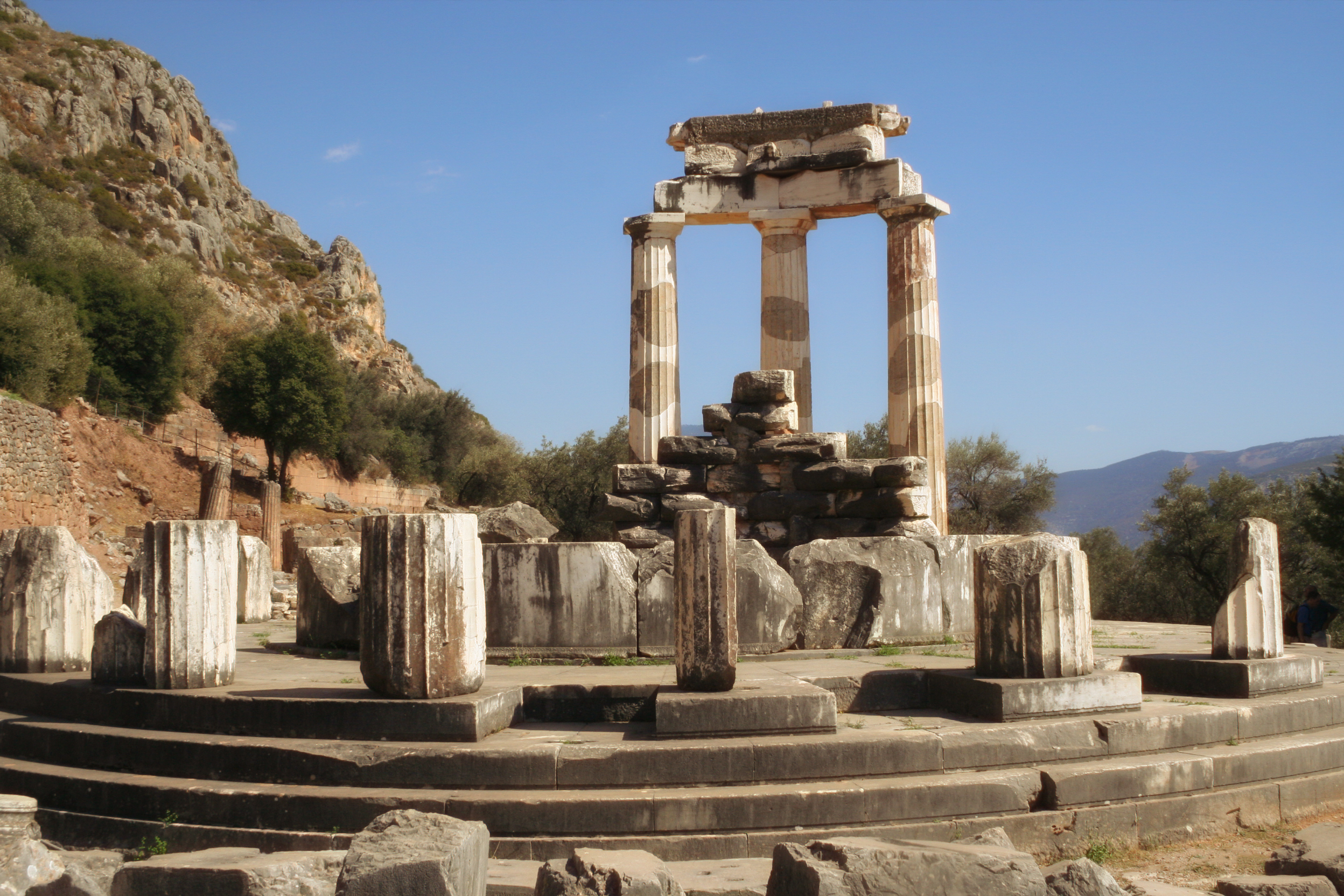
Tholos of Delphi
Almost every photograph of Delphi shows the same three columns. They stand on a circular foundation in the lower sanctuary, against the gray cliffs of Mount Parnassus, framed by olive trees and the deep valley of the Pleistos. Those three columns are the Tholos of Delphi, a circular temple raised around 380-370 BC inside the Sanctuary of Athena Pronaia. The other seventeen columns of the original twenty are gone or scattered. The three you see were re-erected in 1938 by French archaeologists, deliberately reconstructed from fallen drums to give modern visitors a sense of what the building once looked like. The reconstruction is honest about being a reconstruction. The columns lean against time itself, holding up only memory.
Theodorus Phoceus and a Round Temple
The architect was Theodorus of Phocis, named by the Roman writer Vitruvius in his architectural treatise De Architectura. Vitruvius is careful to distinguish him from Theodorus of Samos, the legendary 6th-century engineer who designed the great temple of Hera there. The Phocian Theodorus was a 4th-century BC architect whose work is otherwise mostly lost. The Tholos is his surviving masterpiece, a circular Doric temple at a time when Greek temples were almost universally rectangular. Twenty Doric columns ringed the exterior, supporting a frieze of triglyphs and metopes. The interior cella, a circular chamber inside the colonnade, was crowned by its own smaller frieze. Inside, ten Corinthian pilasters were attached to the curving wall, mixing the heavier exterior order with a lighter, more elaborate interior order. The mixing of orders within one building was unusual for the period.
Three Stones, Three Colors
The architects worked deliberately with material as a design element. The platform was limestone. The superstructure used Pentelic marble, the same fine white stone that built the Parthenon. The thinner slabs and certain decorative elements were what the Greeks called titanolithos, translated as Eleusinian dark stone, a bluish-gray limestone from Eleusis that contrasted vividly against the white Pentelic. The roof was marble, broken into eight curved sections, each crowned with a female statue carved in motion as akroteria, sculptures perched at the corners and peaks of the roofline. The whole effect was polychromatic, three different building stones playing against each other in a way that no monochrome reconstruction can capture. To imagine the building correctly, you have to picture marble against bluish stone, against pale limestone, against bronze or painted statue figures, the whole thing perched at the edge of a cliff.
Amazons, Centaurs, and Gods Fighting
The metopes carved between the triglyphs of the outer frieze depicted scenes from two of the favorite mythological subjects of Greek sculpture: battles between Greeks and Amazons, and battles between Lapiths and Centaurs. Both subjects were stand-ins for the Greek concept of civilization triumphing over barbarism. The carvers worked in high relief, with figures that almost detached from their backgrounds, achieving what scholars later identified as an early example of dynamic anatomical accuracy. The interior frieze, smaller and more fragmentary, may have shown the labors of either Heracles or Theseus. The dating of these carvings, between roughly 380 and 370 BC, places the Tholos at the leading edge of 4th-century BC sculpture, when Greek artists were beginning to push toward the more emotional, more kinetic figures that would dominate the Hellenistic period.
Why a Round Temple Here
Round temples were rare in Greek religion, almost always reserved for special functions. They were associated with hero cults, with chthonic deities, with the tombs of revered figures. No one knows for certain what specific purpose the Tholos served at Delphi. It sits within the precinct of Athena Pronaia, the goddess who guarded the gate of Delphi, but the building itself may have housed a different cult or commemorated something specific that has not survived in the textual record. The fact that the architect of Temple C, the third Athena temple built right next to it, deliberately omitted sculpted decoration to create contrast with the lavish Tholos suggests that the round temple was visually dominant in its sanctuary. It was meant to be the eye-catcher. The lower sanctuary at Delphi, the Marmaria, was a smaller, more intimate complex than the great Apollo precinct above. The Tholos was its centerpiece.
The 1938 Reconstruction
By the time French archaeologists of the Ecole francaise d'Athenes began serious excavation of the Marmaria in the late 19th and early 20th centuries, the Tholos was a heap of carved stone. They identified column drums, capital fragments, sections of frieze, pieces of cella wall, scattered across centuries of earthquake debris. In 1938, three columns were reerected, with surviving original drums and reconstructed sections where original material was missing. The work followed established conservation principles: the modern interventions are visible to the trained eye, and the reconstruction is partial rather than total, leaving the rest of the building's foundation visible as foundation. The result is the image that defines Delphi in millions of postcards and travel guides. Three Doric columns, a curved entablature fragment, the circular base, the cliffs of Phaedriades behind. Whatever else has been lost, that view has been recovered.
From the Air
Located at 38.48 N, 22.51 E on a terrace at roughly 580 meters elevation in the southwestern slopes of Mount Parnassus, central Greece. The Tholos sits in the Marmaria precinct of the lower Delphi sanctuary, less than a mile east of the main archaeological site. The Pleistos valley descends to the southwest toward the Bay of Itea. Nearest airports: Athens-Eleftherios Venizelos (LGAV) 130 km southeast, Nea Anchialos (LGBL) 100 km north. Best viewed from the south below 2,000 meters AGL. The three reconstructed columns are small at altitude; primary visual references are the steep gray cliffs of the Phaedriades north of the site and the modern town of Delphi clinging to the slope. Parnassus rises to 2,457 meters immediately north.