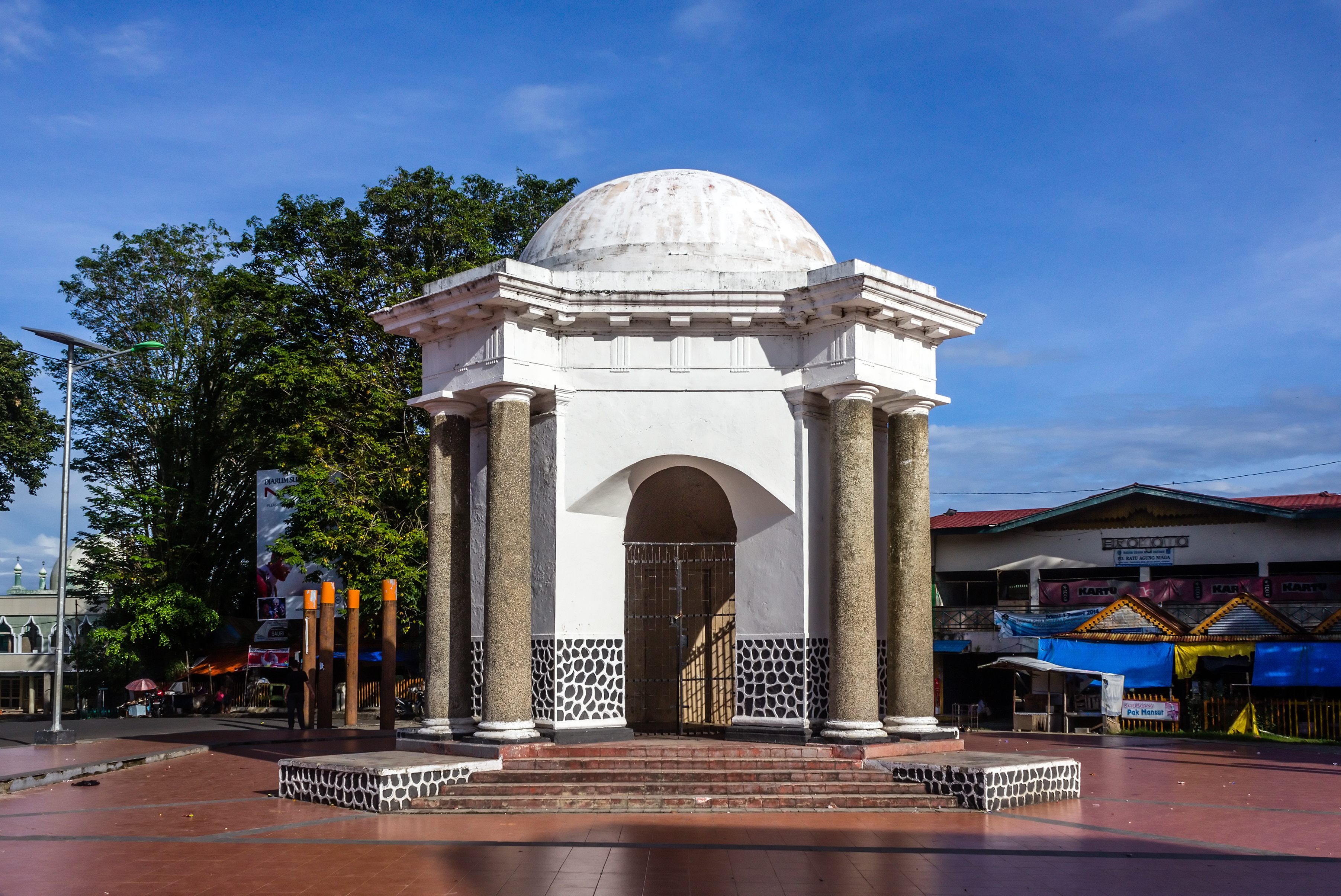
Thomas Parr Monument
The British called him a benevolent father. The people of Bengkulu called him arrogant and ferocious. Thomas Parr, the East India Company's Resident in what was then Bencoolen, lasted just two years before three men broke into his home on the night of 27 September 1807, stabbed him, and cut off his head. The domed monument that stands on Ahmad Yani Street today was built the following year to memorialize Parr, but the story it tells depends entirely on who is doing the telling.
The Company's Man in Bencoolen
The British East India Company arrived on Sumatra's southwest coast in the 17th century, drawn by the same spice and pepper trade that had lured the Dutch and Portuguese before them. Fort Marlborough, constructed to anchor British authority in the region, still stands roughly 170 meters northwest of the monument. Bencoolen was never the jewel of British Asia -- it was a remote, fever-ridden outpost far from the lucrative centers of Calcutta and Madras. But it produced pepper, and that was reason enough to stay.
When Thomas Parr took up the post of Resident in 1805, he brought with him a determination to expand coffee production across the region. The plaque inside the monument would later describe him as a father to the Malay people of Bengkulu. Indonesian historical accounts paint a different portrait: a man who pushed into local customs and land rights with little regard for the communities that had governed themselves long before the Company arrived.
A Night at Mount Felix
By 1807, resentment had sharpened into revolt. Parr's interference with traditional customs, his imposition of new agricultural demands, and the broader weight of Company rule had driven the Bengkulu populace to the breaking point. On the night of 27 September, during a rebellion against his administration, three men entered Mount Felix, Parr's residence. They stabbed and decapitated him. His aide, Charles Murray, suffered fatal wounds in the same attack.
The East India Company crushed the uprising. Whatever grievances had fueled it, the Company had the soldiers and the will to reassert control. But the killing of a Resident was not something to be quietly absorbed. The following year, in 1808, the colonial authorities erected a monument to Parr -- an architectural statement meant to project permanence and order in a place where both had been violently challenged.
The Round Grave
The monument itself is an octagonal structure covering 70 square meters, ringed by six Tuscan-style columns with three arched openings serving as entrances. At 13.5 meters, it is topped with a dome that gives the structure its local nickname: Kuburan Bulek, or "Round Grave." A wooden plaque sits inside, though centuries of tropical humidity have rendered it illegible. Surrounding the monument is a small park enclosed by an iron fence, shaded by trees that soften the commercial bustle of what is now Bengkulu's Chinatown district.
The location was deliberate. When it was built, this area housed the Company's government buildings and ruling council. It was the administrative heart of British Bencoolen. Today those buildings are gone, replaced by shops and a post office, but the monument endures -- a colonial relic absorbed into the daily rhythm of an Indonesian city.
Whose Monument Is It?
Here is where the story turns. A monument erected by a colonial power to honor one of its own has been quietly claimed by the people whose ancestors killed him. The citizens of Bengkulu do not see the Thomas Parr Monument as a tribute to a fallen administrator. They see it as proof of their willingness to defend their land rights and traditional customs, even against a force as powerful as the East India Company. The monument is now designated a cultural property of Indonesia.
This reinterpretation is not unusual in postcolonial Southeast Asia, where the physical remnants of empire are often repurposed rather than demolished. Fort Marlborough nearby is now a tourist attraction. The monument to Parr has become a monument to the rebellion that killed him. The same stones, the same dome, the same columns -- but the meaning has inverted entirely. What was meant to say "we endure" now says "so do we."
From the Air
Located at 3.79S, 102.25E in the coastal city of Bengkulu on Sumatra's southwest coast. The monument sits in the urban center near Fort Marlborough, visible along the shoreline. Nearest airport is Fatmawati Soekarno Airport (WIPL), approximately 14 km south of the city center. Bengkulu's coastal strip runs northwest-southeast, flanked by the Indian Ocean to the west and the foothills of the Barisan Mountains to the east. Best viewed at 3,000-5,000 feet AGL for urban context.