
Thomas Smith (engineer)
Thomas Smith's father was a skipper who drowned in Dundee harbour when Thomas was a child. His widowed mother steered him away from the sea and into ironmongery. That was supposed to be the safe path. Instead it led him, by a chain of small decisions, to become the first Chief Engineer of what would become the Northern Lighthouse Board, to design Scotland's first mainland lighthouse at Kinnaird Head, and to father - or stepfather, more precisely - the dynasty that would light the world's most dangerous coasts. The man whose father had been killed by the sea would spend his life keeping other men's fathers alive.
Broughty Ferry to Edinburgh
Smith was born on 6 December 1752 in Broughty Ferry, a fishing village near Dundee. The drowning of his father shaped his mother's plans for him: a trade onshore. He served his time in ironmongery and then made his way to Edinburgh, where he founded the Greenside Company's Works - a business in lamps and oils. The Greenside Works did not just sell lamps. Smith was an innovator. His lamps, paired with the silvered parabolic reflectors he developed, produced four times the light of a standard oil lamp with no reflector at all. In a city where the streets were still lit by individual householders' candles or by occasional contracted lamps, this was an enormous practical improvement. Edinburgh started using Smith's lamps to light its streets, and Smith made his reputation.
Chief Engineer to the Northern Lights
When the Northern Lighthouse Trust was formed in 1786 to bring order to Scottish coastal lighting, Smith was the obvious candidate for Chief Engineer. He was appointed that year and immediately commissioned to build the first four lighthouses on the most dangerous corners of the coast. He travelled south to learn from English lighthouse builders - perhaps from John Smeaton, who had built the third Eddystone Lighthouse in the 1750s, perhaps from Ezekiel Walker, perhaps from William Hutchinson. The first of his lighthouses was at Kinnaird Head, in Fraserburgh, lit on 1 December 1787. Seventeen whale-oil lamps backed by parabolic reflectors made it the most powerful light of its day. Mull of Kintyre followed in 1788. Then Dennis Head and Eilean Glas in 1789, Pladda in 1790, Little Cumbrae in 1793, Muckle Skerry in 1794, Cloch in 1797, Inchkeith in 1804, Start Point in 1806 - ten lighthouses around the Scottish coast in twenty years.
The Apprentice Who Married His Stepsister
Smith took a stepson into his household when he married a widow with a young son named Robert Stevenson. Stevenson's mother had wanted him for the ministry. He had different ideas. He attached himself to his stepfather's work, was formally apprenticed to Smith in 1791, and proved an even more talented engineer than his teacher. In 1799, Stevenson married his then twenty-year-old stepsister Jane - a circumstance that would tangle the family tree somewhat but cemented an already close relationship. Smith and Stevenson worked side by side for decades. Smith's own son James left home to start his own ironmongery business, and whether there was any rift behind that departure is unknown. Smith's daughter Janet was mother to William Swan, who became a physicist. But it was Robert Stevenson who inherited the soul - and eventually the house - of Thomas Smith's lighthouse enterprise.
The Foundation of the Dynasty
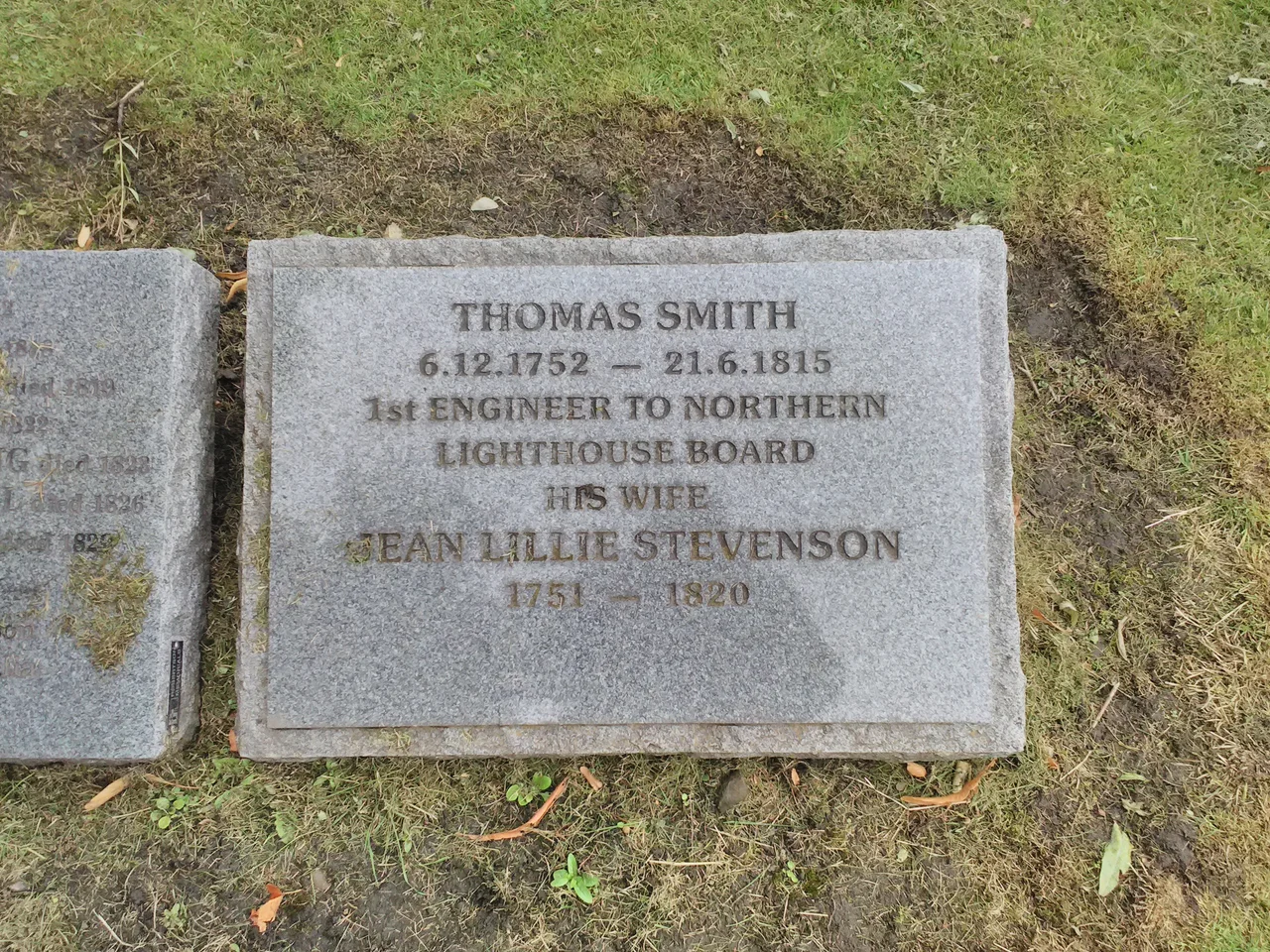
Smith died at his home in Edinburgh - 2 Baxter's Place, at the head of Leith Walk - on 21 June 1815, aged sixty-two. He is buried in the north-east section of Old Calton Burial Ground, beneath the volcanic crag of Calton Hill, in the city he had lit. The house he died in went to Robert Stevenson. So did the lighthouse business. From there, the Stevensons built outward across Scotland and around the world. Robert's son Alan built Skerryvore. David built Muckle Flugga. Thomas built more. Thomas's son was Robert Louis Stevenson, who gave up the family trade for Treasure Island, Kidnapped, and The Strange Case of Dr Jekyll and Mr Hyde. He carried the family's relationship with lighthouses with him; his uncles' towers shape his fiction in ways readers have been tracing ever since. None of it would have happened without the ironmonger from Broughty Ferry whose father drowned and whose mother insisted he stay ashore.
From the Air
Coordinates 57.6982N, 2.0033W (Kinnaird Head, Smith's first lighthouse). Smith was born in Broughty Ferry near Dundee, worked in Edinburgh, and built his first lighthouse here in Fraserburgh. His grave is in Old Calton Burial Ground in Edinburgh, beneath Calton Hill. To trace his career by air, follow the coast from Aberdeen (EGPD) north to Fraserburgh, then west around the Moray Firth. Best viewing altitude for the headland is 1,500-3,000 ft. Lossiemouth (EGQS) lies 55 nm west; Edinburgh (EGPH) is 130 nm south.
Nearby Stories
- Tarlair Swimming Pool 8.2 km away
- New Slains Castle 9.4 km away
- Battle of Slioch 17 km away
- German submarine U-58 (1938) 32 km away
- HMS Exmouth (H02) 33 km away
- Piper Alpha 109 km away
- German submarine U-1274 209 km away
- Jarlshof 236 km away