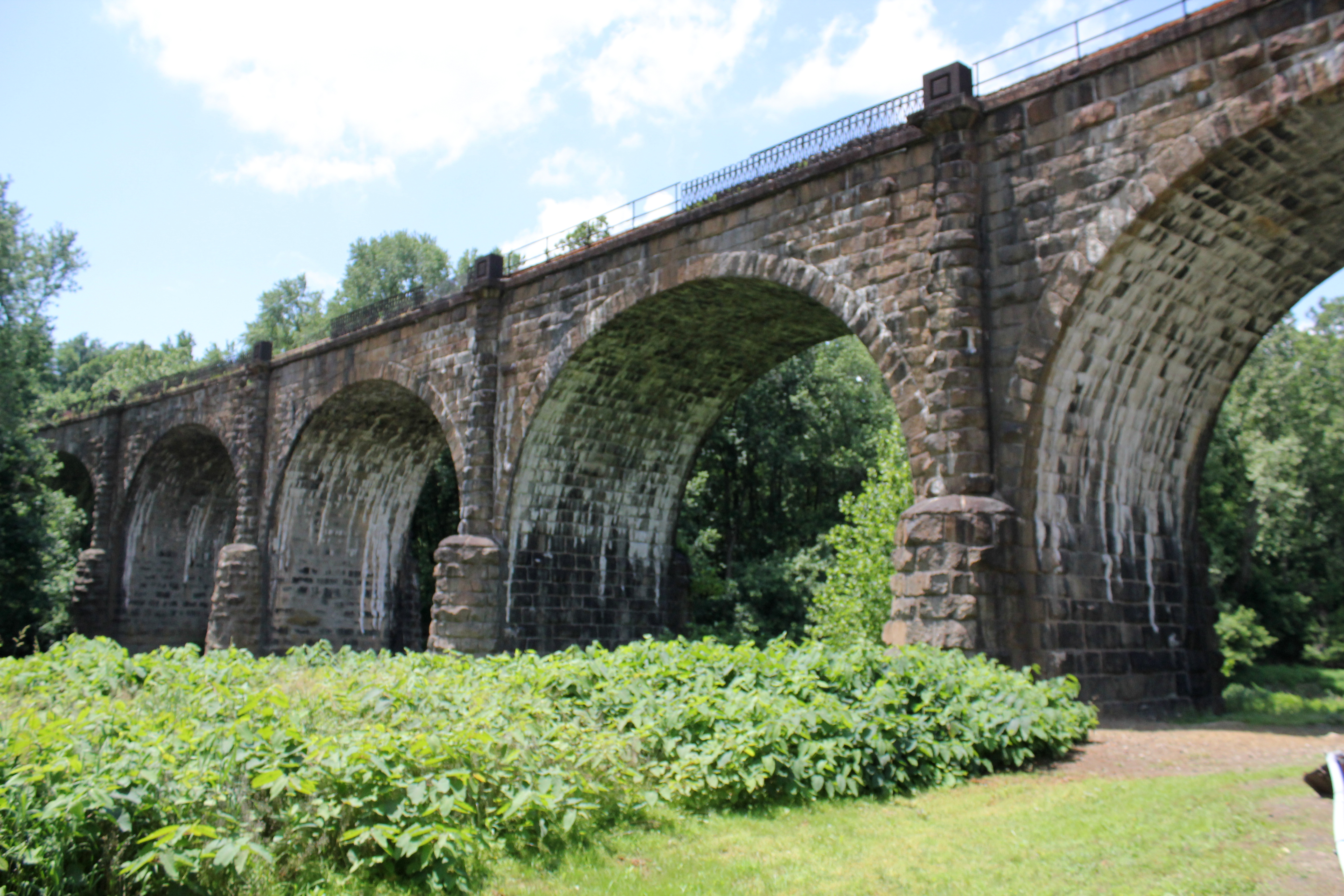
Thomas Viaduct
They called it "Latrobe's Folly." When Benjamin Henry Latrobe II presented his design for an eight-span stone viaduct curving across the Patapsco Valley on a four-degree arc, skeptics predicted the structure would collapse under its own weight. No one had ever built a multi-span masonry railroad bridge on a curve in the United States. The Baltimore and Ohio Railroad commissioned the project anyway, breaking ground on July 4, 1833, and completing it exactly two years later on July 4, 1835. Builder John McCartney celebrated by having his men kneel on the finished deck while he mock-baptized them with whiskey. The doubters were wrong. The Thomas Viaduct has survived the great flood of 1868, Hurricane Agnes in 1972, and nearly two centuries of continuous railroad traffic. Today, CSX freight trains and MARC commuter trains still cross it daily -- 300-ton diesel locomotives rolling over the same stone arches that European engineers once crossed the Atlantic to admire.
Solving the Impossible Curve
The central engineering challenge was deceptively simple to state and fiendishly difficult to solve: how do you build a massive stone bridge on a curve? Latrobe's answer was elegant. He designed the piers as wedge-shaped structures, laying their lateral faces along radial lines fitted to the four-degree curve. This meant that each pier and span had slightly different widths on opposite sides of the structure, requiring painstaking calculations and precise stonework. The resulting bridge spans eight arches in a basket-handle configuration with three centers. The deck stretches 26 feet wide -- broad enough for double track -- and the entire structure contains an enormous volume of hand-laid masonry. A wooden-floored walkway, supported by ornamental cast iron brackets and railings, runs along one side for pedestrian and railway employee use. The total cost came to $142,236.51, a princely sum in the 1830s but a bargain for a bridge that would require almost no major maintenance for its first century of service.
The Railroad That Built a Nation
The Thomas Viaduct was not just an engineering marvel -- it was a strategic artery. The Baltimore and Ohio Railroad, one of the oldest in the United States, had broken ground on July 4, 1828, initially routing west along the Patapsco River to Ellicott's Mills. In 1835, the Washington Branch was constructed, branching off at Relay -- named for the post road hotel where stagecoach horses were changed. The Thomas Viaduct carried this new line across the valley. Its importance became acute during the Civil War: until after that conflict, the B&O was the only railroad into Washington, D.C. Union troops guarded the bridge heavily to prevent Confederate sabotage, understanding that the viaduct was essential for supply trains reaching the capital. From the 1880s through the 1950s, the bridge carried the B&O's legendary Royal Blue Line passenger trains between New York and Washington, and later the Capital Limited to Chicago and the National Limited to St. Louis.
European Engineers Take Notice
Word of the Thomas Viaduct crossed the Atlantic almost as soon as the last stone was set. Between 1834 and 1835, the French government sent engineer Michel Chevalier to study North American canal and railroad networks. Chevalier produced a two-volume report and singled out the Thomas Viaduct as one of the few genuine works of art constructed by American railroads. By 1838, Franz Anton von Gerstner -- then the leading railroad engineer and scholar on the European continent -- made his own pilgrimage to study American railroads, including the B&O and its signature bridge. Von Gerstner described the Thomas Viaduct as one of the most beautiful and best-designed bridges in the United States. Their reports carried the bridge's reputation across Europe at a time when the young American republic was still proving it could match Old World engineering. The viaduct became an early symbol that American infrastructure ambitions were serious and permanent.
Stone That Refuses to Quit
The Thomas Viaduct has outlasted nearly everything around it. The Gothic-style Viaduct Hotel that once stood beside it at Relay operated from 1872 until 1938 and was demolished in 1950. The great flood of 1868 devastated the Patapsco Valley. Hurricane Agnes in 1972 destroyed nearly everything in the valley's path. The viaduct stood through both. Major maintenance did not arrive until 1929, when extensive mortar work was finally carried out, with additional repairs in 1937 and 1938. A 1949 report by the B&O's Chief Engineer predicted those repairs would keep future maintenance to a minimum -- and he was right. When Amtrak took over national passenger service on May 1, 1971, the B&O ended its long-distance trains, but the bridge kept working. CSX acquired the B&O in 1986. Today, MARC's Camden Line runs daily commuter trains over the same arches. The bridge was designated a National Historic Landmark in 1964 and a National Historic Civil Engineering Landmark by the American Society of Civil Engineers in 2010.
From the Air
The Thomas Viaduct sits at 39.222N, 76.713W, spanning the Patapsco River valley between Relay and Elkridge in Maryland. From the air, the eight-arch stone bridge is visible as a distinctive curved structure crossing the green valley of Patapsco Valley State Park. The curve of the bridge is especially apparent from above. Look for the railroad right-of-way crossing the river valley south of the I-195 corridor and north of Route 1. Baltimore-Washington International Airport (KBWI) is approximately 5nm to the southwest. Best viewed at 2,000-3,000 feet AGL. The Patapsco Valley running through the area provides excellent visual reference for navigation.