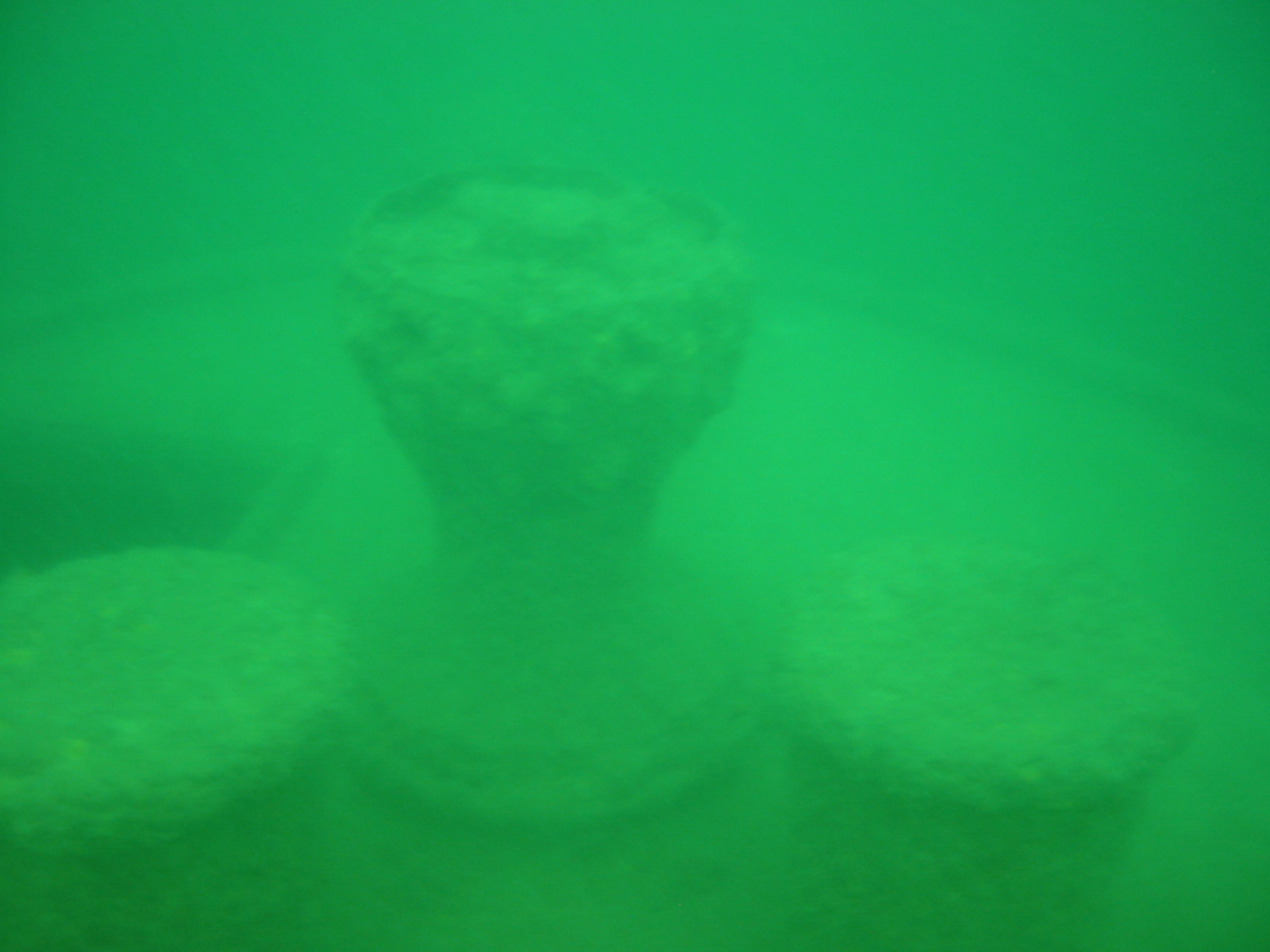
Thomas Wilson (Shipwreck)
It took three minutes. On the morning of June 7, 1902, the whaleback freighter Thomas Wilson cleared the Duluth harbor loaded with Mesabi iron ore, her hatches still open under a clear, calm sky. She never made it to open water. An inbound wooden steamer, the George Hadley, turned hard to port without warning or whistle signal, and drove her bow into the Wilson just forward of the aft hatch. The whaleback rolled to port, righted herself, then plunged bow-first to the bottom of Lake Superior, taking nine of her twenty crew with her. The ship and cargo were valued at $207,000 -- roughly $7.5 million today. But the Thomas Wilson's significance extends far beyond one terrible morning. Resting in the cold, preserving waters just outside the harbor entrance, her wreck is now one of the finest surviving examples of the whaleback steamer, a radical ship design that helped transform the Great Lakes into the industrial highway of a nation.
Captain McDougall's Cigar Ships
The whaleback was the brainchild of Captain Alexander McDougall, who designed these unconventional vessels specifically for the bulk freight trade on the Great Lakes. Where conventional freighters presented flat decks and high sides to the waves, whalebacks were built low and rounded, their hulls roughly cigar-shaped with conoidal bow and stern sections that allowed heavy seas to wash over rather than crash against them. The Thomas Wilson was built in 1892, her hull assembled from heavy steel plates double-riveted to steel angle frames. A pair of coal-fired Scotch boilers generated steam for a three-cylinder triple-expansion engine driving a single screw propeller. The design prioritized cargo capacity and fuel economy over crew comfort. One critical feature: the deck hatches had no coamings -- the raised vertical edges that normally prevent water from entering holds. Instead, hatches sat flush with the deck surface and were simply bolted down. In calm weather, this was merely unconventional. In an emergency, it would prove fatal.
A Clear Morning, A Missing Whistle
The collision was a cascade of human errors. The George Hadley, a 2,073-ton wooden steamer, was inbound for Duluth's coal docks, which were full. The tugboat Annie L. Smith redirected her toward the Superior harbor instead. The Hadley's captain ordered an immediate turn to port -- directly into the path of the outbound Wilson -- without checking for other vessels and without blowing the required whistle signals. Aboard the Wilson, the captain saw the Hadley swinging toward him but feared running aground if he turned to port. He ordered a hard turn to starboard, which brought the two ships together at a terrible angle. The Hadley's bow struck the Wilson just forward of her aft hatch, then recoiled from the impact. Water poured through the unprotected hatches and the gash in the hull simultaneously. The Wilson rolled to port, recovered momentarily, then sank by the bow. The entire sequence, from collision to disappearance, lasted approximately three minutes.
Rules Written in the Wake
The sinking of the Thomas Wilson forced immediate changes to Duluth harbor operations. New regulations mandated that ships could no longer leave the harbor with open hatches -- the very condition that had accelerated the Wilson's flooding. Ships involved in collisions were prohibited from pulling away from each other, since the Hadley's recoil had opened the wound in the Wilson's hull to the full force of the lake. Pilots were now required to call the captain's attention to any sighted vessel before carrying out maneuvering orders, addressing the failure in communication that had sent the Hadley turning blind. All ships were required to install signal systems connecting all parts of the vessel, ensuring that warnings of danger could reach every crew member. These rules, born from the deaths of nine men on a calm June morning, became part of the operating framework that made the Great Lakes shipping lanes safer for the century that followed.
A Whaleback Preserved in Cold Water
Lake Superior's cold, fresh water is one of the finest preservation environments for shipwrecks anywhere in the world. The Thomas Wilson rests just outside the Duluth harbor entrance, her whaleback hull still intact enough to reveal the engineering details that made McDougall's design both innovative and controversial. The flush hatches, the cigar-shaped midsection, the conoidal bow -- all remain legible on the lake bottom. In 1992, the wreck was listed on the National Register of Historic Places under the name Thomas Wilson (Whaleback Freighter) Shipwreck, recognized for its state-level significance in the fields of engineering and maritime history. Artifacts recovered from the site are on display at the Meteor Maritime Museum in nearby Superior, Wisconsin, where visitors can examine them alongside the SS Meteor, the last surviving whaleback ship afloat. Together, the museum and the wreck tell the story of a ship type that was once common on the Great Lakes but has nearly vanished from the world.
From the Air
The wreck site is located at approximately 46.783°N, 92.069°W, just outside the Duluth Ship Canal entrance in Lake Superior. The wreck is not visible from the air, but the harbor entrance and Ship Canal are prominent landmarks. The Aerial Lift Bridge marks the canal entrance and is one of the most recognizable structures on Lake Superior's western shore. Duluth Sky Harbor Airport (KDYT) is on Minnesota Point (Park Point), the narrow sand spit that forms the harbor's eastern boundary, approximately 1.5 nm south of the wreck site. Duluth International Airport (KDLH) is about 7 nm northwest. From 2,000-4,000 feet AGL, the entire Duluth-Superior harbor complex is visible, including the ore docks, grain elevators, and the shipping channel where the Thomas Wilson departed on her final voyage.