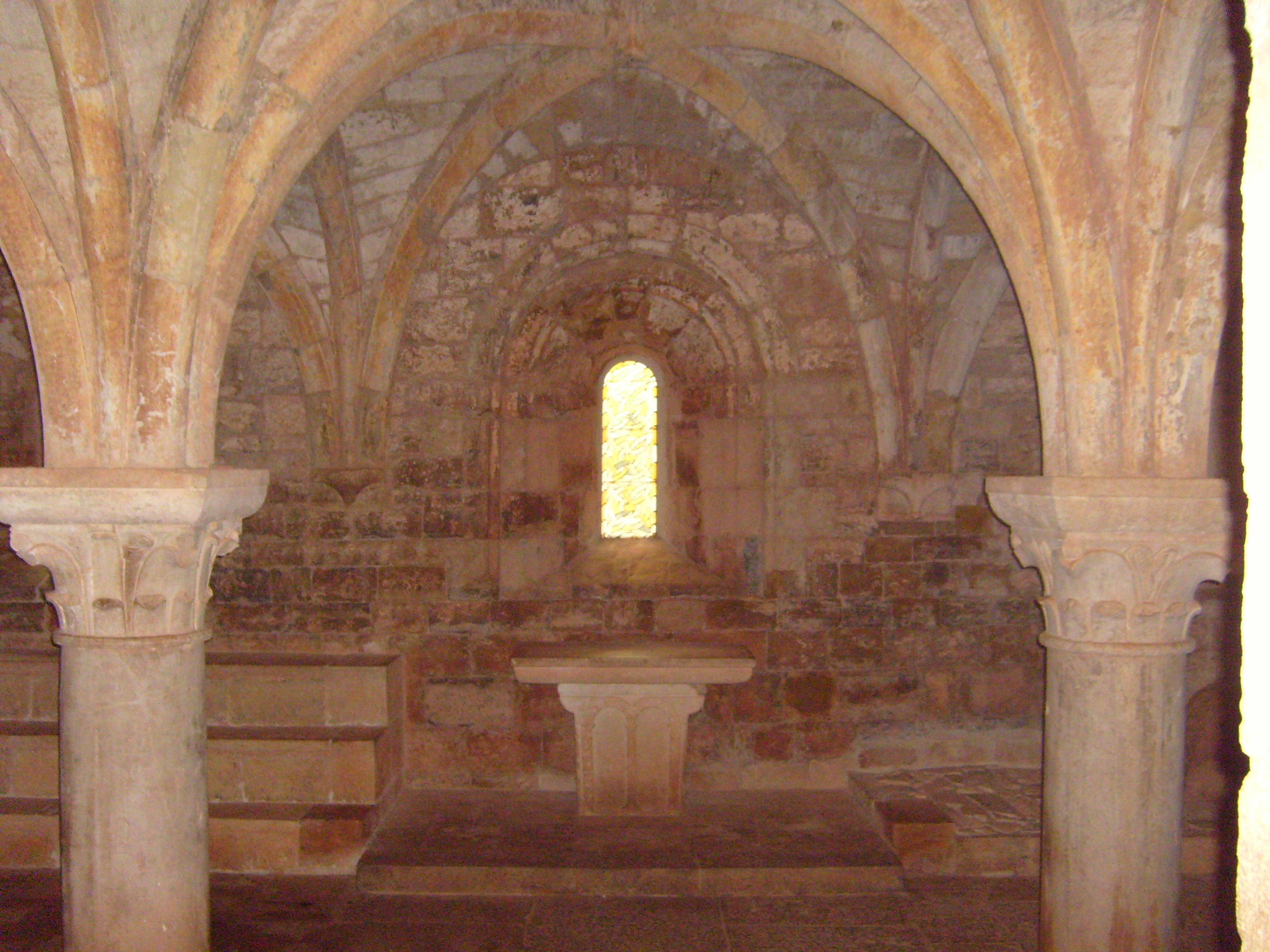
Thoronet Abbey
The acoustics tell you everything about the Cistercians' intentions. Inside the church at Thoronet Abbey, the stone walls produce an echo so long and resonant that monks were physically compelled to sing slowly, deliberately, in perfect unison. Rush a note, and the echo would expose the error. Fall out of harmony, and the walls would amplify the discord. The building itself was a disciplinarian, enforcing through physics what the Rule of Saint Benedict demanded through faith.
Built Upon Rock and Silence
Thoronet is one of the Three Sisters of Provence -- together with Senanque Abbey and Silvacane, the trio represents the purest expression of Cistercian architecture in France. Cistercian monks founded their community at a site called Notre-Dame de Florielle around 1136, but the location proved unsuitable for their farming needs. Around 1157, they moved twenty-five kilometers south to Le Thoronet, where more fertile land, several streams, and a spring offered better prospects. Construction of the monastery began around 1176 and was completed in the early 13th century. Because the entire complex was built in a single campaign, it possesses a unity of design that is rare in medieval architecture. Every stone was quarried locally, cut to match the surrounding terrain in color and texture, so the abbey seems to grow from the hillside rather than sit upon it. There is no ornamentation. The Cistercians believed that decoration distracted from God, and Thoronet is their most eloquent argument for that conviction.
A Troubadour Turned Abbot
The first known abbot of Le Thoronet was Folquet de Marseille, elected in 1199 -- a man whose life traced an arc from secular fame to monastic austerity. Born around 1150 to Genoese merchants, Folquet became one of medieval Europe's celebrated troubadours, composing love songs performed across the courts of Provence. In 1195, he abandoned his musical career and entered monastic life. He rose to become abbot of Thoronet, then Bishop of Toulouse in 1205. Dante honored him by placing him among the inhabitants of Paradise in the Divine Comedy's Canto IX. The trajectory from troubadour to monk captures something essential about Thoronet itself: the deliberate renunciation of worldly beauty in favor of something austere, demanding, and -- to those who entered its walls -- more profound.
Decline, Rescue, and Resurrection
At its peak, Le Thoronet housed no more than twenty-five monks, sustained by cattle ranching, sheep farming, salt ponds at Hyeres, and fisheries along the coast. Sheepskins were turned into parchment for the scriptorium. By the 14th century, decline had set in. The Great Famine and the Black Plague devastated the region's population. By 1433, only four monks remained. Absentee abbots appointed by the kings of France collected income but never visited. By the 18th century, the buildings were crumbling and the last abbot -- living far away in Bourges -- declared bankruptcy in 1785. The seven remaining monks dispersed. When revolutionary authorities tried to sell the property in 1791, local officials declared its church and cemetery 'treasures of art and architecture' and 'the Property of the Nation.' In 1840, the writer Prosper Merimee, France's first inspector of monuments, placed Thoronet on the inaugural list of national historic monuments. The French government gradually purchased the entire complex, completing the acquisition in 1938.
The Architecture of Truth
Thoronet's influence extends far beyond medieval monasticism. After World War II, the Dominican priest Father Couturier wrote to Le Corbusier urging him to visit: 'It seems to me that there you will find the essence of what a monastery must have been like at the time it was built.' Le Corbusier came, studied the interplay of light and stone, and later wrote that 'the light and the shadow are the loudspeakers of this architecture of truth.' His Convent of La Tourette near Lyon, completed in 1960, draws directly from Thoronet's principles -- the tower, the simple volumes, the alternation of solid walls and voids that give light its dramatic power. The British architect John Pawson cited Thoronet as inspiration for the Cistercian abbey of Novy Dvur in the Czech Republic, completed in 2004. Eight centuries after its construction, the abbey continues to teach architects that austerity is not the absence of beauty but its distillation.
From the Air
Located at 43.46N, 6.26E in the Var department of Provence, between Draguignan and Brignoles. The abbey sits in a wooded valley and is not easily visible from high altitude -- look for the clearing in the forested hills northwest of Le Luc. Nearest airports: Toulon-Hyeres (LFTH), Le Castellet (LFMQ). Best viewed at 2,000-4,000 feet AGL in the morning light, when the stone takes on warm golden tones.