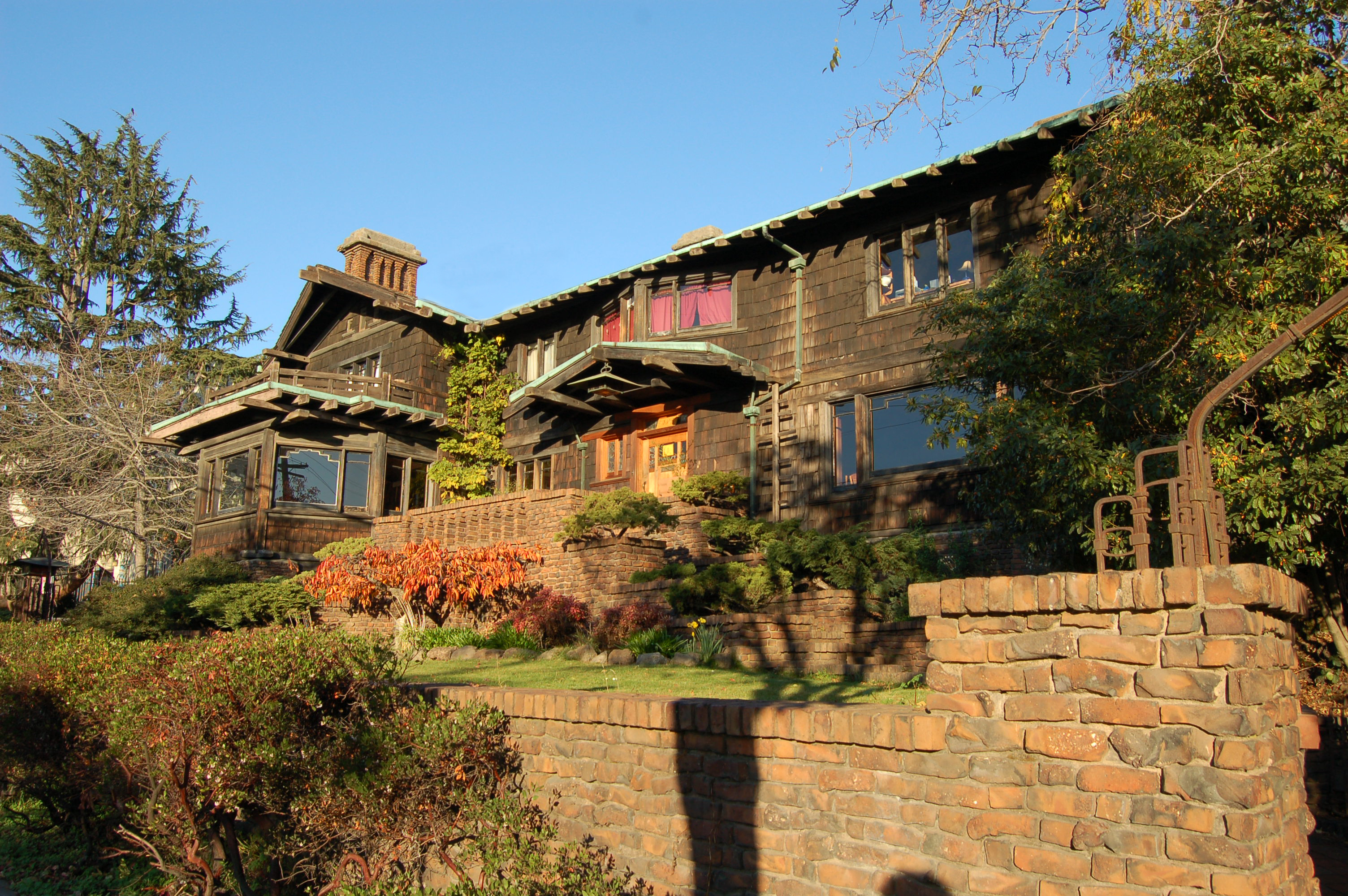
Thorsen House
You can knock on the door. That is not a metaphor. The Thorsen House, one of the finest examples of American Craftsman architecture ever built, is a working fraternity house, and the members of Sigma Phi will answer, show you the entry hall paneled in Burmese teak, point out the square ebony plugs that cover the brass screws in the Honduras mahogany walls, and let you stand in front of the fireplace surrounded by mauve tiles from the Grueby Faience Company. Thousands of visitors a year do exactly this. The last of five "ultimate bungalows" designed by the legendary firm of Greene & Greene, the Thorsen House has been a frat house since 1942, which makes it either the most architecturally significant fraternity in America or the most unlikely preservation success story in California - probably both.
A Lumber Baron's Commission
William Randolph Thorsen made his fortune in wood, which may explain why he wanted a house that celebrated it. Born in 1860, Thorsen was a successful lumber merchant from Michigan who relocated to California in the early twentieth century, eventually settling in Berkeley after years running the West Side Lumber Company in Tuolumne. His wife, Caroline Canfield Thorsen, was the younger sister of Nellie Canfield Blacker, whose husband Robert R. Blacker had already commissioned Greene & Greene to build a house in Pasadena in 1907. The family connection made the introduction natural: if the Blackers could have a Greene & Greene house, the Thorsens would have one too. Construction began on the Berkeley hillside, and by 1909 the house was complete - the last of the five residences that architectural historian Robert Judson Clark would later dub the "ultimate bungalows" in the 1960s.
The Art of Wood and Light
The term "bungalow" is technically a misnomer. Bungalows are small, single-story houses, and the Thorsen House is neither small nor single-story. But Charles and Henry Greene's masterwork shares a philosophical kinship with the Craftsman bungalow tradition: the honest expression of materials, the rejection of industrial ornamentation, the insistence that a building's structure should be its beauty. Greene & Greene houses announce their construction boldly in wood, and the Thorsen House is their most eloquent statement. The entry hall glows with Burmese teak. The living and dining rooms are sheathed in Honduras mahogany, each panel fastened with brass screws hidden beneath hand-fitted ebony plugs - a detail that turns a structural necessity into a decorative art. The front door features leaded art glass depicting a gnarled grape vine, designed by Emil Lange, who created glass for several Greene & Greene houses including the famous Gamble House in Pasadena.
Five Houses, Three Cities, One Vision
The Thorsen House belongs to an exclusive architectural family. Greene & Greene's five ultimate bungalows are scattered across Southern and Northern California: the Ford, Gamble, and Blacker houses in Pasadena, the Pratt House in Ojai, and the Thorsen in Berkeley. Together they represent the pinnacle of the American Craftsman style, an offshoot of the British Arts and Crafts Movement that championed handcraft over industrial production. Each house was a total design project. Greene & Greene did not stop at walls and rooflines; they designed custom furniture for the Thorsen dining room, and the family later called them back for additional pieces and modest alterations. Every element was considered, from the species of wood to the shape of a screw cover. The Gamble House in Pasadena is the most famous of the five, now a museum operated by the Gamble House Conservancy, but the Thorsen holds a distinction none of the others can claim: it is still a home.
From the Thorsens to Sigma Phi
William and Caroline Thorsen lived in their Greene & Greene house from its completion in 1909 until their deaths in 1942 - William at eighty-two, Caroline at eighty-four. What happened next could have been a preservation disaster. A grand residence with exotic wood interiors and handcrafted art glass, orphaned by its original owners in the middle of World War II, might easily have been subdivided, neglected, or demolished. Instead, the California Alpha Chapter of the Sigma Phi Society acquired the house. Sigma Phi, founded in 1827, is the oldest national fraternity in continuous existence, and its Berkeley chapter has treated the Thorsen House with a care that few institutional owners manage. The fraternity hosts communal dinners, organizes concerts, and welcomes tours throughout the week. Walk up to the door any afternoon, knock, and someone will let you in.
Still Standing, Still Open
Preservation stories rarely end this well. Most significant historic houses become museums - roped off, temperature-controlled, visited in hushed reverence. The Thorsen House is visited in bare feet and backpacks. Students sleep in rooms paneled with wood that a lumber baron chose a century ago. Dinner is cooked in a kitchen that Greene & Greene designed. The art glass grape vine in the front door catches the afternoon light the same way it did when the Thorsens first turned the key. The house is a Berkeley Landmark and sits on the National Register of Historic Places, but its most effective preservation strategy has nothing to do with official designations. It works because people live in it, because the door is answered when you knock, because a building that could have become a relic became a home instead - and has never stopped being one.
From the Air
The Thorsen House sits at 37.8690N, 122.2520W on the Berkeley hillside near the UC Berkeley campus. From the air, the house is part of the residential neighborhood north of campus, though its distinctive Craftsman roofline is difficult to distinguish at altitude. Look for the residential grid between the campus and the Berkeley Hills. Nearest airports: Oakland International (KOAK) approximately 8 nm south, and Buchanan Field (KCCR) approximately 14 nm northeast. Best viewed at lower altitudes in clear conditions; the Berkeley Hills provide a scenic backdrop.