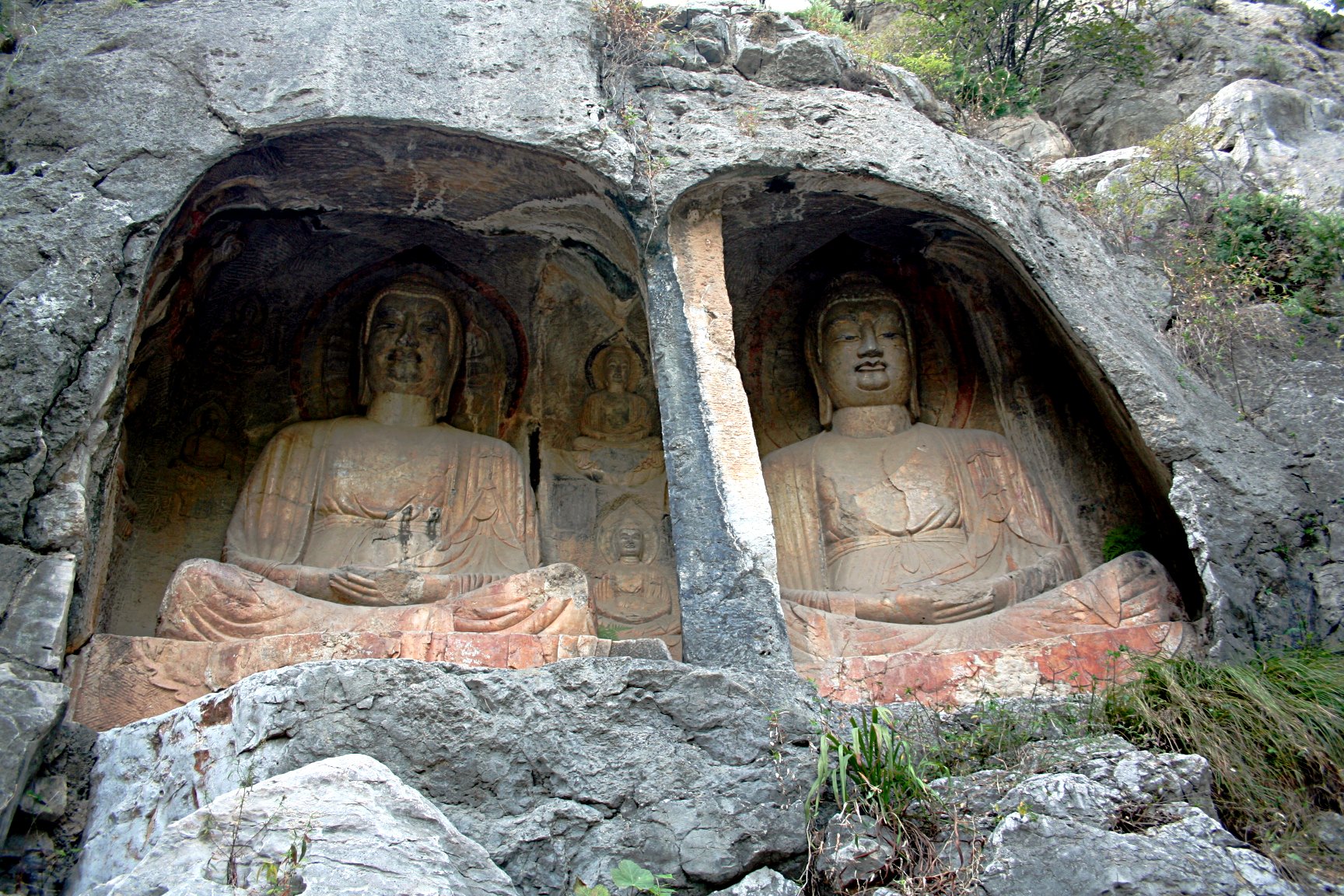
Thousand-Buddha Cliff
In 619 AD, one year after the Tang dynasty's founding, a 70-year-old monk named Sha Dong picked up his chisel and began carving a Buddha into a cliff face southeast of Jinan. He was old enough to know that the Tang government's official policy favored Taoism over Buddhism, which made his act not just devotional but subtly defiant. The inscription he left beside his carving was careful to explain that the statue's sole purpose was prayer, not political expression. Over the next several decades, Sha Dong's solitary Buddha was joined by hundreds of others, carved into a 63-meter stretch of cliff that became the largest collection of Buddhist rock sculptures in Shandong Province.
An Old Man's Persistence
After Sha Dong carved the first sculpture, a quarter century passed before another monk took up the work. Ming De, also elderly, added two more Buddhist figures and donated money for additional carvings. He felt his life was ending and wanted to ensure the work continued after his death. But Ming De proved harder to kill than he expected. In 657 AD, still alive and still carving, he continued adding statues and inscriptions to the cliff face. Like Sha Dong before him, Ming De was careful to note in his inscriptions that these images were for prayer alone. The Tang dynasty encouraged Taoism; to carve Buddhist statues was to risk official displeasure. Both monks navigated this tension with a diplomat's care and a believer's stubbornness.
Emperors' Daughters in Stone
The cliff's carvings are not exclusively religious. Among the more than 210 statues and 43 inscriptions, secular figures appear alongside the Buddhas and bodhisattvas. Nobility, government officials, and famous monks all received the honor of being immortalized in stone. Among the most notable are depictions of Princess Nanping, the daughter of Emperor Taizong of Tang, and her husband Liu Xuanyi. Their presence on the cliff suggests that the site carried imperial sanction despite the government's official preference for Taoism -- or perhaps that the Tang court's relationship with Buddhism was more nuanced than its policies suggested. The carvings span the period from 618 to 684, with most dating to the earliest decades of Tang rule.
The Valley of Supernatural Power
The Thousand-Buddha Cliff stands immediately west of the ruins of the Shentong Temple -- the "Supernatural Power" Temple -- which was once one of the most important Buddhist centers in northern China. The temple is gone, but its name still resonates. The cliff is oriented north-south, its carved face catching the morning light and casting the figures into shifting relief as the sun moves overhead. Combined with the nearby Four-Gates Pagoda, the Dragon-and-Tiger Pagoda, and the Nine Pinnacle Pagoda, the cliff forms part of a sacred landscape that concentrates more than a thousand years of Buddhist art and architecture in a single rural valley. The cliff face itself is the most democratic of these monuments: where the pagodas were built by organized effort and institutional resources, the cliff began with one old man, one chisel, and one stubborn act of faith.
From the Air
The Thousand-Buddha Cliff is located at 36.45°N, 117.13°E near Liubu Village, Licheng District, about 33 km southeast of Jinan, Shandong Province. The cliff face runs 63 meters in the north-south direction and sits immediately west of the former Shentong Temple site. From the air, the cliff is part of a cluster of Buddhist heritage sites in a hilly, forested valley. Nearest major airport: Jinan Yaoqiang International (ZSJN), approximately 45 km northwest. The terrain is moderate hills with vegetation.